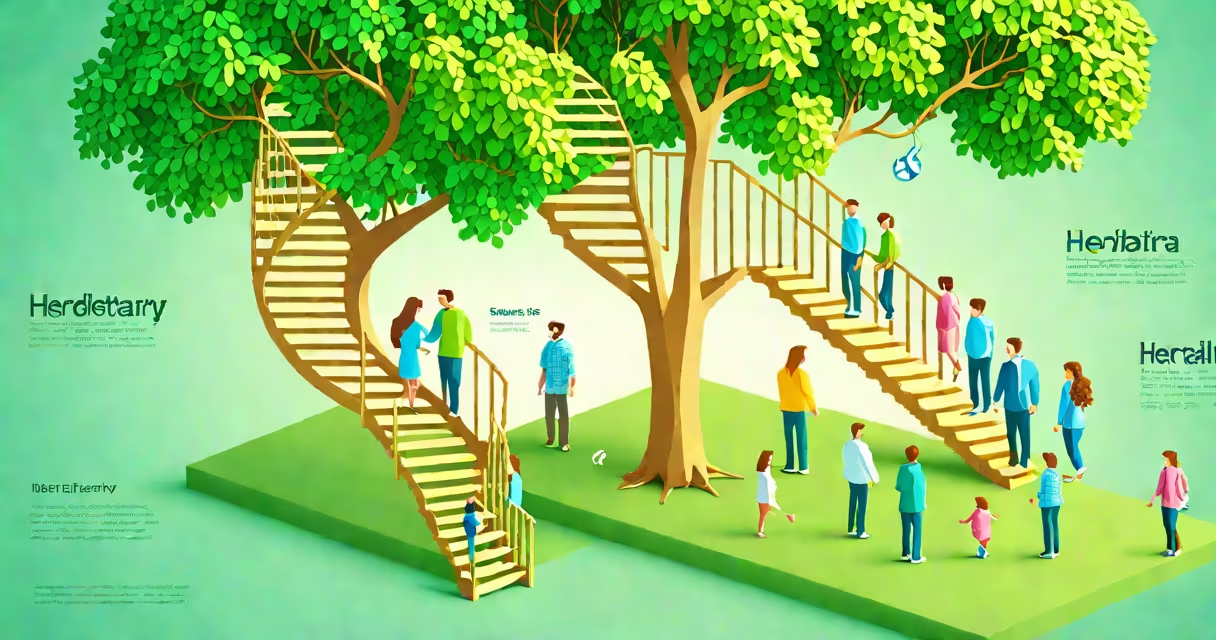
What is hereditary about refers to traits, conditions, or characteristics passed from parent to child through genes. These are encoded in DNA and can influence physical features, disease risk, and certain behaviors. Heredity operates through specific gene variants inherited from both parents.
Genes are segments of DNA located on chromosomes. When a parent passes a copy of a chromosome to their child during conception, they also pass along the genes on that chromosome. Some traits appear in every generation because they're dominant-meaning only one copy of the gene is needed to express the trait. Others remain hidden unless two copies are inherited-one from each parent-and are called recessive.
For example, cystic fibrosis is caused by mutations in the CFTR gene. A child must inherit two defective copies-one from each parent-to develop the condition. If only one copy is inherited, the person is a carrier but typically shows no symptoms. This pattern illustrates how heredity works at the molecular level.
Hereditary traits follow predictable patterns based on whether the responsible gene is dominant or recessive. Dominant traits appear when just one copy of the gene is present. Recessive traits require two copies. Some conditions, like Huntington's disease, are autosomal dominant-meaning a single mutated copy leads to illness, often appearing in adulthood.
Other patterns exist. X-linked traits are carried on the X chromosome. Males have one X and one Y chromosome, so a single faulty gene on the X can cause disorders like hemophilia. Females have two X chromosomes, so they usually need two defective copies to show symptoms-making them less likely to be affected.
A 2021 study published in Nature Genetics analyzed over 100,000 individuals and confirmed that 30% of common diseases have a significant hereditary component. Conditions such as type 2 diabetes, coronary artery disease, and certain cancers show higher prevalence among relatives, even when environmental factors are controlled.
Not all hereditary traits are health-related. Physical features like eye color, hair texture, and blood type are also inherited. The table below outlines major categories of hereditary traits and their transmission patterns.
| Type | Transmission Pattern | Example | Prevalence in Families |
|---|---|---|---|
| Autosomal dominant | One mutated copy causes condition | Huntington's disease | 50% chance per child if one parent is affected |
| Autosomal recessive | Two mutated copies required | Cystic fibrosis | 25% chance if both parents are carriers |
| X-linked recessive | More common in males | Red-green color blindness | 8% of males in some populations |
| Complex/influenced | Multiple genes + environment | Heart disease, obesity | Higher risk if close relative has condition |
Some traits don't follow strict Mendelian patterns. Height, for instance, results from hundreds of gene variants interacting with nutrition and lifestyle. While height is highly heritable-genetic factors explain about 80% of variation-it's not determined by a single gene.
People often assume that if a trait runs in a family, it must be purely genetic. But environment plays a major role. For example, high cholesterol can be hereditary-but diet, exercise, and medication also affect levels. A person may carry a gene variant linked to heart disease, but a healthy lifestyle can reduce actual risk.
Another error is thinking that all inherited conditions are severe or life-threatening. Many hereditary traits are benign. Blue eyes, for instance, result from a mutation in the OCA2 gene. It's not a disorder-it's just variation. Similarly, sickle cell trait offers protection against malaria in regions where the disease is endemic, showing that some hereditary traits have survival advantages.
One non-obvious fact: epigenetics modifies how genes are expressed without changing the DNA sequence itself. Stress, diet, and toxins can alter gene activity across generations. A 2018 study in Science showed that descendants of Dutch famine survivors had altered metabolic profiles-even though their DNA was unchanged. This means some effects of heredity aren't passed through genes alone.
Sickle cell anemia is a classic example of what is hereditary about. It results from a single mutation in the HBB gene, which codes for beta-globin in hemoglobin. When a person inherits two defective copies-one from each parent-they produce abnormal hemoglobin that distorts red blood cells into a sickle shape. These cells block blood flow, causing pain, organ damage, and increased infection risk.
However, people with just one copy-called sickle cell trait-are generally healthy. They don't develop the disease but can pass the gene to offspring. In sub-Saharan Africa, where malaria is common, this trait provides resistance. That's why the gene persists despite its harmful effects when inherited twice.
I once observed this changing firsthand while volunteering at a clinic in Kenya. A mother with sickle cell trait had two children-one with the disease, one without. Both were healthy except for the child who inherited two defective genes. The family understood the inheritance pattern through counseling and chose prenatal testing for future pregnancies.
Not all traits labeled "hereditary" are truly genetic. Some conditions arise from new mutations not present in either parent. Achondroplasia, a form of dwarfism, occurs in about 80% of cases due to spontaneous mutations in the FGFR3 gene. These changes happen during early fetal development and aren't inherited.
Also, some conditions appear to run in families but have no clear genetic basis. Autism spectrum disorder (ASD) has a strong hereditary component-twin studies show concordance rates of 60-90% in identical twins-but no single gene explains most cases. Environmental influences like maternal infections during pregnancy or advanced parental age contribute.
Understanding what is hereditary about requires distinguishing between genetic predisposition and deterministic inheritance. A positive family history increases risk, but it doesn't guarantee outcome. For example, BRCA1 and BRCA2 gene mutations raise breast cancer risk to 60-80%, but many carriers never develop cancer.
Genetic testing can clarify inheritance patterns. Clinical guidelines from the American College of Medical Genetics and Genomics recommend testing for known pathogenic variants in high-risk families. However, not all genetic findings are actionable. Variants of uncertain significance (VUS) complicate interpretation and may lead to unnecessary anxiety.
What is hereditary about involves the transfer of genetic material from one generation to the next. It includes everything from eye color to serious medical conditions. While some traits follow simple rules, others involve complex interactions between multiple genes and environment.
Knowing what is hereditary about helps people make informed choices about health, reproduction, and screening. It also prevents misattribution-assuming a trait is genetic when lifestyle or chance plays a bigger role.