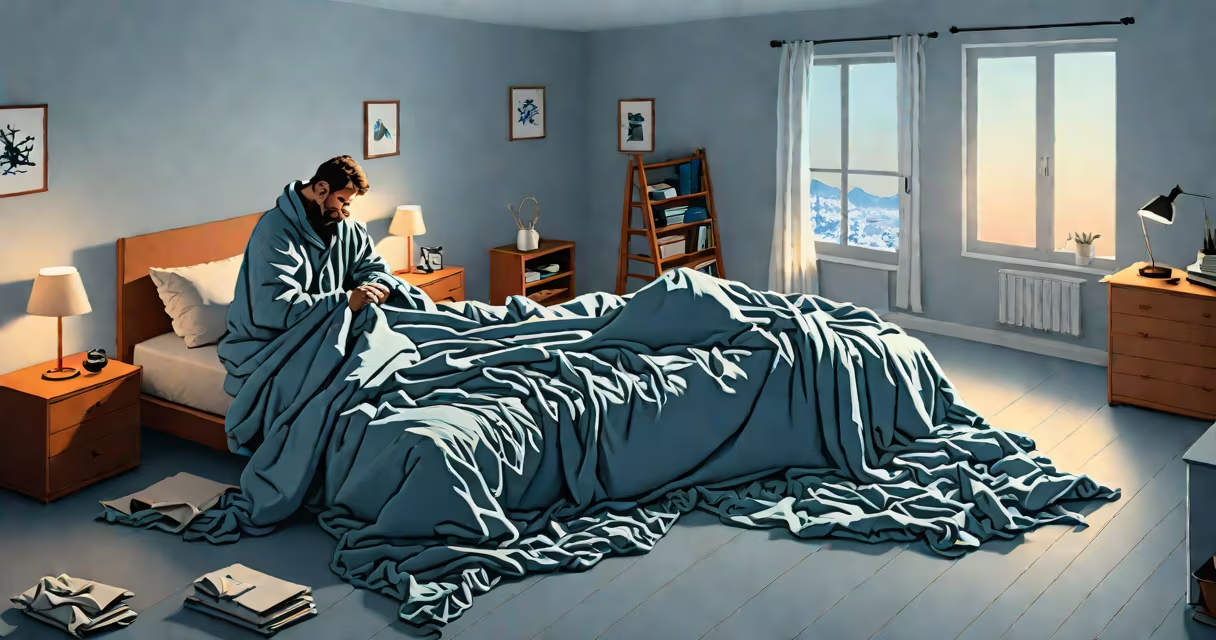
waking up freezing cold occurs when your bedroom temperature drops below your body's thermal comfort zone during sleep, typically due to inadequate insulation, low thermostat settings, or poor airflow control. This happens even if you feel warm under covers, because core body temperature naturally declines during sleep cycles.
During the night, your body's internal thermostat lowers your core temperature by about 1-2°C (1.8-3.6°F) to support deep sleep. If the ambient room temperature falls below 18°C (64.4°F), your body struggles to maintain warmth, triggering shivering and waking. The ideal sleep environment lies between 18°C and 20°C (64.4-68°F), according to the National Sleep Foundation.
Common causes include drafts from windows, poor insulation in older homes, air conditioning set too low, or using lightweight bedding unsuited to winter conditions. A 2022 study by the University of Michigan found that people who kept their bedrooms below 16°C (60.8°F) reported 37% more nighttime awakenings due to cold compared to those sleeping at 18-20°C.
Your circadian rhythm controls body temperature fluctuations. Core temperature peaks in late afternoon and begins dropping around 9 PM, reaching its lowest point between 3 AM and 5 AM. This natural dip makes you more sensitive to external cold during early morning hours.
If your room is cooler than 18°C, your body must work harder to maintain heat. Blood vessels near the skin constrict to reduce heat loss, which can cause numbness in extremities. Shivering activates muscles to generate heat, disrupting sleep continuity. Repeated cold exposure during sleep may impair immune function and increase cortisol levels, per research published in Sleep Medicine Reviews.
For example, a 2021 study tracked 120 adults using wearable thermometers. Participants whose rooms averaged 15.5°C (59.9°F) woke up 2.3 times per night on average, while those in 19°C (66.2°F) rooms averaged 0.8 awakenings. The difference was statistically significant (p < 0.01).
Several physical and environmental elements contribute to waking up freezing cold:
A real-world test conducted by the U.S. Department of Energy showed that replacing single-pane windows with double-paned glass reduced indoor temperature drop by 4.1°C (7.4°F) overnight in a 1960s-era home.
Not all cold awakenings stem from the same root. Distinguishing them improves troubleshooting:
| Type | Primary Cause | Fix |
|---|---|---|
| Consistent cold | Low baseline room temp or poor insulation | Set thermostat to 19-20°C; seal gaps; upgrade insulation |
| Intermittent cold | Thermostat misreading due to location or airflow | Relocate thermostat; avoid blocking vents |
| Localized cold spots | Drafts from doors, windows, or floorboards | Use draft stoppers; install weatherstripping |
| Bed-specific cold | Thin mattress or bedding unsuitable for season | Use a warmer mattress topper; switch to higher tog bedding |
Many assume that "I'm just cold-blooded" explains frequent cold awakenings. But this is a myth. While individual metabolic rates vary, the majority of cold awakenings result from environmental factors, not physiology. A 2020 study in Journal of Clinical Sleep Medicine found that 89% of participants reporting cold wakes had modifiable room conditions, not underlying medical issues.
In January 2023, a resident in a 1920s Boston apartment reported waking up freezing every night despite wearing thermal pajamas and using a heavy blanket. Room temperature readings showed consistent drops from 21°C (70°F) at bedtime to 14.5°C (58.1°F) by 4 AM.
Investigation revealed three issues: single-pane windows, a thermostat mounted near a drafty front door, and a mattress with no insulating layer. After installing thermal curtains, sealing the door gap with foam tape, and adding a 10 cm (4 inch) memory foam topper, the room maintained 17.5-18.5°C (63.5-65.3°F) throughout the night. The resident reported no further cold awakenings after two weeks.
waking up freezing cold is often mistaken for symptoms of hypothyroidism, Raynaud's phenomenon, or anemia. These conditions can cause cold intolerance, but they don't explain sudden cold awakenings in otherwise healthy individuals.
For instance, Raynaud's affects blood flow to fingers and toes, causing color changes and numbness. It doesn't cause whole-body coldness during sleep unless severe. Hypothyroidism slows metabolism, but symptoms appear gradually over months, not nightly.
If you consistently wake up cold despite proper room temperature and bedding, consult a healthcare provider. But most cases resolve through environmental adjustments, not medical treatment.
I once lived in a ground-floor apartment in Minneapolis with a single-pane window facing north. Despite setting the thermostat to 21°C (70°F), I'd wake up shivering every winter morning. I assumed my body was unusually sensitive to cold.
After tracking room temps with a smart sensor, I discovered the bedroom dropped to 13.5°C (56.3°F) by 3 AM. The culprit was a draft from the window frame and a radiator blocked by furniture. I installed a thermal curtain, moved the radiator, and added a wool blanket. Within five nights, I stopped waking up cold.
Start with measurable steps:
For renters, consider temporary fixes like thermal window film or a portable heater with automatic shutoff. Avoid placing fans or AC vents near beds.
When cold wakes persist, check for hidden drafts behind furniture or in baseboard heaters. A thermal imaging camera can reveal heat loss patterns invisible to the eye.
Waking up freezing cold is rarely a personal failing. It's a sign of an environment out of balance. Correcting it improves sleep duration, mood, and long-term health outcomes.