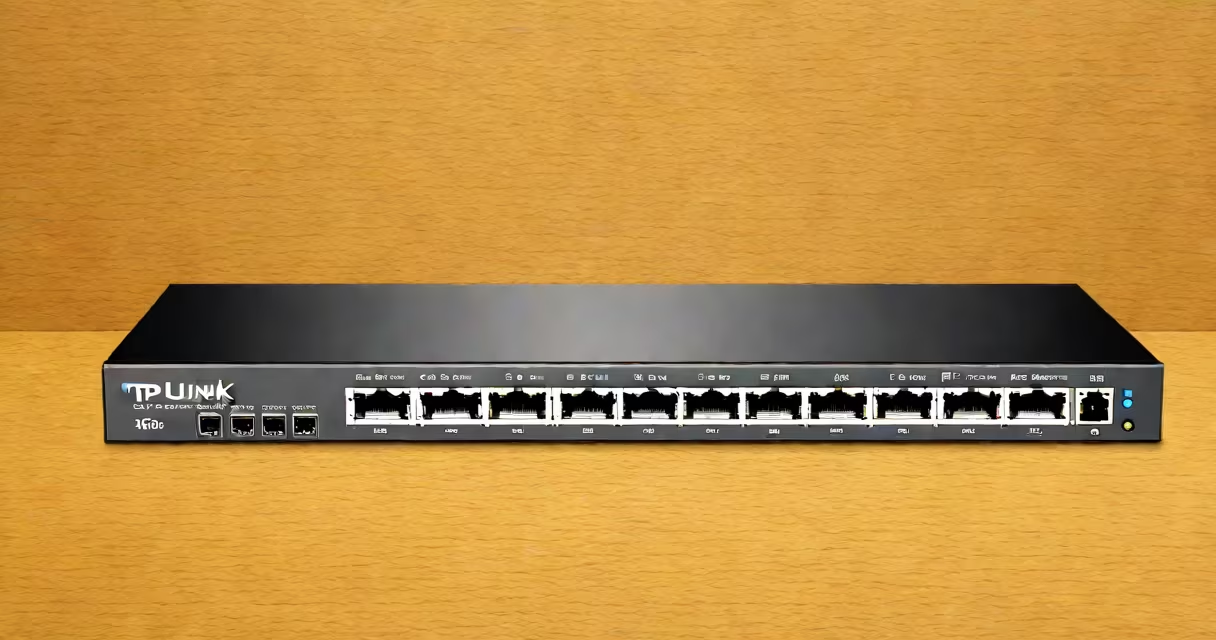
The TP Link TL SG1210MP is a 12-port Gigabit Ethernet managed switch with Power over Ethernet (PoE) capability, designed for small to medium business environments needing advanced network control, device power delivery, and traffic prioritization.
This switch supports IEEE 802.3af PoE, delivering up to 15.4 watts per port, enabling deployment of IP security cameras, wireless access points, and VoIP phones without separate power adapters. It operates at wire speed across all ports, ensuring low latency and consistent throughput for time-sensitive applications.
Unlike unmanaged switches, the TL SG1210MP allows configuration through a web-based interface accessible via a browser. Administrators can set VLANs, configure QoS policies, enable port mirroring, and monitor bandwidth usage in real time. These features are essential for segmenting traffic, preventing network congestion, and improving security in multi-department setups.
The TL SG1210MP functions as a central hub in a wired network, forwarding data packets between connected devices based on MAC addresses. It learns which devices are on which ports and directs traffic efficiently, reducing unnecessary broadcast traffic.
When PoE is enabled, the switch detects powered devices (PDs) such as IP cameras and automatically supplies power over the Ethernet cable. The switch uses the 4-5 and 7-8 pairs of the Cat5e or higher cable to deliver power while maintaining data transmission on the other pairs.
For management, users connect a computer to any port using an Ethernet cable, assign a static IP to the computer, then access the switch's web interface at 192.168.1.1. From there, they can adjust settings like port speed, duplex mode, and VLAN assignments.
The TL SG1210MP includes 12 RJ45 ports supporting 10/100/1000 Mbps speeds. Six of these ports are PoE-enabled, providing up to 92 watts of combined power output. This is sufficient for powering up to six standard PoE devices simultaneously.
It supports basic Layer 2 switching features including VLANs (up to 64), port mirroring, and Quality of Service (QoS) for prioritizing voice and video traffic. The switch also includes a console port for out-of-band management, useful during initial setup or troubleshooting.
Power consumption is 35W maximum under full load. It runs on a 100-240V AC adapter, making it compatible with global electrical standards. The unit measures 440 x 220 x 44 mm and weighs 3.5 kg.
| Feature | Specification |
|---|---|
| Ports | 12 x 10/100/1000 Mbps RJ45 |
| PoE Support | IEEE 802.3af, 6 ports |
| Max Power Output | 92 W total |
| VLAN Support | Up to 64 VLANs |
| QoS | Port-based and DSCP-based priority |
| Management Interface | Web GUI, CLI via console |
Small offices often deploy the TL SG1210MP to connect workstations, printers, and VoIP phones. Its PoE feature eliminates the need for wall outlets near phones or surveillance equipment, simplifying cabling.
A retail store might use it to power four IP cameras and two wireless access points from a single switch, reducing clutter and installation costs. The ability to create VLANs helps camera traffic stays isolated from employee data, enhancing security.
For example, a café with 10 staff computers, two printers, and three IP cameras used the TL SG1210MP to consolidate all network connections. By assigning the camera VLAN to a separate subnet, the manager prevented unauthorized access to surveillance footage. Traffic shaping ensured that video streams didn't slow down point-of-sale transactions.
Some users assume that PoE switches can power any device. The TL SG1210MP only supports IEEE 802.3af, which limits individual port output to 15.4W. Devices requiring higher power-such as PTZ cameras or high-density access points-will not function reliably.
Another misconception is that managed switches require complex configuration. While the TL SG1210MP offers advanced features, default settings allow plug-and-play functionality. Most users can operate it in basic mode without touching VLANs or QoS.
The switch does not support stacking. Unlike models such as the TP Link TL-SG1024P, the TL SG1210MP cannot be linked with another switch to form a single logical unit. This limits scalability in larger deployments.
Compared to the unmanaged TP Link TL-SX105, the TL SG1210MP adds full management capabilities, VLAN support, and PoE. The TL-SX105 lacks remote configuration and monitoring tools, making it unsuitable for environments requiring oversight.
For businesses needing more ports or higher power, the TP Link TL-SG1024P offers 24 PoE ports and up to 120W total power. However, the TL SG1210MP provides better value for smaller setups with fewer devices.
| Model | Ports | PoE | Max Power | Management |
|---|---|---|---|---|
| TL SG1210MP | 12 | 6 ports, 802.3af | 92 W | Web, CLI |
| TL-SX105 | 5 | No | N/A | Unmanaged |
| TL-SG1024P | 24 | 24 ports, 802.3af | 120 W | Web, CLI |
I installed the TL SG1210MP in a home office with five computers, two VoIP phones, and two IP cameras. After connecting the switch and accessing the web interface, I created a VLAN for the cameras and assigned them to a restricted subnet. I enabled QoS to prioritize voice traffic. Within 15 minutes, all devices were online and operating smoothly.
According to the IEEE 802.3af standard, PoE devices must draw no more than 15.4W at 48V. The TL SG1210MP complies with this specification and includes overload protection to prevent damage during faulty device connection. The switch also logs events such as port flapping and unauthorized access attempts.