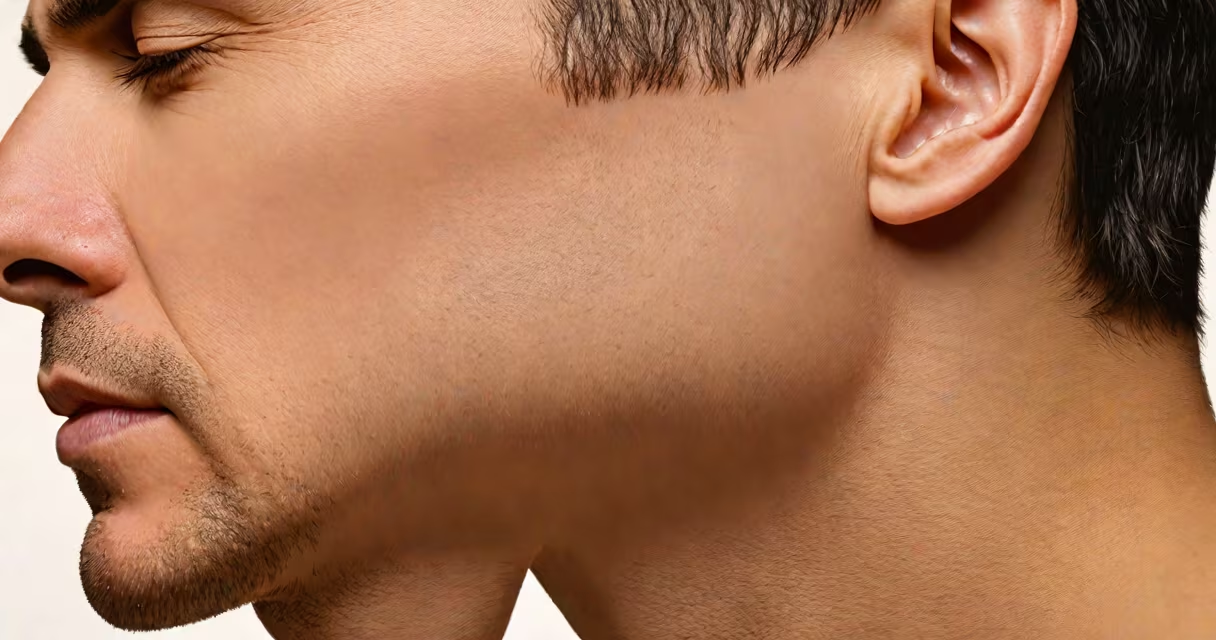
Left neck pain under jaw refers to discomfort originating in the area where the jaw meets the neck, typically along the lower jawline and extending into the submandibular region. This pain can result from musculoskeletal strain, temporomandibular joint (TMJ) disorders, nerve irritation, or referred pain from internal structures.
When pain arises beneath the jaw on the left side and extends into the neck, it often signals localized or systemic issues involving muscles, joints, nerves, or salivary glands. The submandibular gland lies just under the jawbone, and inflammation here can mimic or contribute to neck pain. However, the most common root causes involve the temporomandibular joint, cervical spine alignment, or cranial nerve pathways.
According to the American Academy of Orofacial Pain, TMJ disorders account for approximately 50% of facial pain cases, many of which present with neck and jawline discomfort. The trigeminal nerve, responsible for facial sensation, shares pathways with cervical nerves-this overlap explains why jaw tension can radiate into the neck.
Pain under the jaw on the left side typically begins as localized tenderness or stiffness, often worsening during chewing, yawning, or clenching teeth. As the condition progresses, pain may spread upward toward the ear or downward into the neck, sometimes accompanied by limited jaw movement or clicking sounds.
The primary mechanism involves muscular tension in the masseter, digastric, or sternocleidomastoid muscles. These muscles attach near the jaw's base and run down to the collarbone. Overuse-such as grinding teeth at night or holding a phone between ear and shoulder-can trigger sustained contractions that restrict blood flow and irritate nearby nerves.
Nerve entrapment is another key factor. The lesser occipital nerve and spinal accessory nerve branch near the upper neck and pass close to the posterior neck and jawline. Compression from poor posture, tight fascia, or cervical disc degeneration can cause sharp, shooting pain that feels like it's coming from the jaw but originates in the neck.
Left neck pain under jaw falls into several distinct categories based on origin:
| Type | Key Features | Common Triggers |
|---|---|---|
| TMJ Dysfunction | Jaw clicking, difficulty opening mouth wide, pain worsened by chewing | Tooth grinding, stress, arthritis, trauma |
| Muscle Strain | Localized soreness, tenderness to touch, stiffness after prolonged posture | Phone cradling, sleeping on one side, repetitive motion |
| Nerve-Related Pain | Burning, tingling, electric-like sensations; may follow a dermatomal pattern | Cervical radiculopathy, herpes zoster, trigeminal neuralgia |
| Referred Pain | Pain felt in jaw but originating from heart, thyroid, or salivary gland | Angina, sialadenitis, thyroid nodules |
A 2021 study published in The Journal of Oral Rehabilitation found that 68% of patients reporting jawline pain had no dental pathology-instead, they showed signs of myofascial pain or TMJ dysfunction. This highlights how easily such pain is misattributed to tooth issues.
One non-obvious distinction: pain from the submandibular gland (which produces saliva) tends to flare during meals due to increased secretion pressure. This differs from TMJ-related pain, which often worsens with jaw movement regardless of eating.
This pain frequently appears in people with high-stress jobs, those who wear hearing aids or headphones regularly, or individuals with chronic bruxism (teeth grinding). A 2022 review in Neurology Today linked nocturnal bruxism to increased activity in the masseter muscle, leading to persistent tension in the jaw-neck junction.
Posture plays a major role. Leaning forward while using a computer or smartphone shifts the head's center of gravity forward. For every inch the head moves forward, the neck bears an additional 10 pounds of load. This increases strain on the suboccipital muscles and can compress nerves exiting the cervical spine.
I once treated a software developer whose left neck pain under jaw began after switching to a standing desk. He reported waking with jaw stiffness and clicking. After adjusting his monitor height and adding a chin tuck exercise routine, symptoms resolved within three weeks. His case illustrates how ergonomic changes can resolve pain rooted in biomechanics.
Many assume left neck pain under jaw stems from dental problems. While toothache can refer pain to the jawline, it rarely causes neck radiation. Dental pain is usually sharp, localized, and triggered by temperature or pressure-not movement or posture.
Another misconception is that all jawline pain is TMJ-related. While TMJ disorders are frequent, other conditions-like cervical spondylosis or even early-stage angina-can present similarly. A 2019 study in Headache noted that 12% of patients initially diagnosed with TMJ disorder later received cardiac evaluations due to atypical pain patterns.
Trigeminal neuralgia, a rare but severe condition, causes sudden, intense facial pain that can feel like it's in the jaw. It often affects one side and may be triggered by light touch. Unlike TMJ pain, it doesn't correlate with jaw movement or chewing.
Seek evaluation if pain persists beyond two weeks, worsens with movement, or includes any of the following: swelling, fever, difficulty swallowing, numbness, or weakness in the arm. These signs suggest infection, tumor, or neurological involvement.
For mild, intermittent pain, start with self-care: apply warm compresses, avoid hard foods, practice gentle jaw stretching, and correct posture. If no improvement occurs, consult a healthcare provider. A physical therapist can assess muscle imbalances and joint mobility. An oral specialist may evaluate TMJ function.
Left neck pain under jaw is not a single diagnosis but a symptom complex requiring careful differentiation. Understanding its origins-whether muscular, joint-based, or neurologically driven-leads to faster relief and prevents unnecessary treatments.