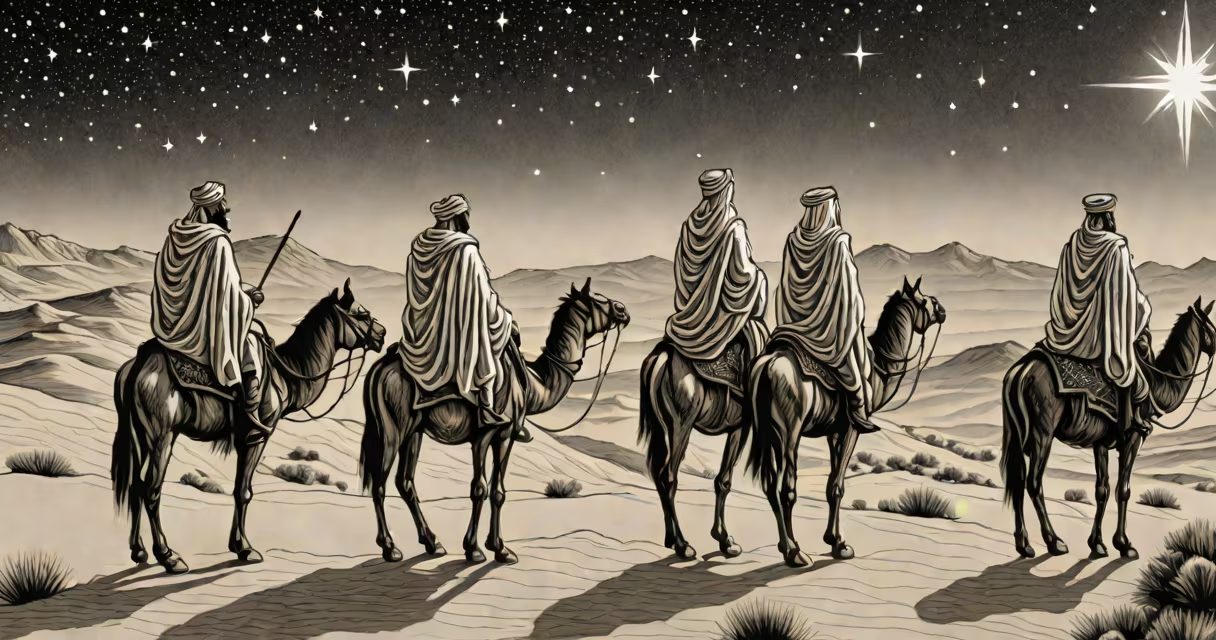
The scripture on the three wise men is found in Matthew 2:1-12, which describes Magi from the East arriving in Jerusalem seeking the newborn "king of the Jews," guided by a star. They travel to Bethlehem, where they worship Jesus and offer gifts of gold, frankincense, and myrrh.
These Magi-often called the "three wise men" in Western tradition-are not named in the Bible. The Gospel of Matthew uses the Greek term μάγοι (magoi), meaning "wise men" or "astrologers," likely referring to Zoroastrian priests from Persia or Mesopotamia. Their process reflects a key moment in Christian theology: the recognition of Jesus by Gentiles, affirming his universal significance.
Matthew's account includes specific details absent from other Gospels. The Magi arrive after Jesus' birth, not during the nativity scene traditionally depicted in Christmas imagery. Herod's reaction-fear and plotting-highlights the political tension surrounding Jesus' arrival. The Magi avoid returning to Herod, following a divine warning in a dream, underscoring God's protection over the infant.
The narrative unfolds in stages. First, the Magi observe a celestial phenomenon-an unusual star-suggesting divine intervention. They interpret it as a sign of a new king's birth. Their process from the East, possibly from regions near modern-day Iran or Iraq, indicates long-distance travel under uncertain conditions. This process symbolizes faith and perseverance in seeking truth.
Upon reaching Jerusalem, they ask, "Where is the one who has been born king of the Jews?" This question unsettles King Herod, who consults religious leaders. They cite Micah 5:2, pointing to Bethlehem as the prophesied birthplace. Herod then sends the Magi to Bethlehem under false pretenses, intending to kill the child.
When the Magi see the star stop over a house in Bethlehem, they rejoice. The text says, "They were overjoyed." They enter the home, fall to their knees, and worship Jesus. They offer gifts: gold for kingship, frankincense for divinity, and myrrh-a burial spice-foreshadowing Jesus' death. These gifts reflect theological layers beyond mere symbolism.
Matthew 2:1-12 is part of a larger literary structure. The Gospel of Matthew emphasizes Jesus as the fulfillment of Old Proof prophecy. The Magi's visit aligns with Isaiah 60:3: "Nations will come to your light, and kings to the brightness of your dawn." This verse is referenced in liturgical readings during Epiphany.
There is no mention of the Magi being three in number in the original text. The tradition of three arises from the three gifts listed. Early Christian writers like Origen (c. 185-254 CE) speculated about their number, but the Bible never specifies it. Some early manuscripts even suggest the Magi numbered more than three.
A common misconception is that the Magi arrived at the manger on the night of Jesus' birth. But Matthew states they came "after Jesus was born," and the family was living in a house, not a stable. This detail is critical-the Magi did not witness the birth itself but arrived later, possibly months after.
Different Christian traditions interpret the Magi differently. In Eastern Orthodoxy, the Magi are seen as representatives of all nations coming to Christ. In Roman Catholic and Protestant traditions, they are often venerated as saints, though the Bible doesn't name them or declare them canonized.
By the 4th century, church fathers like Jerome and Augustine began assigning names: Melchior, Gaspar, and Balthazar. These names appear in later apocryphal texts and art but are not in the canonical Gospels. The names were popularized through medieval hymns and liturgical calendars.
| Tradition | Number of Magi | Names | Gifts | Origin |
|---|---|---|---|---|
| Biblical (Matthew) | Unspecified | None given | Gold, frankincense, myrrh | East (likely Persia/Mesopotamia) |
| Western Church (medieval) | Three | Melchior, Gaspar, Balthazar | Gold, frankincense, myrrh | Europe, Asia, Africa (symbolic) |
| Eastern Orthodox | Unspecified | None | Same | Universal Gentile representation |
Another non-obvious fact: the star described in Matthew is not identified as a comet, supernova, or planetary conjunction in the text. The Gospel never explains its nature. Modern scholars have proposed various astronomical events-such as a conjunction of Jupiter and Saturn in 7 BCE-but Matthew presents the star as a miraculous sign, not a scientific anomaly.
Many assume the Magi were kings because of the term "wise men" and their royal gifts. But the word "magus" refers to scholars or astronomers, not royalty. The idea of them as kings arose centuries later, influenced by Psalm 72:10: "May the kings of Tarshish and of the isles bring gifts." This verse was interpreted messianically.
Some believe the Magi visited Jesus on Christmas Day. But the timeline suggests they arrived months after the birth. The Gospel of Luke places Jesus' circumcision on the eighth day and Mary's purification on the 40th day. The Magi's visit likely occurred after that, possibly during the time of Herod's reign, which ended in 4 BCE.
Another error: thinking the Magi were "kings" due to artistic depictions. Renaissance paintings often show them in royal robes, but this is symbolic, not historical. The Gospel does not describe their attire or status. Their identity lies in their act of worship, not rank.
In the Roman Catholic liturgy, Matthew 2:1-12 is read on January 6-the Feast of the Epiphany. This day celebrates the manifestation of Christ to the Gentiles. In many churches, the Magi's gifts are blessed and distributed to the faithful as symbols of spiritual offering.
For example, in 2023, St. John's Cathedral in Chicago held a procession where children carried replicas of the Magi's gifts. The priest read Matthew 2:1-12 aloud, emphasizing the theme of "all nations coming to the light." The sermon focused on inclusivity: Jesus was not just for Jews, but for all people.
This event illustrates how scripture on the three wise men continues to function in practice-not as a historical record alone, but as a living narrative of encounter and devotion.
I once attended a small church service in rural Kentucky where the congregation reenacted the Magi's process using a handmade map and lanterns. The reading of Matthew 2:1-12 was followed by a silent prayer. Afterward, a child asked, "Why did they bring myrrh? That's for dead people."
The pastor replied, "Because even then, they knew Jesus would die-and still chose to worship him. That's the heart of the story." The silence that followed was deeper than any explanation. The scripture on the three wise men wasn't just a tale-it was a challenge to faith.
The scripture on the three wise men is a key passage in Matthew's Gospel, marking the first public acknowledgment of Jesus by non-Jewish figures. It underscores the universality of Christ's mission and the power of seeking truth through signs and faith. While traditions may add names, numbers, and symbolism, the core remains: seekers from afar found the light.
Understanding this scripture requires separating legend from text. The Magi were not kings, not necessarily three, and not present at the birth. But they were wise enough to follow a star, brave enough to face a tyrant, and humble enough to kneel before a child. Their process continues to inspire those who seek meaning beyond the known.