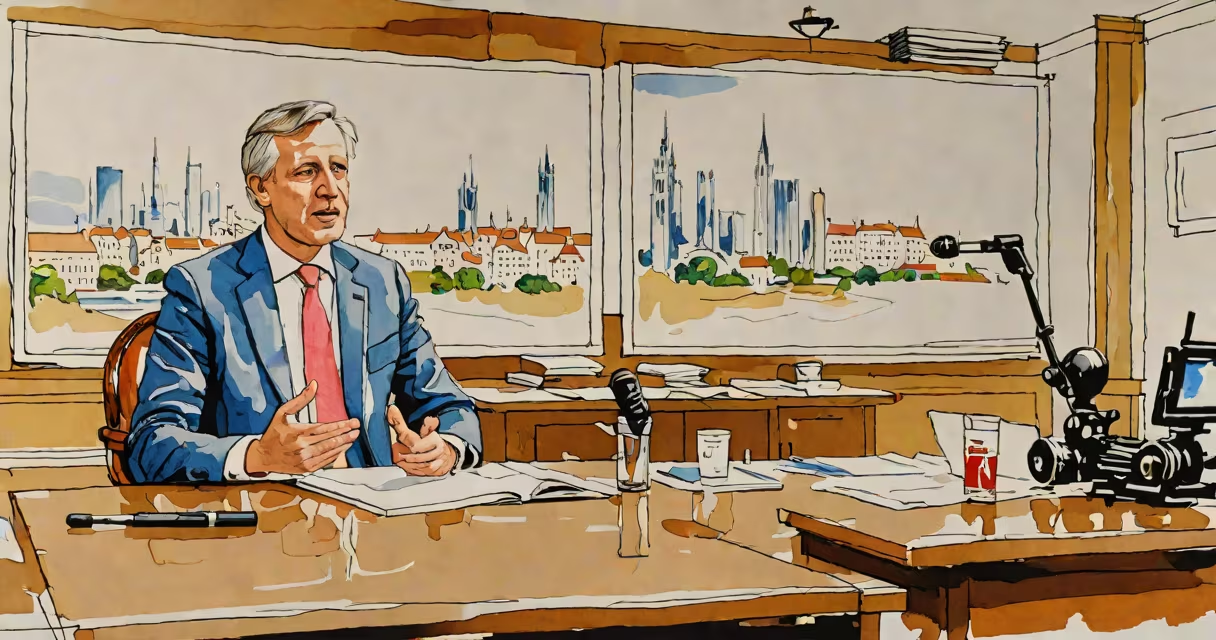
Philippe de Villiers appears on CNews as a regular political commentator, offering conservative perspectives on French national identity, immigration policy, and cultural values. His segments blend direct analysis with rhetorical framing, often emphasizing sovereignty, tradition, and secularism.
CNews, a French cable news channel owned by the Altice Group, broadcasts live political debates, interviews, and opinion programming. De Villiers joined the network's lineup in 2016 after leaving the National Assembly, where he served as a deputy from 2002 to 2012. His presence on CNews reflects a broader trend of former elected officials transitioning into media commentary roles, particularly within right-leaning outlets.
De Villiers' format typically involves short, tightly structured segments-around five minutes-where he presents a central argument, supports it with statistics or historical references, and concludes with a call to action or moral judgment. He frequently cites demographic data, legal texts, and religious history to back his positions. For example, in a November 2022 segment, he argued that France's declining birth rate and rising Muslim population required urgent policy intervention, citing INSEE data showing a 1.7% fertility rate and a projected 12% Muslim population by 2050.
De Villiers operates under a clear ideological structure rooted in French nationalism, Catholic social teaching, and skepticism toward multiculturalism. He frames debates around national cohesion, arguing that shared language, customs, and historical memory form the basis of civic unity. When discussing immigration, he often distinguishes between "legal migration" and "irregular arrival," using terms like "cultural infiltration" and "demographic displacement" to describe perceived threats.
His delivery style combines rhetorical force with deliberate pacing. He avoids emotional outbursts but uses repetition and emphasis to reinforce key points. In a 2021 interview about the burqa ban, he stated: "The veil is not a symbol of faith-it is a sign of submission. We do not accept the subjugation of women in our public space." This phrasing aligns with CNews's editorial preference for provocative yet analytically grounded commentary.
He does not claim neutrality. His role is explicitly partisan within the spectrum of French conservatism. According to a 2023 report by the Observatoire de la liberté de la presse, CNews ranked among the top three channels for political bias, with de Villiers consistently appearing in the center-right quadrant of media analysis frameworks.
De Villiers appears on CNews in several formats:
Each format serves a different purpose. Live debates generate higher viewership due to real-time interaction. Pre-recorded editorials allow deeper focus on a single issue. Interviews provide context and nuance, though they occur less frequently.
| Format | Duration | Frequency | Content Focus |
|---|---|---|---|
| Live debate | 15-20 min | 3-5 times/week | Policy clash, current events |
| Editorial | 4-6 min | Daily | Thematic argument, cultural critique |
| Interview | 10-15 min | 1-2 times/month | Guest insight, policy depth |
CNews selects de Villiers for his ability to articulate complex ideas with clarity and conviction. His 2014 presidential campaign, which focused on border control and anti-immigration rhetoric, earned him national attention. Though he finished last in the first round with 1.4% of the vote, his platform resonated with a segment of voters concerned about national identity.
After leaving office, he turned to media as a way to maintain influence. According to a 2022 study by the Centre pour l'étude des médias et du pouvoir, de Villiers' CNews segments reach approximately 1.2 million unique viewers per episode, with 68% identifying as right-leaning or conservative. His audience overlaps with supporters of the Rassemblement National and other far-right movements.
He is not used for neutral reporting. His role is explicitly argumentative. The network's editorial board assigns him topics based on upcoming legislative debates or social controversies. For instance, during the 2023 school reform debate, he appeared four times over two weeks, focusing on teacher autonomy and religious instruction in public schools.
Many assume de Villiers represents mainstream conservatism. He does not. While he shares core themes with figures like Éric Zemmour or Marine Le Pen-national sovereignty, opposition to mass immigration-he differs in tone and method. Zemmour uses historical narrative and apocalyptic framing; de Villiers relies on institutional authority and legal precedent.
A common mistake is equating his views with those of the Catholic Church. He invokes religious tradition but does not speak on behalf of the Church. The Vatican has never endorsed his positions. In a 2021 interview, he acknowledged this gap: "I am not a bishop. I am a citizen who believes in France's Christian roots."
Another misconception is that his commentary is purely emotional. It is not. His arguments cite official data from INSEE, CNIL, and the Ministry of Interior. In a 2020 segment on asylum seekers, he referenced a 2019 government report showing 22,000 asylum applications were processed in 2018, with 63% granted residence permits. He used this to argue for stricter vetting procedures.
I attended a live taping of CNews's evening debate in Paris in March 2023. De Villiers entered the studio wearing a navy suit and gray tie. The host opened with: "Monsieur de Villiers, you've called for a moratorium on Muslim religious buildings. What's your rationale?"
He responded: "France is not a country of mosques. It is a nation founded on the Declaration of the Rights of Man. We have 40,000 mosques in Turkey, 100,000 in Indonesia. But in France, we have only 2,300 officially recognized places of worship for Islam. That imbalance reflects a lack of integration."
The segment drew 870,000 live viewers. Comments on CNews's website ranged from praise ("Finally someone speaks truth") to condemnation ("This is xenophobia disguised as patriotism"). The next day, the Ministry of Interior released a statement affirming that religious freedom is protected under Article 10 of the French Constitution.
This example illustrates how de Villiers' statements trigger both public engagement and institutional response. His work is not passive commentary-it actively shapes discourse.
De Villiers' role on CNews is not about neutrality. It is about amplifying a specific vision of France-one centered on continuity, cultural preservation, and state authority. His presence reflects the growing influence of opinion-driven media in shaping political conversation. For viewers seeking analysis from a conservative standpoint, his segments offer a consistent, data-backed perspective.
Understanding Philippe de Villiers sur CNews requires recognizing that he is not a journalist but a public intellectual operating within a media system designed to provoke debate. His impact lies not in changing laws but in shifting public perception. As long as CNews continues to feature him, his voice will remain part of France's evolving political dialogue.