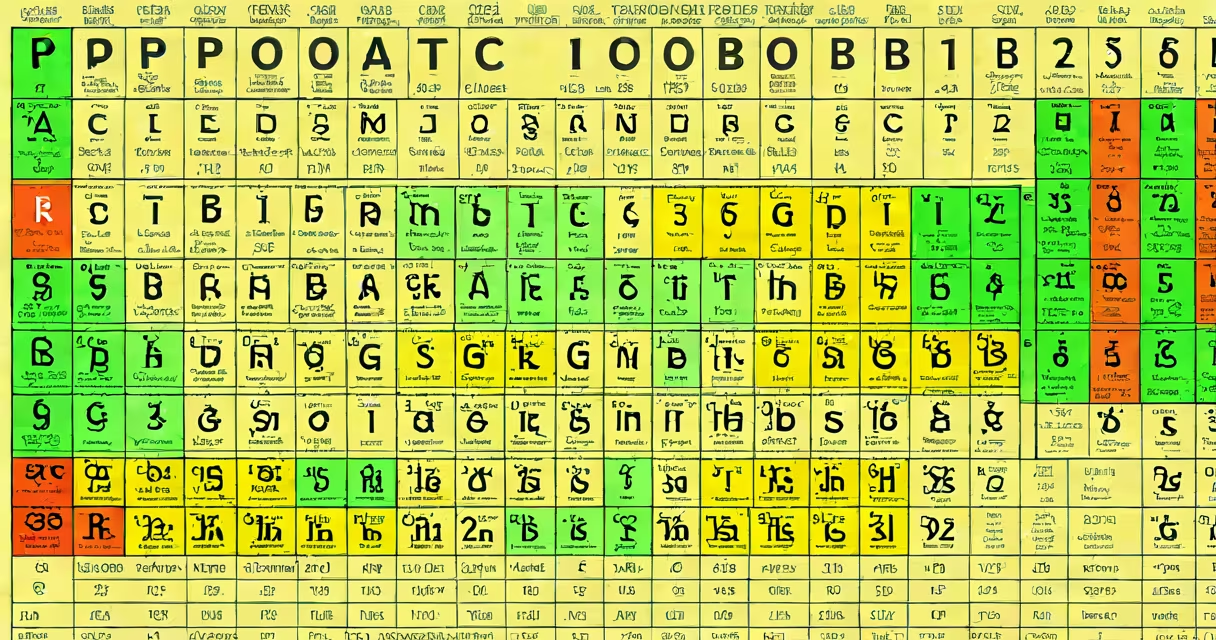
The periodic table with mass number and proton number displays each chemical element with its proton count (atomic number) and total nucleons (mass number), enabling precise identification of isotopes and elemental composition.
This version of the periodic table goes beyond standard layouts by showing two critical values for each element: the proton number (also called atomic number) and the mass number. The proton number defines the element's identity-hydrogen always has 1 proton, carbon has 6, uranium has 92. The mass number indicates the total protons plus neutrons in a specific isotope. For example, carbon-12 has 6 protons and 6 neutrons, giving a mass number of 12.
Unlike basic periodic tables that list only the atomic number and average atomic mass, this format includes discrete mass numbers for individual isotopes. This makes it essential for chemistry, nuclear science, and materials analysis where isotope-specific behavior matters. The International Union of Pure and Applied Chemistry (IUPAC) recognizes atomic number as the defining property of an element, while mass number varies between isotopes of the same element.
Each element box contains two numbers: the lower number is the proton number (Z), and the upper number is the mass number (A). These appear in the format AZX, where X is the element symbol. For example, 147N represents nitrogen-14, with 7 protons and 7 neutrons.
Mass number is not the same as atomic mass. Atomic mass (listed in most periodic tables) is a weighted average of all naturally occurring isotopes. Carbon's atomic mass is 12.011 u, reflecting contributions from carbon-12 (98.9%) and carbon-13 (1.1%). But carbon-12 has a mass number of exactly 12. The distinction matters in nuclear reactions and radiometric dating.
A common mistake is assuming that the mass number listed in a table applies to all atoms of that element. That's false. The mass number shown is typically for the most stable or abundant isotope. Iron-56 is the most stable iron isotope, but iron-54 and iron-57 also exist. Only iron-56 has a mass number of 56.
There are two main formats for displaying this data:
| Type | Use Case | Example |
|---|---|---|
| Isotope-specific table | Nuclear physics, medical imaging | 13153I (iodine-131) used in thyroid treatment |
| Standardized periodic table | High school and college chemistry | 23892U (uranium-238) as the dominant isotope |
These tables are used in laboratories to identify unknown samples via mass spectrometry. When a sample emits ions with a mass-to-charge ratio corresponding to 23592U, scientists confirm it contains uranium-235, a fissile isotope used in reactors and weapons.
One non-obvious fact: the mass number is always a whole number, even though atomic masses are decimal values. This reflects that nucleons are counted in integers-protons and neutrons don't come in fractions. The decimal atomic mass arises from averaging multiple isotopes with different whole-number mass numbers.
Many assume that the number listed under an element is its mass number. That's incorrect. Most periodic tables show average atomic mass, not mass number. For example, chlorine's atomic mass is 35.45 u, but its two major isotopes are chlorine-35 (mass number 35) and chlorine-37 (mass number 37).
Another confusion: mixing up atomic number and mass number. The atomic number determines the element's position and electron configuration. The mass number affects stability and decay rate. For instance, carbon-14 (mass number 14) decays over time, making it useful in archaeology. Carbon-12 (mass number 12) is stable and forms the basis of organic chemistry.
I once used a periodic table with mass numbers to analyze a rock sample in a geology lab. The mass number pattern for lead isotopes helped date the rock using uranium-lead dating. Without the correct mass number assignments, we'd have misidentified the age by millions of years.
For quick reference, look up the proton number and mass number of gold. Gold's atomic number is 79, meaning it has 79 protons. Its most stable isotope, gold-197, has a mass number of 197. This means it has 118 neutrons (197 − 79 = 118). Knowing this helps explain why gold is chemically inert-it has a filled d-shell and high nuclear binding energy.
Understanding the periodic table with mass number and proton number allows accurate interpretation of elemental behavior, especially in fields requiring precision such as nuclear medicine, environmental science, and materials engineering.
When studying elements, always verify whether the number listed is the atomic number (defines the element) or the mass number (specifies the isotope). This distinction prevents errors in calculations involving molar mass, half-life, or reaction stoichiometry.
Use the periodic table with mass number and proton number to decode real-world applications-from diagnosing diseases with radioactive tracers to analyzing ancient artifacts through carbon dating.