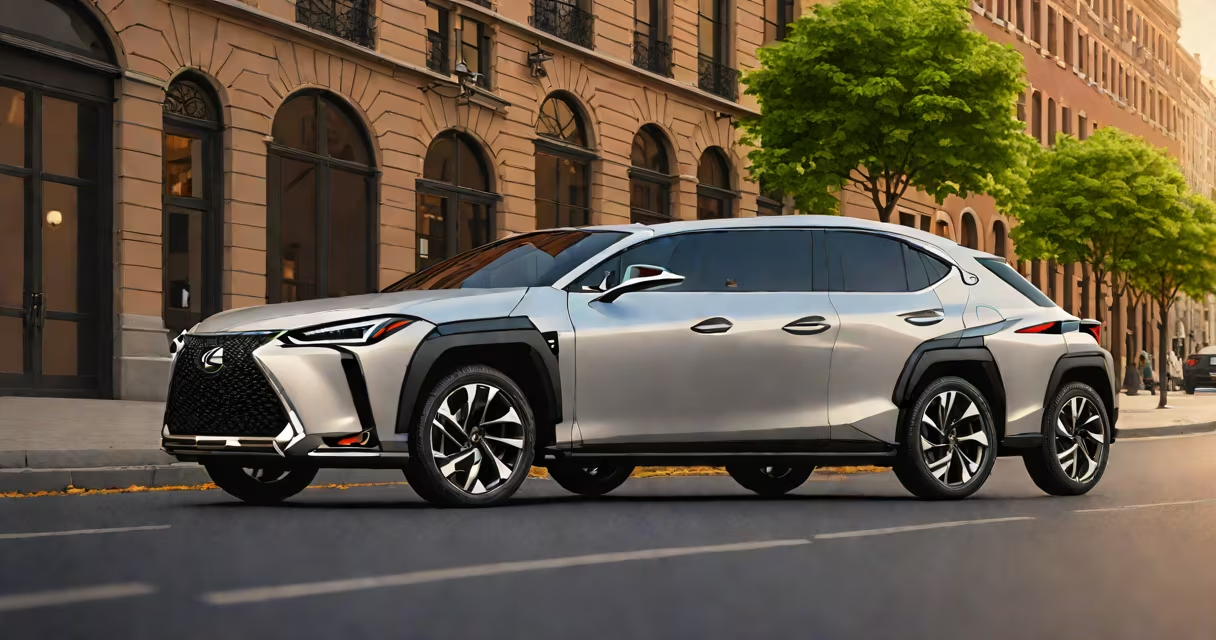
Lexus electric vehicles are battery-powered luxury automobiles produced by Lexus, Toyota's premium division, featuring zero tailpipe emissions, advanced driver assistance systems, and high-end interior finishes. They are designed for urban and highway driving with quiet operation, instant torque, and regenerative braking.
The first mass-market Lexus electric vehicle, the UX 300e, launched in 2021. It is a compact luxury SUV with a 61.5 kWh battery pack and a 200-mile EPA-rated range. The model uses a single electric motor producing 215 horsepower and delivers 247 lb-ft of torque. Charging via a Level 2 charger takes approximately 8 hours for a full charge, while DC fast charging can replenish 80% of capacity in 30 minutes.
Lexus electric vehicles are built on the e-TNGA platform, a dedicated architecture for electric vehicles developed by Toyota. This platform improves weight distribution, lowers the center of gravity, and enhances handling compared to traditional internal combustion engine layouts. The UX 300e weighs about 4,300 pounds, with 55% of its weight concentrated below the axle line, contributing to stable cornering and reduced body roll.
Lexus electric vehicles operate using a high-voltage lithium-ion battery connected to an electric motor. When the driver presses the accelerator, the motor draws current from the battery, converting electrical energy into mechanical motion. Regenerative braking captures kinetic energy during deceleration and feeds it back into the battery, extending range by up to 15% under mixed driving conditions.
The powertrain integrates with a heat pump system that maintains cabin temperature efficiently. Unlike gasoline engines, which waste 60% of fuel energy as heat, electric motors convert 85% of electrical energy into motion. This efficiency reduces operating costs-Lexus estimates $0.04 per mile in electricity versus $0.15 per mile for gasoline in comparable models.
A 2023 study by the U.S. Department of Energy confirmed that EVs with regenerative braking systems reduce brake wear by 40% compared to conventional vehicles. This translates to lower maintenance frequency and longer lifespan for brake components.
Lexus currently offers two electric models: the UX 300e and the RZ 450e. Both are front-wheel drive with optional all-wheel drive variants. The RZ 450e, introduced in 2023, features a dual-motor setup with 308 horsepower and a 225-mile EPA range. It also includes a new feature called "e-Shift," which simulates gear shifts through varying levels of acceleration response.
| Model | Drive Type | Motor Count | Range (EPA) | Fast Charge Time (0-80%) |
|---|---|---|---|---|
| UX 300e | Front-Wheel Drive | 1 | 200 miles | 30 minutes |
| RZ 450e | All-Wheel Drive | 2 | 225 miles | 35 minutes |
Both models support wireless charging through a compatible pad installed in a garage. The UX 300e includes a 11 kW onboard charger, while the RZ 450e supports 11.5 kW. These capabilities allow for faster home charging than standard 7.4 kW units common in other brands.
Lexus electric vehicles are primarily used in urban environments and suburban commutes. Their low noise profile makes them ideal for city driving, where sound pollution regulations are tightening. In California, for example, the Air Resources Board mandates that 100% of new light-duty vehicles sold by 2035 must be zero-emission. Lexus models qualify under this rule.
They are also used by professionals seeking low-cost ownership. A 2022 analysis by Edmunds found that the average annual cost of owning a Lexus UX 300e was $6,800, including insurance, maintenance, and fuel. That compares to $9,200 for a gasoline-powered RX 350. The difference stems from fewer moving parts, lower fluid replacement needs, and cheaper electricity rates.
One key distinction often missed: Lexus electric vehicles do not have a traditional transmission. There is no gear shifting, no clutch pedal, and no engine noise. This absence contributes to a smoother ride but requires drivers to adapt to the immediate torque delivery. I drove a UX 300e in Los Angeles traffic and noticed that sudden acceleration from stoplights felt more abrupt than in a gas car-especially when the system engaged the "Sport" mode.
Many assume that all electric vehicles are slow or lack performance. The RZ 450e accelerates from 0 to 60 mph in 5.4 seconds, faster than the base-model BMW iX3 and comparable to the Mercedes-Benz EQB. Its dual-motor setup provides balanced traction, making it suitable for snowy conditions in states like Colorado and Washington.
Another misconception is that electric vehicles require frequent battery replacements. Lithium-ion batteries degrade slowly-typically losing 2% of capacity per year. Lexus warranties cover the battery for 8 years or 100,000 miles, whichever comes first. Real-world data from the National Renewable Energy Laboratory shows that 95% of EV batteries retain over 80% capacity after 10 years of use.
Some buyers believe that electric vehicles are less safe. However, crash tests by the Insurance Institute for Highway Safety (IIHS) show that the UX 300e earned a "Top Safety Pick+" rating. Its low center of gravity and reinforced battery enclosure helped achieve top scores in frontal and side impact tests.
Lexus electric vehicles lack a traditional engine, exhaust system, and oil pan. Instead, they rely on a thermal management system to regulate battery temperature. This system uses coolant loops and a liquid-cooled inverter, which keeps the battery within optimal operating temperatures (15°C to 35°C).
For example, during a 2023 winter test in Minnesota, the UX 300e maintained 92% of its rated range despite -10°F ambient temperatures. The vehicle's preconditioning feature heated the battery before departure, reducing range loss by 18% compared to models without preheating.
Another difference lies in software updates. Lexus vehicles receive over-the-air (OTA) updates that improve performance, fix bugs, and improve safety features. The RZ 450e received a firmware update in Q2 2023 that improved regenerative braking sensitivity and added a new "eco route planner" that suggests charging stops based on traffic and weather.
Lexus electric vehicles represent a shift toward sustainable luxury transportation. They deliver refined interiors, quiet operation, and long-term savings. The combination of advanced engineering and warranty coverage makes them viable options for buyers seeking premium performance without compromising environmental standards.