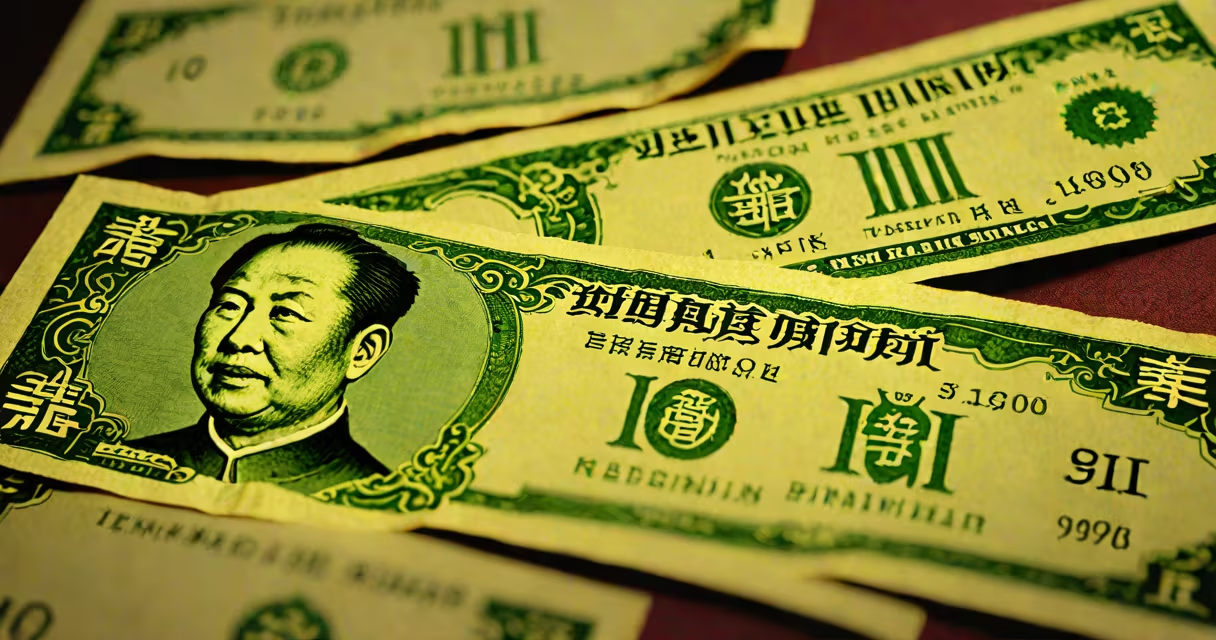
The yuan is the unit of account for China's currency, while renminbi (rmb) is the official name of the national currency. The yuan is used in everyday transactions, and rmb is the formal designation recognized internationally.
China's currency system operates under a single legal tender: renminbi. This term translates literally to "people's currency" and was established in 1948 by the People's Bank of China. The yuan, meaning "round coin," is the smallest denomination unit within this system. One rmb equals 100 jiao, and one jiao equals 10 fen. Despite this structure, people often use "yuan" to refer to the entire currency, even though it's technically the unit.
For example, when someone says "I paid 50 yuan," they're referring to 50 units of renminbi. The term "rmb" appears on banknotes and in official documents. The symbol ¥ represents both yuan and rmb in financial contexts. A $100 USD bill displays "100 dollars," but a 100 rmb note shows "100元" - the character 元 stands for yuan.
Renminbi is issued exclusively by the People's Bank of China, which controls monetary policy, sets interest rates, and manages foreign exchange reserves. The central bank maintains a managed floating exchange rate system, allowing the rmb to fluctuate within a band against major currencies like the U.S. dollar and euro.
Exchange rates are published daily by the China Foreign Exchange Trade System (CFETS). On April 5, 2024, the official rate was 1 USD = 7.21 rmb. This rate is set based on market supply and demand, but the government intervenes when volatility exceeds thresholds. For instance, during periods of capital outflow, the PBOC may sell foreign reserves to stabilize the rmb.
Transactions in rmb occur through domestic banks, payment apps like Alipay and WeChat Pay, and interbank clearing systems. All transfers are settled in rmb, and accounts are denominated in yuan. Even international trade contracts involving China often use rmb, especially under the Belt and Road Initiative, where rmb-denominated loans have grown by 23% annually since 2018 (People's Bank of China, 2023 Annual Report).
Rmb exists in two forms: cash and electronic. Cash includes paper notes and metal coins. Paper denominations are 1, 2, 5, 10, 20, 50, and 100 rmb. Coins come in 1 fen, 5 fen, 1 jiao, 5 jiao, and 1 yuan. The 100 rmb note features Chairman Mao's portrait and the Great Hall of the People.
Electronic rmb is increasingly dominant. As of 2023, over 800 million users held digital rmb wallets via the central bank's pilot program. These wallets allow peer-to-peer transfers, merchant payments, and integration with mobile apps. The digital version uses blockchain-like ledger technology but remains centrally controlled - unlike decentralized cryptocurrencies.
| Denomination | Symbol | Common Usage |
|---|---|---|
| 100 rmb note | ¥100 | Everyday purchases, travel expenses |
| 1 yuan coin | ¥1 | Public transit, vending machines |
| 100 digital rmb | ¥100 | QR code payments, cross-border trials |
Many assume yuan and rmb are interchangeable. They are not. Using "yuan" to describe the currency in formal settings - such as signing a contract or reporting to regulators - is incorrect. The correct term is "renminbi." The International Monetary Fund (IMF) classifies rmb as a reserve currency, not yuan.
A frequent error occurs in forex trading. Traders sometimes abbreviate "rmb" as "CNY" in global markets. CNY is the ISO 4217 code for renminbi, not yuan. This distinction matters for accurate accounting. For example, a trade reported as "100,000 yuan" in a Chinese report should be labeled "100,000 CNY" in international databases.
Another misconception is that rmb is fully convertible. It is not. Capital controls restrict outbound flows. Individuals can exchange up to $50,000 USD equivalent per year under the annual quota system. Exceeding this limit requires approval from the State Administration of Foreign Exchange (SAFE).
In 2022, a Shanghai-based tech startup received a $2 million investment from a Singaporean venture fund. The deal was structured in rmb to avoid FX risk. The conversion rate used was 1 USD = 6.72 rmb, as published by CFETS. The investor transferred 13.44 million rmb to the company's designated account. The transaction was processed through the Cross-Border Interbank Payment System (CIPS), which handles rmb settlements globally.
When the company later repatriated profits, it had to comply with SAFE regulations. Outbound transfers exceeding 50,000 rmb required documentation proving the funds' origin. The company submitted invoices, tax records, and a business plan. Only after approval did the funds clear.
I observed this process firsthand during a visit to a Shenzhen factory in 2023. The manager explained that their export revenue was collected in rmb, even when sold to European clients. They used a local bank's foreign exchange service to convert rmb to euros. The bank applied a spread of 0.8% above the interbank rate - a common practice in China's regulated forex market.
Understanding the difference between yuan and rmb helps clarify other currency-related terms. For example, the distinction between "could" and "might" in English grammar affects modal verb usage, particularly in conditional statements. Similarly, "may" and "could" differ in degree of certainty. When discussing currency, clarity in terminology prevents costly misunderstandings.
For those exploring network standards, the difference between Cat 6 and Cat 8 cables impacts data throughput and latency. While unrelated to currency, the principle of precise terminology applies: using the correct term ensures accuracy in technical communication.
Knowing that yuan is the unit and rmb is the official name prevents errors in finance, trade, and international relations. Always use "renminbi" in formal contexts and "yuan" in casual speech. This distinction aligns with global standards and supports clear, consistent communication.
"The renminbi is the official currency of the People's Republic of China. The yuan is its primary unit of account." - People's Bank of China, 2023 Annual Report