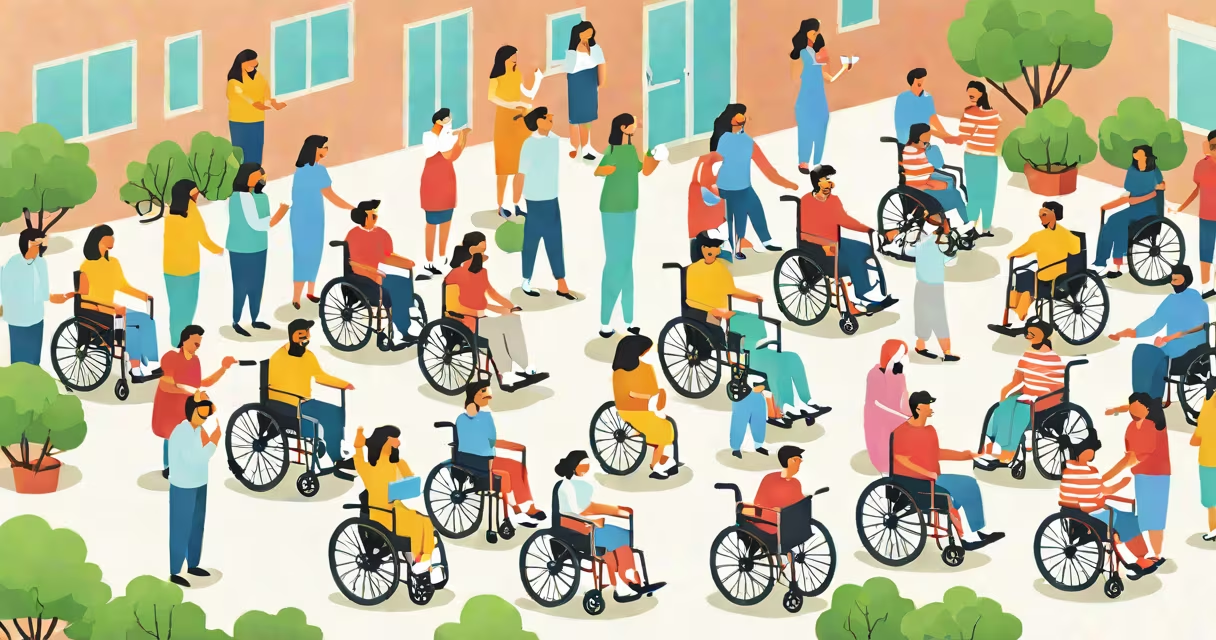
The international day of persons with disability is a United Nations-recognized observance held annually on December 3 to advance the rights and well-being of people with disabilities worldwide. It promotes inclusion, accessibility, and the full participation of persons with disabilities in all aspects of life.
Established by the UN General Assembly in 2016 through Resolution 70/175, the day marks the anniversary of the adoption of the Convention on the Rights of Persons with Disabilities (CRPD) in 2006. The CRPD is a legally binding treaty that affirms the equal rights of people with disabilities and calls for states to eliminate discrimination and ensure access to education, employment, healthcare, and political participation.
Each year, the UN designates a theme to focus global attention. For 2023, the theme was "Leadership and participation: advancing the rights of persons with disabilities." This emphasizes the importance of including people with disabilities in decision-making processes at all levels-from local governance to international policy forums.
On December 3, governments, civil society organizations, schools, businesses, and individuals participate in events that raise awareness and advocate for change. Activities include public lectures, art exhibitions, film screenings, policy dialogues, and community outreach programs.
Nations may issue official statements, host national conferences, or launch new accessibility initiatives. For example, in 2022, Canada launched a national strategy to improve digital accessibility across federal services, aligning with the day's goals. In India, state governments organized workshops on sign language interpretation and accessible infrastructure design.
Events are often coordinated through national disability councils or NGOs. The World Blind Union, for instance, runs annual webinars on inclusive education during this period. These efforts aim to translate awareness into tangible improvements in daily life.
The international day of persons with disability is not a holiday with paid leave or public celebrations. Instead, it functions as a coordinated advocacy platform. Its core elements include:
A common misconception is that the day is solely about charity or pity. That's incorrect. The UN explicitly frames it as a human rights observance. As the World Health Organization notes, "Disability is not a deficit-it is part of human diversity."
Organizations and individuals engage at different levels based on capacity and mandate. A comparison of participation tiers shows distinct patterns:
| Engagement Level | Examples | Scope & Impact |
|---|---|---|
| International | UN agencies, WHO, UNESCO | Set global policy direction; publish reports; coordinate cross-border action. |
| National | Ministries of health, disability commissions | Launch national plans; enforce anti-discrimination laws; fund local projects. |
| Local | Community centers, schools, small nonprofits | Host awareness sessions; install ramps; train staff in inclusive practices. |
| Individual | Students, artists, activists | Share stories online; attend events; advocate in workplaces. |
One non-obvious fact: the day is not uniformly observed in all countries. Some nations integrate it into existing frameworks-like Japan's Disability Independence Law implementation-and report progress annually. Others lack formal structures, relying on NGO-led efforts. According to UNDESA, 128 member states reported official activities in 2022, while 45 did not.
People often mistake the international day of persons with disability for other similar observances. It is not the same as International Coming Out Day (observed October 11), which focuses on LGBTQ+ identity and visibility. While both promote inclusion, their histories, goals, and communities differ.
Another error is assuming the day is limited to physical disabilities. The CRPD defines disability broadly: "a long-term condition affecting body function or structure, resulting in interactional barriers." This includes intellectual, sensory, mental health, and neurodivergent conditions. A person with autism or chronic pain qualifies under the definition.
There's also confusion around funding. The UN does not provide direct grants for events. Instead, it offers free educational materials and encourages partnerships with private sector sponsors. In 2021, Microsoft partnered with the UN to release an accessibility toolkit used by over 10,000 educators in 50 countries.
In 2023, the city of Melbourne, Australia, launched a week-long program titled "Access Now." On December 3, they hosted a public forum at Federation Square featuring 15 speakers with disabilities. Topics included accessible voting systems, inclusive urban planning, and workplace accommodations.
Before the event, city officials conducted a barrier audit of 20 public venues. They discovered 68% lacked audio descriptions for visual content. As a result, the city committed $1.2 million over three years to retrofit facilities with assistive technologies.
After the forum, 74% of attendees reported increased confidence in advocating for change. One participant, a woman with cerebral palsy who runs a tech startup, said: "For the first time, I felt seen-not as a problem to fix, but as someone with solutions."
Research shows that coordinated awareness days lead to measurable shifts in policy. A 2022 study published in The Lancet Global Health found that countries with formal observance mechanisms were 3.2 times more likely to pass national disability inclusion legislation within five years compared to those without.
The day strengthens accountability. When governments announce commitments on December 3, they're subject to follow-up by civil society groups. In 2020, the European Commission faced criticism after failing to meet targets set during the observance. Public pressure led to revised timelines and increased funding.
As the World Health Organization states, "Inclusion is not optional-it is essential for sustainable development." The international day of persons with disability serves as a recurring reminder that equity requires consistent effort, not just goodwill.
Every year, the day reaffirms that people with disabilities are not passive recipients of aid-they are leaders, innovators, and citizens whose voices must be heard. The UN's call to action remains clear: "Leave no one behind."
Understanding the international day of persons with disability helps clarify its role as a global catalyst for justice, dignity, and shared progress. It is not a single event but a yearly opportunity to build a world where everyone belongs.