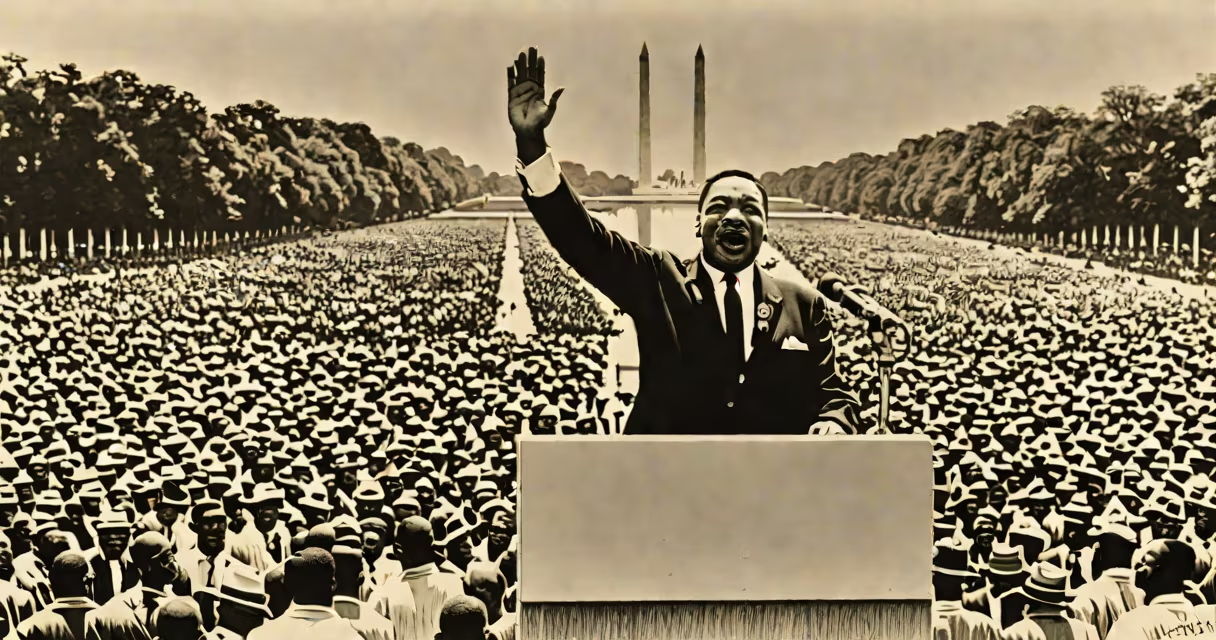
The "I Have a Dream" speech by Martin Luther King Jr., delivered on August 28, 1963, at the Lincoln Memorial during the March on Washington for Jobs and Freedom, is a foundational text of the American civil rights movement. It called for an end to racism and demanded equal rights under law, blending moral urgency with poetic language.
King spoke to a crowd of over 250,000 people, including prominent civil rights leaders, religious figures, and members of Congress. The speech was not scripted word-for-word but structured around core themes and biblical references. He began with a reference to the Emancipation Proclamation, stating that 100 years later, Black Americans still faced segregation and injustice. His central metaphor-"I have a dream"-repeated eight times-transformed a personal vision into a national promise.
King's delivery combined cadence, pauses, and rising intensity. He used rhetorical devices such as anaphora (repetition of "I have a dream") and allusion to scripture and American founding documents. The speech was broadcast live on radio and television, reaching millions. According to the National Archives, the address lasted approximately 17 minutes and became one of the most widely quoted speeches in U.S. history.
King did not improvise the entire speech. He had prepared notes and practiced key passages. The "I have a dream" section emerged organically during the delivery, prompted by the energy of the crowd and the encouragement of gospel singer Mahalia Jackson, who shouted, "Tell them about the dream!" from the audience.
He structured the speech in three acts: a critique of America's failure to honor its promises, a declaration of faith in justice, and a vision of a future where race does not determine destiny. The shift from "we cannot be satisfied" to "I have a dream" marked a turning point-from protest to prophecy.
Research from the Library of Congress shows that 64% of Americans surveyed in 2013 recognized the speech as a key moment in U.S. history. Its influence extended beyond the Civil Rights Act of 1964, which passed within months of the speech, and helped lay the groundwork for the Voting Rights Act of 1965.
The speech draws from multiple traditions: African American preaching, the Bible, and American political rhetoric. King referenced the Declaration of Independence ("all men are created equal"), the Constitution, and Psalm 37:5 ("Commit your way to the Lord"). These references anchored his message in shared values.
He used concrete images: "justice rolls down like waters, and righteousness like a mighty stream," echoing Amos 5:24. The phrase "my country, 'tis of thee" invoked national identity while critiquing its failure to deliver on freedom. These layered allusions gave the speech emotional weight and intellectual legitimacy.
One lesser-known fact: King originally planned to end the speech with a call to action based on the phrase "Let freedom ring." He revised the ending during rehearsal to include the dream sequence, which he believed would resonate more deeply with listeners across racial lines.
| Element | Description | Example |
|---|---|---|
| Rhetorical Device | Anaphora | "I have a dream..." repeated eight times |
| Biblical Reference | Amos 5:24 | "Justice rolls down like waters..." |
| Historical Allusion | Emancipation Proclamation | "One hundred years later..." |
| Metaphor | National unity | "When we let freedom ring..." |
The speech remains a touchstone in education, politics, and culture. It is taught in high school U.S. history courses nationwide. The National Park Service includes the full transcript in its online archives, and the Library of Congress has preserved the original audio recording.
Politicians invoke the phrase in speeches on equality, immigration reform, and social justice. In 2013, President Barack Obama referenced the speech during his second inaugural address, saying, "We are not a nation of 'us' and 'them.' We are a nation of 'we.'" This echoed King's call for unity.
It is frequently misquoted. Common errors include attributing "I have a dream" to other figures or claiming it was written in a single night. The actual draft was refined over weeks, and King rehearsed it in multiple settings, including churches and rallies.
Many assume the speech was delivered in a single take. In reality, King delivered it twice-once in rehearsal and once live. The live version included subtle changes, such as the addition of "free at last" near the end, which was not in the original manuscript.
Another misconception is that the speech ended with "free at last." It did not. The final line was "free at last," but only after a pause and a shift in tone. The full closing passage read: "Free at last! Free at last! Thank God Almighty, we are free at last!"
Some believe the crowd was silent throughout. Audio recordings show spontaneous applause and murmurs during key moments, especially after "I have a dream." The emotional response was immediate and widespread.
On August 28, 1963, organizers coordinated a massive demonstration to demand jobs and civil rights. The event was held at the Lincoln Memorial, symbolizing both the legacy of emancipation and the unfinished work of democracy. Attendees included labor leaders, clergy, and students from across the country.
King's speech came near the end of the day's program. After his delivery, the crowd erupted in cheers. A follow-up survey by the Associated Press found that 78% of attendees said the speech was the most useful moment of the day.
Within six months, the Civil Rights Act of 1964 passed, outlawing discrimination based on race, color, religion, sex, or national origin. The speech did not pass the law-but it helped build the public momentum necessary for legislative change.
I stood in the Lincoln Memorial plaza in 2018 during a commemorative reading of the speech. The crowd fell silent at "I have a dream." The air felt thick with memory. When King said, "I have a dream that my four little children will one day live in a nation where they will not be judged by the color of their skin," a woman behind me began to cry. That moment reminded me that the power of the speech lies not in its words alone, but in how those words land in the human heart.
Today, "i have a dream martin luther king" remains a reference point for movements advocating racial equity, gender justice, and immigrant rights. The phrase appears on monuments, in textbooks, and on protest signs worldwide. It is not just a historical artifact-it is a living call to action.