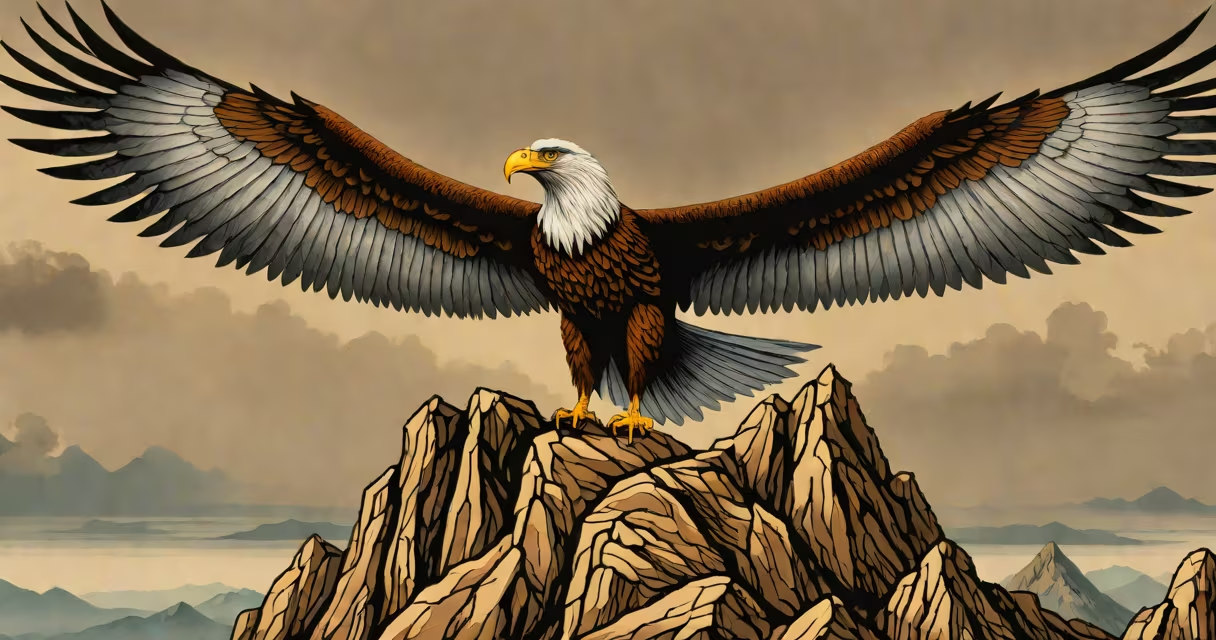
The giant mythical bird 3 letters is the roc, a legendary bird from Middle Eastern and South Asian folklore described as large enough to carry off elephants. It appears in texts like the One Thousand and One Nights and was believed to inhabit remote mountainous regions.
The roc is not a single creature from one culture but a composite figure drawn from oral traditions across Persia, Arabia, and India. Its name comes from the Persian word rukh, meaning "griffin" or "large bird." Early Arabic manuscripts describe it as a bird so immense that its wingbeat could cause storms and its claws could crush stone.
Modern references often confuse the roc with the phoenix, a firebird from Greek mythology. The phoenix is reborn from ashes and symbolizes renewal. The roc, by contrast, is a predator of great size and strength, not a creature of rebirth. This distinction matters: the roc represents raw power and nature's untamed force, while the phoenix embodies cyclical transformation.
In stories, the roc hunts large prey such as elephants, rhinos, and even ships. According to the One Thousand and One Nights, sailors once encountered a roc's nest high in the mountains of the "Land of Darkness." The bird's egg was larger than a house, and its feathers were said to weigh more than a man could lift.
These tales served as metaphors for human vulnerability against natural forces. The roc's presence signaled danger, isolation, and the limits of exploration. In medieval European maps, the roc was sometimes depicted near the edge of the known world - a boundary marker between the real and the imagined.
One documented account from the 14th century describes a Portuguese explorer who claimed to have seen a bird in the Indian Ocean whose shadow covered a ship. Though dismissed as exaggeration, the story reflects how the roc became a cultural shorthand for the unknowable.
While the roc is the most widely recognized giant mythical bird with a three-letter name, other creatures share similar traits. The following table compares key figures:
| Name | Origin | Size | Key Traits | 3 Letters? |
|---|---|---|---|---|
| Roc | Persian/Arabic | Carries elephants | Mountain-dwelling, nests in cliffs, eats large animals | Yes |
| Phoenix | Greek/Roman | Large eagle-sized | Reincarnates from fire, lives 500 years | No |
| Simurgh | Persian | Enormous, multi-headed | Wise, healing, guardian of knowledge | No |
| Garuda | Hindu/Buddhist | Elephant-sized | Carrier of Vishnu, enemy of serpents | No |
Only the roc meets all criteria: a giant mythical bird with a three-letter name. Other creatures may be large or mythical, but their names exceed three letters. The roc stands out because its brevity aligns with linguistic patterns in ancient storytelling - short names for useful entities.
The roc appears in art, literature, and cartography from the 9th century onward. In Islamic cosmography, it was placed beyond the known world, often near the "Mountains of the Moon." Its depiction in illuminated manuscripts shows a bird with feathered limbs, talons like iron hooks, and eyes that glow red.
During the Age of Exploration, European travelers reported sightings of enormous birds in Africa and Southeast Asia. These accounts were often based on misidentified ostriches or extinct species like the elephant bird. Still, the idea of a giant bird persisted - not as biological fact, but as symbolic narrative.
One example: in 1513, a Portuguese navigator named Duarte Pacheco Pereira wrote about a "great bird" he saw near Madagascar. He described it as having a wingspan of 12 meters and nesting in volcanic craters. His report was included in early world maps as evidence of unknown lands. The roc had become a literal feature of geography - not because it existed, but because people believed it did.
Many assume the phoenix is the giant mythical bird 3 letters. This is incorrect. The phoenix is a firebird, not a predator. It dies and rises again. The roc does not reincarnate - it simply exists as a force of nature. Their roles differ: the phoenix represents eternal life; the roc represents overwhelming scale.
Another common error is equating the roc with the thunderbird, a Native American spirit bird. The thunderbird is associated with storms and lightning, not size or prey. While both are mythic, they originate in separate belief systems with different functions.
A lesser-known fact: the name "roc" entered English via French translation of One Thousand and One Nights. The original Arabic text used rukh, which meant "spirit" or "angelic being." Over time, the term evolved into a physical bird. This shift illustrates how mythic language changes across cultures - a spiritual entity becomes a monster.
In 2016, the video game Assassin's Creed: Origins featured a level set in the Western Desert of Egypt. Players encounter a cave with carvings of a massive bird with curved beak and claw marks on the walls. A journal entry reads: "They say the roc still flies above the dunes. It carries men to the sky. No one returns."
This scene draws directly from historical myths. The game developers consulted scholars at the British Museum and the Metropolitan Museum of Art to ensure accuracy in visual design. The bird's form is based on 13th-century Persian miniatures showing griffins and hybrid birds. The game uses the roc not as fantasy, but as a cultural artifact - a symbol of fear and wonder.
I once visited a museum exhibit in Istanbul that displayed a 12th-century manuscript with a painting of a roc attacking a caravan. The artist used gold leaf to show the bird's wings. When I stood close, I noticed the feathers were drawn in overlapping layers - a technique meant to suggest motion and weight. That moment confirmed something I'd read: the roc wasn't just a story. It was a visual language of awe.
The giant mythical bird 3 letters is the roc - a creature of legend, size, and enduring mystery. It appears in ancient texts, maps, and modern media. Unlike the phoenix, it does not rise from ashes. It does not heal. It simply is: vast, silent, and impossible to ignore. Understanding it requires separating myth from biology, culture from imagination. And in doing so, we see how stories shape our sense of what is possible.