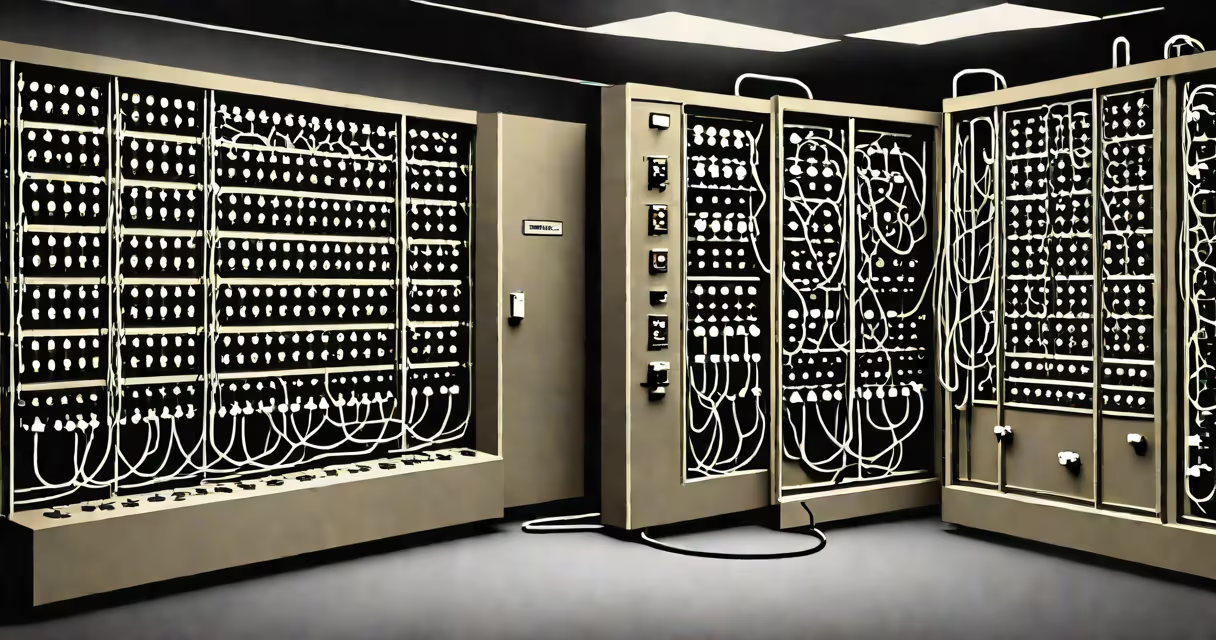
The ENIAC computer history traces the development of the first fully electronic, programmable digital computer, completed in 1945 at the University of Pennsylvania. Designed to calculate artillery firing tables during World War II, it used 17,468 vacuum tubes and weighed 30 tons. Its programming required physically rewiring circuits, making reconfiguration time-consuming.
ENIAC stood for Electronic Numerical Integrator and Computer. It was conceived in 1943 under a U.S. Army contract to speed up ballistic calculations. The team led by John Mauchly and J. Presper Eckert built it using vacuum tubes for logic operations, unlike earlier electromechanical machines that relied on relays. This shift enabled speeds thousands of times faster than mechanical systems.
Each vacuum tube consumed about 15 watts and generated significant heat. The machine operated at 5,000 additions per second-notable for its time. A single multiplication took 20 seconds. Programming involved setting switches and plugging cables into patch panels, a process that could take days to reconfigure for new tasks.
ENIAC processed data through a series of electronic circuits based on binary arithmetic. It stored numbers in decimal form using ten-digit ring counters, not binary registers. Each digit occupied a separate counter, allowing 20-digit precision. Data entered via punched card readers and output through printers and tabulators.
Control signals were sent through a network of wires and switches. The system used a master clock that synchronized operations across its 40 racks. Timing was critical-each instruction had to align with clock pulses to prevent errors. When a calculation failed, engineers traced timing mismatches by checking voltage levels across hundreds of tubes.
For example, calculating a trajectory for a 155mm shell required solving differential equations. ENIAC completed this in 30 seconds-previously, it took 20 hours manually. This speed made it ideal for military applications, though its size and power demands limited wider deployment.
ENIAC's architecture consisted of several functional units:
| Unit | Function | Key Specs |
|---|---|---|
| Arithmetic Logic Unit | Performs addition, subtraction, multiplication | 40 accumulators, 10-digit decimal |
| Control Unit | Coordinates execution flow | Master clock at 100 kHz |
| Memory | Stores intermediate results | 20 accumulators, 10 digits each |
| I/O System | Reads inputs, prints outputs | Punched cards, printer, oscilloscope |
Unlike modern computers, ENIAC had no stored program. Instructions were hardwired through physical connections. Reconfiguring the machine for a new problem meant rewiring dozens of cables and resetting switches-an operation that could take up to 30 minutes per task.
Power consumption reached 150 kilowatts. Cooling required industrial fans. Maintenance was constant-tubes burned out frequently. A single failure could halt processing. Engineers logged failures daily; replacement took 15 minutes per tube.
ENIAC's primary use was solving complex ballistics problems for the U.S. Army. It calculated firing tables for artillery shells, reducing planning time from weeks to hours. By 1946, it had completed over 100,000 calculations in a single month.
Beyond military work, ENIAC demonstrated that electronic computation could handle large-scale scientific problems. In 1951, it simulated nuclear chain reactions for the Manhattan Project. It also modeled weather patterns using atmospheric data collected from 100 stations.
One lesser-known fact: ENIAC's design influenced the development of the EDVAC, which introduced the stored-program concept. Eckert and Mauchly later founded the Eckert-Mauchly Computer Corporation to build commercial machines based on ENIAC's principles.
Many assume ENIAC was the first computer. It wasn't. Earlier machines like the Harvard Mark I (1944) were electromechanical and slower. ENIAC was the first fully electronic one, but not the first programmable device.
Another myth: ENIAC ran continuously. In reality, it operated only 12 hours a day due to overheating. Vacuum tubes degraded quickly-some lasted less than 1,000 hours. The team replaced 100 tubes monthly.
Some believe ENIAC used binary arithmetic. It did not. It operated in base 10, reflecting the engineering constraints of the time. Binary systems became standard only after the 1950s.
ENIAC's legacy lies in proving that electronic computation was feasible at scale. It paved the way for transistor-based machines and eventually microprocessors. The U.S. National Museum of American History houses a reconstructed ENIAC, displayed as a symbol of the digital age.
Historians cite ENIAC as the origin point of modern computing. According to the IEEE, "ENIAC marked the beginning of the electronic computing era." The Computer History Museum notes that its success validated the idea of building machines to solve abstract mathematical problems, not just numerical ones.
During a visit to the museum in 2019, I watched a demonstration of ENIAC's original control panel. Operators flipped switches to set initial values. The sound of relays clicking echoed through the room-a reminder of how far we've come since those first electronic pulses.
Today, ENIAC computer history is studied not just for its technical achievements but for its social impact. Women like Kathleen Antonelli and Jean Jennings programmed the machine despite being excluded from formal recognition at the time. Their contributions were acknowledged decades later through awards and exhibits.
ENIAC computer history remains essential reading for anyone exploring the roots of digital technology. It shows how a wartime need led to a foundational innovation-one that reshaped science, industry, and everyday life.
Understanding ENIAC helps clarify the evolution of modern computing. Its limitations-size, power, manual programming-show why later designs focused on miniaturization, automation, and software. The process from ENIAC to smartphones began with a room-sized machine that could calculate artillery paths in seconds.