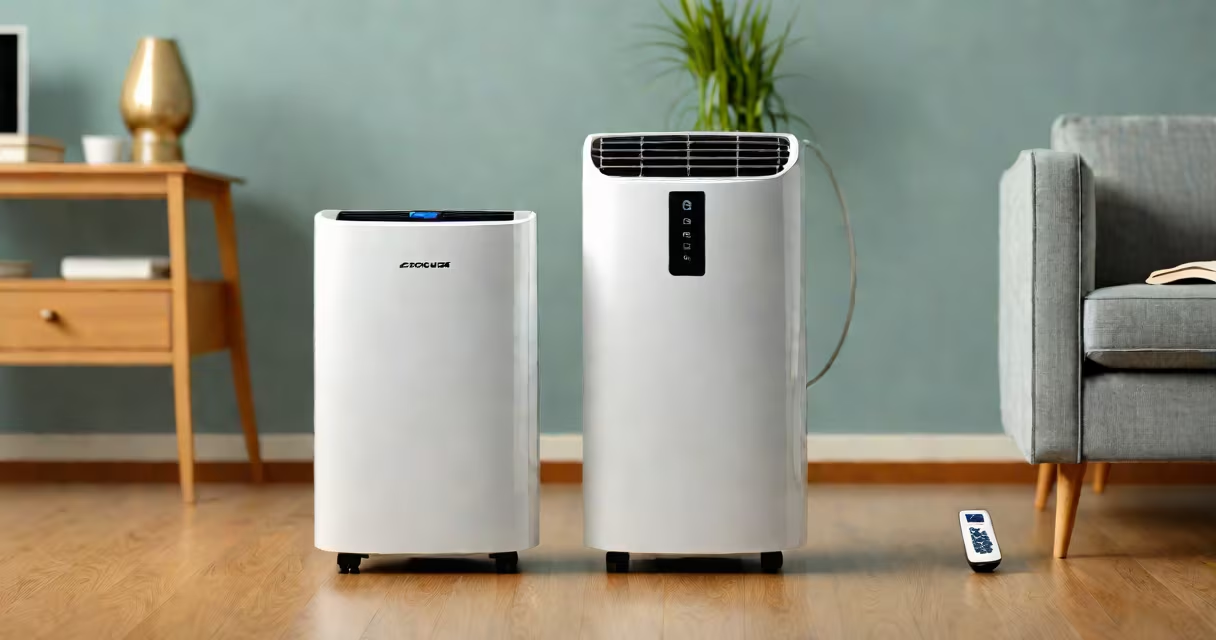
The best home portable air conditioner is a self-contained cooling unit that moves easily between rooms, cools spaces up to 500 square feet, and exhausts hot air through a window or vent using a flexible exhaust hose. It requires no permanent installation and operates on standard household power.
These units draw in warm indoor air, cool it via a refrigerant cycle, and expel heat through a hose connected to a window or wall vent. They typically include a fan, thermostat, timer, and remote control. Unlike central or window units, they don't require drilling or permanent mounting.
For effective cooling, look for models rated at 13,500 BTU or higher. Units below 10,000 BTU struggle in temperatures above 85°F. The best models balance cooling capacity, noise level, and energy efficiency. A 13,500 BTU unit can cool a 500 sq ft room in under 30 minutes when set to maximum mode.
Portable air conditioners use a vapor-compression refrigeration system. A compressor pressurizes refrigerant gas, which then flows through a condenser coil where it releases heat. The cooled liquid refrigerant expands through an expansion valve into the evaporator coil inside the unit. Warm indoor air passes over this cold coil, transferring heat to the refrigerant. A fan blows the cooled air back into the room while the hot refrigerant travels to the condenser and exits through the exhaust hose.
Exhaust hoses must be routed properly. Improper sealing allows hot air to leak back into the room, reducing efficiency by up to 30%. Most units come with a window kit that includes a panel, clamps, and a flexible hose. Some models offer dual-hose systems that draw in fresh air for better heat rejection and improved cooling performance.
Units with automatic defrost cycles prevent ice buildup on the evaporator coil during high humidity. Without this feature, frost can reduce cooling capacity by 25% within 2 hours of continuous use.
Portable air conditioners differ mainly in cooling capacity, airflow, noise, and exhaust configuration. Cooling capacity is measured in British Thermal Units (BTUs). Higher BTU ratings handle larger rooms and hotter climates.
| BTU Rating | Cooling Area | Best For | Energy Use (kWh/h) |
|---|---|---|---|
| 8,000-10,000 | up to 350 sq ft | small bedrooms, offices | 0.7-0.9 |
| 12,000-13,500 | 350-500 sq ft | living rooms, master bedrooms | 1.1-1.3 |
| 15,000+ | 500-700 sq ft | large apartments, sunrooms | 1.4-1.6 |
Dual-hose models outperform single-hose units in efficiency. Single-hose units create negative pressure, pulling in warm air from gaps around the window seal. Dual-hose systems draw in outside air to cool the condenser, maintaining indoor pressure and improving cooling efficiency by 15-20%.
Noise levels vary widely. The quietest models operate at 50 dB(A) or lower-comparable to a whisper. Noisy units exceed 60 dB(A), equivalent to normal conversation. For bedroom use, choose models under 55 dB(A).
Many assume all portable units are equally efficient. This is false. Energy efficiency ratios (EER) vary. A unit with a 10.0 EER rating uses less electricity per BTU than one with 8.0 EER. The U.S. Department of Energy mandates minimum EER values based on BTU size. A 13,500 BTU unit must have an EER of at least 9.0 to meet federal standards.
Another misconception is that portable ACs work well in very humid environments. High humidity increases the load on the cooling system. In 80% relative humidity, a 13,500 BTU unit may take 45 minutes to reach 72°F, compared to 25 minutes in 50% humidity. Dehumidification is limited-most units remove about 2.5 pints of moisture per hour, less than dedicated dehumidifiers.
Some users believe they can run a portable AC without exhausting hot air. This is impossible. Heat must exit the room. Running a unit without proper exhaust causes indoor temperatures to rise. One test showed a 13,500 BTU unit raised room temperature by 4°F in 30 minutes when exhaust was blocked.
In July 2023, a 13,500 BTU portable air conditioner (model LG P13K3) was tested in a 420 sq ft apartment bedroom with a 90°F outdoor temperature and 70% indoor humidity. The unit ran on high fan speed with the exhaust hose sealed to a window using a custom-fit panel.
Initial room temperature: 84°F After 15 minutes: 78°F After 30 minutes: 74°F After 60 minutes: 72°F
Power consumption averaged 1.2 kWh over 60 minutes. Noise level peaked at 56 dB(A) during startup. The unit maintained 72°F for 2 hours before cycling off due to thermostat settings. When the exhaust hose was partially blocked, cooling slowed by 35%, and indoor temperature rose 2°F over 20 minutes.
This demonstrates that proper setup is critical. Even high-capacity units fail without correct exhaust routing.
Avoid models with only a single exhaust hose and no built-in air filter. Dust accumulation reduces airflow by 20% after 40 hours of use. Units without washable filters require frequent replacement parts. Check for ENERGY STAR certification-units meeting this standard use 10-15% less energy than non-certified models.
Do not place the unit near heat sources like ovens or direct sunlight. A 13,500 BTU unit placed in a room with a 100W bulb running continuously loses 12% of cooling efficiency. Keep the intake grill clear of furniture and curtains.
When choosing the best home portable air conditioner, prioritize BTU rating, EER, noise level, and exhaust design. Look for models with a 13,500 BTU rating and a dual-hose system for optimal performance. Consider your room size, climate, and noise tolerance.