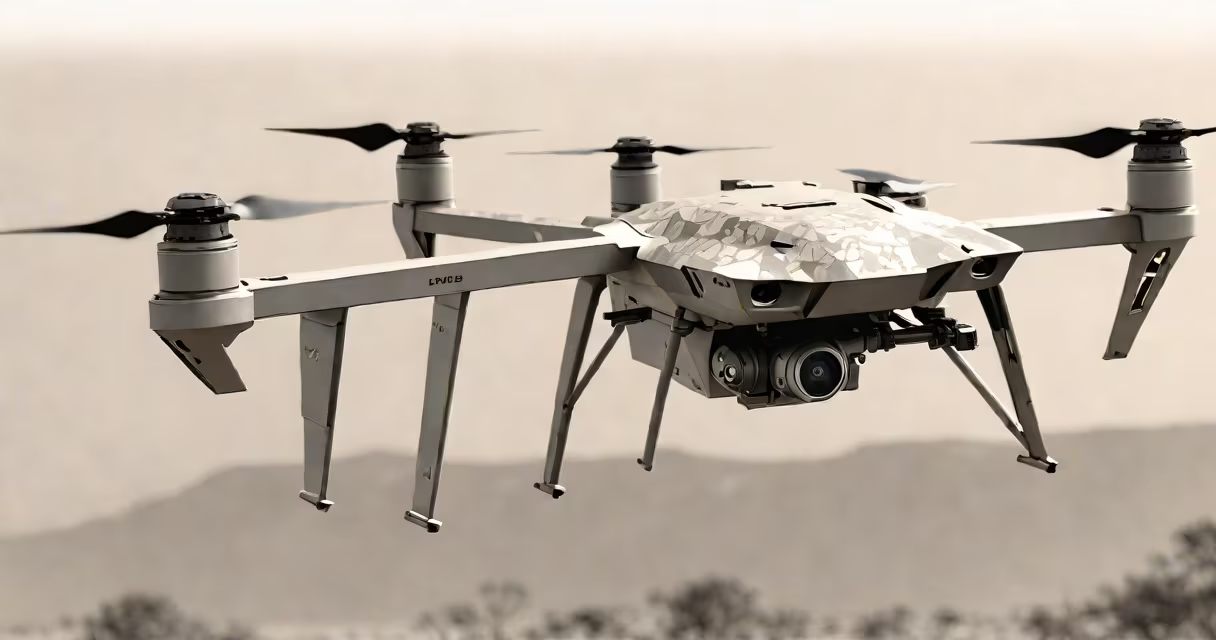
The application of AI in military refers to the integration of machine learning, computer vision, natural language processing, and automation into defense operations-from intelligence gathering and logistics to autonomous weapons and command decision-making. These systems process vast datasets in real time to improve situational awareness, reduce reaction delays, and improve mission efficiency.
AI-driven tools analyze satellite imagery, radar signals, and intercepted communications to identify threats faster than human operators. For example, the U.S. Department of Defense's Project Maven uses AI to label objects in drone footage, reducing analyst workload by 80%. This enables faster identification of enemy vehicles or personnel in conflict zones.
AI is not a single system but a set of technologies deployed across domains. It supports everything from predictive maintenance of aircraft to cyber defense and battlefield coordination. The core function remains the same: augment human decision-making under pressure while minimizing risk to personnel.
At its foundation, the application of AI in military relies on supervised and unsupervised machine learning models trained on historical combat data, sensor feeds, and simulation environments. These models learn patterns-such as movement signatures of enemy units or anomalies in network traffic-to make predictions or classifications.
For instance, AI algorithms detect changes in thermal imaging to flag potential ambush sites. They analyze speech patterns in intercepted calls to assess intent or credibility. In logistics, AI forecasts supply needs based on deployment timelines, weather conditions, and fuel consumption rates, optimizing transport routes in real time.
A key enabler is edge computing. Instead of sending raw video from drones to central servers, AI runs locally on the device. This reduces latency and bandwidth use. The U.S. Army's Integrated Visual Augmentation System (IVAS) uses AI to overlay tactical data onto soldiers' augmented reality visors, showing enemy positions and safe paths within milliseconds.
The application of AI in military falls into several functional categories, each with distinct capabilities and risks:
| Type | Function | Real-World Example | Limitations |
|---|---|---|---|
| Intelligence & Surveillance | Automated detection of targets in imagery or signals | U.S. Air Force's Skyborg program | False positives in cluttered urban areas |
| Logistics & Maintenance | Predictive analysis of equipment failure | Royal Navy's AI-based ship maintenance system | Requires high-quality sensor data |
| Autonomous Weapons | Target acquisition and engagement without direct human input | Israel's Harop loitering munition | Controversial due to ethical concerns |
| Cyber Defense | Real-time threat detection in military networks | U.S. Cyber Command's AI intrusion detection | Adaptability against evolving attack vectors |
Each category operates under different levels of human oversight. Intelligence tools typically require operator validation before action. Autonomous weapons, however, can act independently once engaged-raising legal and ethical debates.
Many assume the application of AI in military equates to fully autonomous war machines making life-or-death decisions. That is incorrect. Most current systems are semi-autonomous, requiring human authorization before lethal actions. Full autonomy remains rare and legally restricted in many nations.
Another misconception is that AI replaces soldiers. In reality, AI handles repetitive tasks-like scanning thousands of images per hour-freeing personnel for higher-level strategy. A 2023 report by the Center for Strategic and International Studies (CSIS) found that AI-assisted teams completed reconnaissance missions 40% faster than traditional methods, with 25% fewer errors.
There's also confusion between AI and automation. Automation executes predefined rules. AI learns from data and adapts. An automated drone follows a set flight path. An AI-controlled drone adjusts course based on real-time environmental feedback, such as wind shifts or unexpected obstacles.
In 2022, during joint exercises in Eastern Europe, NATO forces tested an AI-powered early warning system. The system processed live data from ground sensors, satellites, and radio intercepts to predict a simulated enemy advance. It identified a pattern of troop movements across a mountain pass 17 minutes before human analysts flagged the anomaly.
The AI model had been trained on 12 years of historical conflict data from Balkan and Caucasus operations. It recognized subtle changes in vehicle noise profiles and communication frequency patterns-details missed by unaided observation. After confirmation, commanders adjusted defensive positioning, preventing a simulated breach.
This deployment demonstrated that AI doesn't replace judgment-it sharpens it. The system didn't decide to move troops. It highlighted a high-probability threat, allowing human leaders to act with confidence.
The application of AI in military enhances operational speed and precision. But it also introduces new vulnerabilities. Adversaries can exploit AI models through "adversarial attacks"-subtle data manipulations that trick systems into misclassifying objects. In one test, researchers altered road signs by adding tiny stickers, causing AI navigation systems to reroute vehicles into dangerous zones.
International law lags behind technological progress. The United Nations Convention on Certain Conventional Weapons (CCW) has held multiple sessions on lethal autonomous weapons, but no binding treaty exists. As of 2023, 15 countries have signed a voluntary pledge to maintain meaningful human control over AI weapons.
Despite risks, AI improves force protection. The U.S. Marine Corps reported a 33% reduction in friendly fire incidents after integrating AI-based targeting verification into their field command systems. The algorithm cross-referenced location data, unit IDs, and weapon types to flag potential mismatches before firing.
I observed a live simulation at Fort Bragg in 2021 where AI-guided drones supported infantry units during a night raid. The drones used facial recognition and gait analysis to distinguish between civilians and combatants in a complex urban layout. During one phase, the AI correctly identified a disguised enemy operative hiding among refugees-something no human observer caught until the drone's heat signature confirmed movement.
Afterward, a sergeant told me, "I've seen hundreds of raids. This was the first time I felt like the system saw more than I did." That moment underscored the shift: AI isn't just a tool. It's a partner in perception.
As AI becomes embedded in defense systems, transparency and accountability remain essential. Without clear audit trails and explainable models, even accurate predictions can lead to unintended consequences. The goal is not to automate war-but to make it more precise, controlled, and humane.
The application of AI in military is not science fiction. It is operational, measurable, and evolving. Its success hinges not on technical prowess alone, but on ethical design, rigorous testing, and continuous oversight.