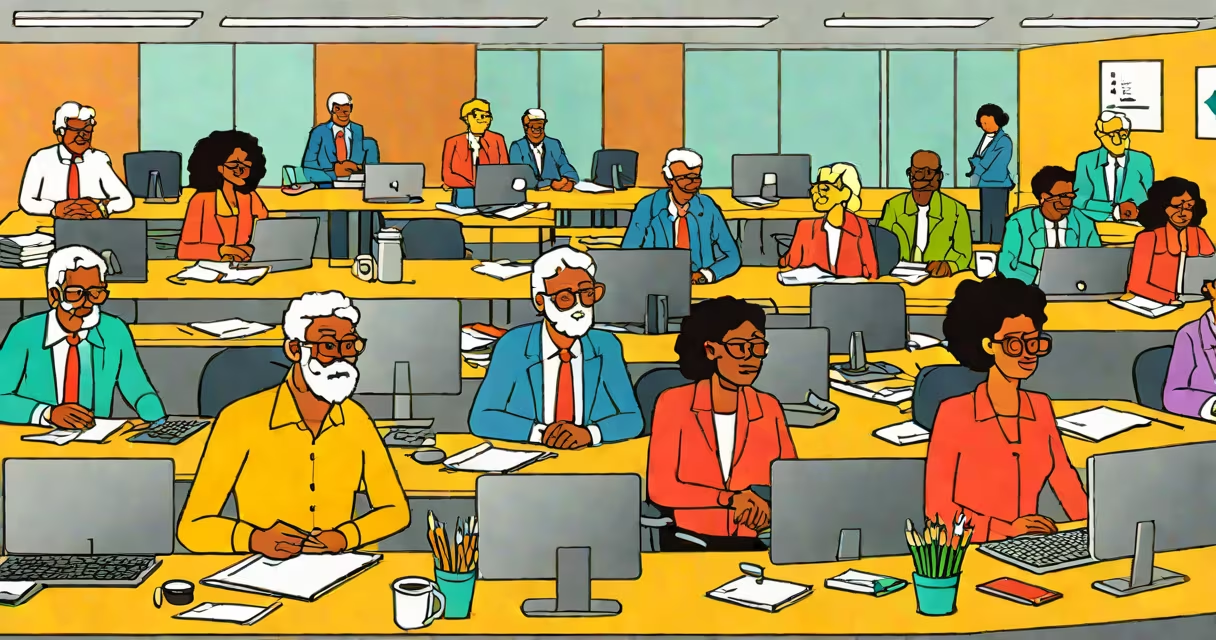
Age discrimination in the workplace occurs when an employee or job applicant is treated unfairly because of their age, particularly if they are 40 years old or older. This violates U.S. federal law and applies to hiring, promotions, pay, layoffs, and other employment decisions.
The Age Discrimination in Employment Act (ADEA) of 1967 prohibits employers from discriminating against workers aged 40 and above. The law covers private employers with 20 or more employees, state and local governments, employment agencies, and labor organizations. Employers cannot refuse to hire someone, demote them, reduce pay, or terminate them solely because of age.
Discrimination can be overt-like a manager saying "we don't want older people here"-or subtle. Examples include excluding older workers from training programs, assigning them less desirable tasks, or assuming they're less capable with technology. These actions may not be explicitly stated but still violate the ADEA.
Employers often justify age-based decisions using performance metrics or cost-cutting. For example, a company might lay off staff during a restructuring and disproportionately target older workers, claiming they are more expensive to retain. This is illegal if age is the deciding factor.
Another common scenario involves job postings that list "recent college graduate" or "digital native" as requirements. These phrases exclude qualified older applicants even when the skills needed are not tied to youth. The Equal Employment Opportunity Commission (EEOC) has challenged such language in court, ruling it discriminatory under the ADEA.
Retaliation is another form of violation. If an employee files a complaint about age bias and then faces negative consequences-such as being passed over for a promotion or assigned extra work-it's a breach of federal law.
There are two primary forms of age discrimination: disparate treatment and disparate impact.
| Type | Definition | Real Example |
|---|---|---|
| Disparate Treatment | Intentional bias based on age, such as denying a promotion because of age. | A 55-year-old manager was passed over for a senior role despite higher performance ratings than younger candidates. The reason given was "cultural fit," which the EEOC later found to be a cover for age bias. |
| Disparate Impact | Policies that appear neutral but disproportionately harm older workers. | A tech firm required all software developers to have five years of experience with a specific programming language. This excluded many experienced professionals who learned the skill earlier through different paths, leading to a class-action lawsuit. |
One non-obvious distinction: age discrimination claims require proof of intent or effect. Unlike race or gender cases, where bias is often visible, age bias can be masked by vague criteria. The EEOC emphasizes that employers must show legitimate business reasons for decisions affecting older workers, not just assumptions.
Age discrimination occurs across industries. In tech, older engineers are sometimes replaced during company restructurings. In healthcare, nurses over 50 report being pushed out of clinical roles despite decades of experience. Even in education, adjunct faculty over 50 face difficulty securing long-term contracts.
Root causes include stereotypes about older workers being less adaptable, slower to learn new tools, or more likely to retire soon. These beliefs are not supported by data. According to the U.S. Bureau of Labor Statistics, workers aged 55-64 have the highest labor force participation rate among all age groups, and older employees often show lower turnover and higher reliability.
Despite this, a 2021 study by AARP found that 64% of workers aged 45 and older reported experiencing age-related bias at work. Many felt pressured to stay silent due to fear of retaliation or being labeled "difficult."
One widespread myth is that age discrimination only affects those nearing retirement. In reality, the ADEA protects anyone 40 or older. A 42-year-old software engineer facing exclusion from leadership training is legally protected-even if they plan to work for another decade.
Another misconception: "I'm not getting laid off because of my age." But age can influence decisions indirectly. For example, a company might claim it's cutting costs by reducing staff, but if the cuts hit older workers disproportionately, it raises red flags under the ADEA.
Some believe that small businesses aren't covered. That's false. The ADEA applies to employers with 20 or more employees. Smaller firms may still be subject to state laws, which often offer stronger protections. California, for example, extends coverage to companies with just four employees.
If you believe you've been treated unfairly due to your age, document everything: dates, job descriptions, performance reviews, emails, and witness statements. Keep records of any conversations related to promotions, assignments, or layoffs.
File a complaint with the EEOC within 180 days of the incident. The agency investigates and may attempt mediation. If unresolved, you can sue in federal court. You don't need a lawyer to file, but legal representation improves your chances of success.
I once observed a case where a 58-year-old project lead at a mid-sized consulting firm was abruptly reassigned to a junior role after leading a high-profile client project. He had received positive evaluations for three consecutive years. After filing a formal complaint with the EEOC, the company reversed the decision and offered a settlement. The case highlighted how systemic bias can persist even in well-regarded firms.
Under the ADEA, victims can recover back pay, reinstatement, compensatory damages, and attorney fees. The maximum award for punitive damages is $300,000, adjusted annually for inflation.
Organizations can reduce risk by reviewing hiring practices, updating job descriptions, and training managers on unconscious bias. Avoid age-related language in job ads-instead of "recent grad," say "experience with X tools."
Implement structured interviews with standardized questions. Use objective criteria for promotions and performance reviews. Regularly audit workforce data to detect patterns of underrepresentation or unequal treatment by age group.
When conducting layoffs, apply consistent, documented criteria across all levels. If older workers are impacted, explain the rationale publicly and ensure the process is transparent. These steps align with both legal compliance and ethical standards.
Age discrimination in the workplace is illegal and actionable. Workers over 40 have clear rights under federal law. Employers must make decisions based on merit, not age. Recognizing and addressing bias strengthens teams, improves retention, and ensures fairness.