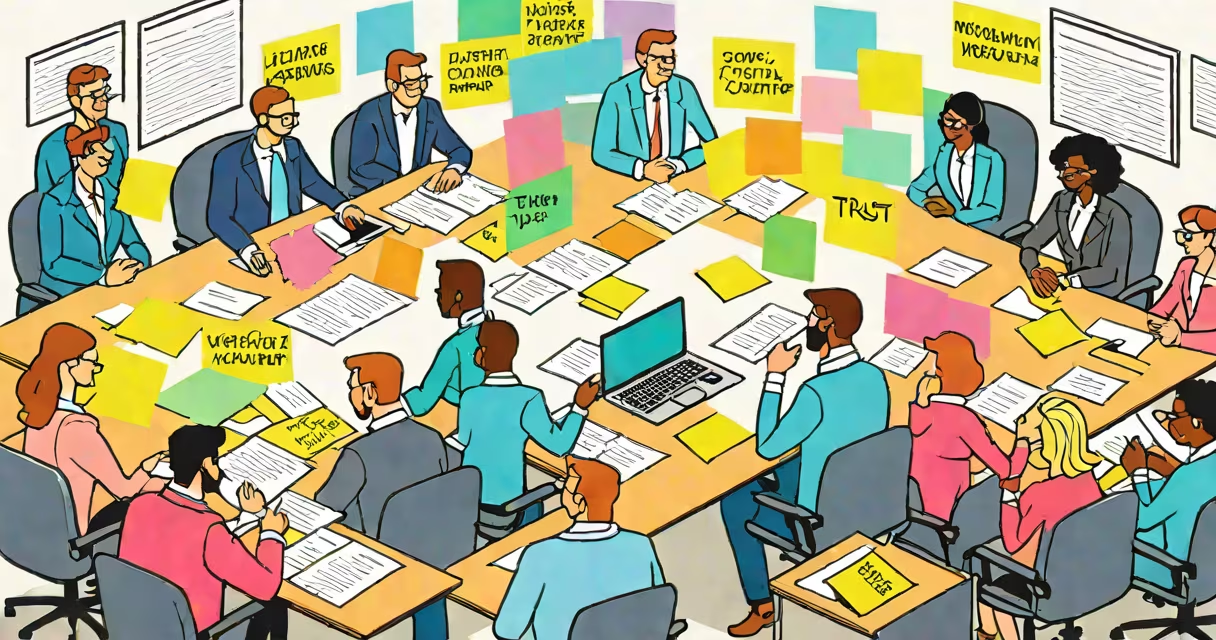
Words to describe work culture are specific terms that convey the shared values, behaviors, and norms within an organization. They reflect how people interact, make decisions, and perceive leadership. These descriptors go beyond surface-level traits like "friendly" or "busy" to capture deeper patterns of trust, autonomy, and accountability.
Work culture shapes everything from employee retention to innovation speed. A culture described as "transparent" means leaders share information openly and expect feedback. One labeled "results-driven" emphasizes measurable outcomes over process adherence. These aren't vague ideals-they're observable through daily interactions, meeting structures, and reward systems.
Understanding these terms helps employees assess fit, managers evaluate team health, and organizations benchmark against industry standards. The right vocabulary enables clear communication about what's working-or breaking-within a team.
These descriptors act as shorthand for complex social systems. When someone says a company has a "meritocratic" culture, they mean promotions and recognition are based on performance, not seniority or connections. This implies structured evaluations, public acknowledgment of achievement, and minimal favoritism.
Language shapes perception. Using "toxic" to describe a workplace signals high stress, poor boundaries, and frequent burnout. But "toxic" is subjective. More precise alternatives include "high-pressure," "demanding," or "emotionally charged." The latter three allow for nuance: a demanding culture may still support growth, while an emotionally charged one often erodes psychological safety.
At a tech startup I observed, the term "move fast" was used constantly. Over time, I noticed it masked a pattern of rushed decisions, skipped documentation, and recurring rework. The word "fast" didn't reflect efficiency-it reflected a culture prioritizing velocity over quality. That distinction matters when evaluating long-term sustainability.
Organizations typically fall into one of several culture archetypes. Each has distinct behavioral markers and associated language.
| Culture Type | Key Traits | Descriptive Words | Real-World Example |
|---|---|---|---|
| Collaborative | Team-based decision-making, shared goals | inclusive, supportive, transparent | Google's early engineering teams emphasized peer review and cross-functional pairing. |
| Hierarchical | Clear chain of command, top-down direction | structured, disciplined, formal | U.S. military units operate under strict hierarchy, with defined roles and limited deviation. |
| Autonomous | Individual ownership, minimal oversight | self-directed, new, flexible | Basecamp's remote-first model gives employees full control over their schedules and workflows. |
| Performance-Focused | Results measured rigorously, high accountability | driven, competitive, outcome-oriented | Amazon's leadership principles emphasize "deliver results" and "dive deep" in execution. |
These types aren't mutually exclusive. A company can be both autonomous and performance-focused-like a sales team where reps set their own targets but are evaluated weekly on conversion rates. The key is identifying which traits dominate the experience.
Many assume "culture" is synonymous with perks-free snacks, nap pods, or casual dress codes. But those are symptoms, not causes. A culture described as "fun" may lack psychological safety. Employees might smile during meetings but avoid speaking up in conflict.
Another common error is equating "positive" with "healthy." A culture can be upbeat and energetic while being exclusionary or unsustainable. For example, a finance firm with high morale but constant overtime and low promotion diversity may be "positive" on the surface but "unfair" in practice.
According to Harvard Business Review, 75% of employees report feeling disconnected from their company's stated values. That gap exists because many organizations use vague terms like "team player" or "go-getter" without defining them. Without clarity, these words become empty slogans.
When describing a workplace, choose terms grounded in behavior, not emotion. Instead of saying "this place feels toxic," observe: "There are no regular check-ins between managers and reports," or "feedback is delivered publicly and critically." These observations lead to accurate descriptors like "unsupportive" or "publicly critical."
Use the structure: Behavior → Pattern → Descriptor. For example:
This method prevents mislabeling. Calling a culture "aggressive" when it's actually "assertive" changes how you interpret it. Aggressive implies hostility; assertive suggests confidence without disrespect.
I once interviewed a candidate who described her last job as "high-energy." On further questioning, she explained that meetings lasted 90 minutes with no agenda, and decisions were made in real time without follow-up. The correct descriptor wasn't "high-energy"-it was "chaotic" or "disorganized." The word choice changed the entire assessment.
Words to describe work culture are tools for clarity, not buzzwords. They help individuals assess fit, leaders diagnose issues, and teams align on values. Avoid vague labels like "good" or "bad." Be specific: "structured," "supportive," "ambiguous," "rigid."
Use precise language to reflect reality. When you can name the culture accurately, you can either thrive within it or decide whether to leave. The right words don't just describe a workplace-they reveal its inner workings.