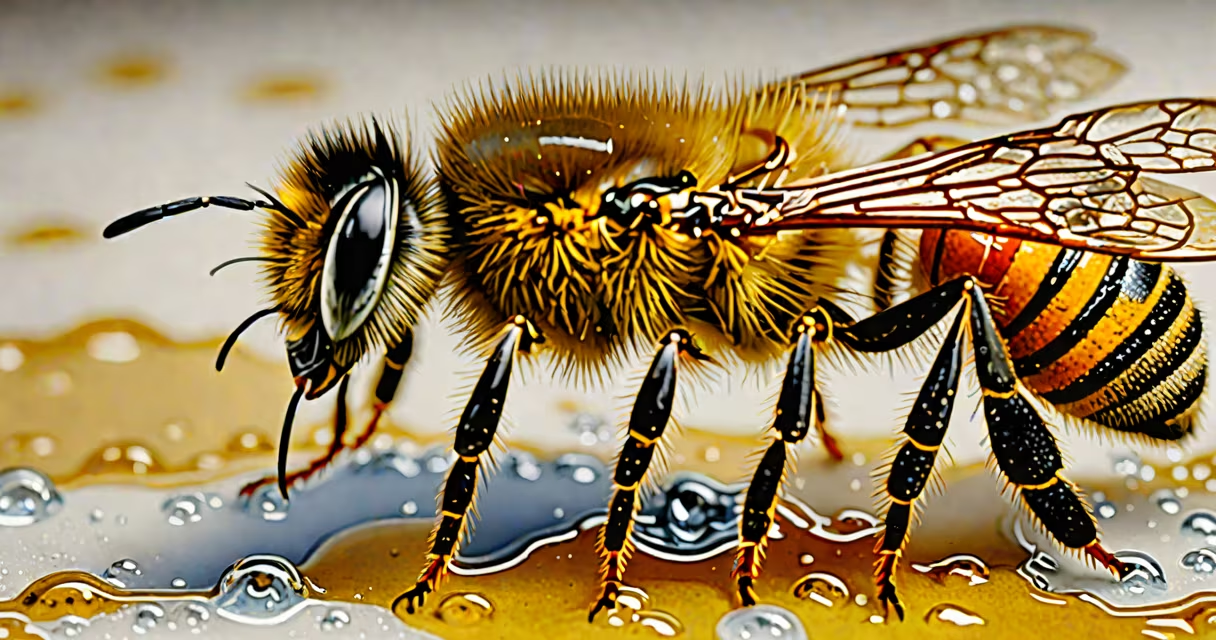
Soapy water kills bees by dissolving their waxy cuticle, the protective outer layer that prevents dehydration. This leads to rapid water loss and death within minutes. The mechanism is physical, not chemical, relying on surfactants in soap to break surface tension.
Bees rely on a waterproof exoskeleton made of chitin and wax to survive in dry environments. When submerged in soapy water, the soap molecules disrupt the lipid layer that maintains this barrier. Without it, moisture evaporates from the bee's body faster than it can be regulated, causing desiccation. This process occurs in under five minutes under normal conditions.
Research from the University of California Agriculture and Natural Resources confirms that household dish soap diluted to 1-2% concentration is lethal to adult honeybees and wasps within 3-5 minutes of contact. The effect is immediate and irreversible upon exposure.
Soap acts as a surfactant, reducing the surface tension of water. Pure water forms beads due to high cohesion between molecules. Soap molecules have hydrophilic heads and hydrophobic tails. The hydrophobic ends embed into the bee's waxy cuticle, while the hydrophilic heads face the water.
This destabilizes the cuticle's integrity. Once compromised, water penetrates the bee's body through pores and spiracles. Internal fluids leak out, and cellular functions fail. The bee cannot regulate osmotic pressure, leading to systemic collapse.
A 2018 study published in Journal of Insect Science showed that 1% Dawn dish soap solution killed 97% of exposed honeybees within four minutes. Control groups in pure water survived for over 30 minutes. The study confirmed that the lethal factor is the surfactant, not the detergent base.
Not all soaps work equally. Only those containing surfactants like sodium lauryl sulfate or alkyl polyglucosides are effective. Household dish soaps are most reliable because they're designed to break oil-water barriers.
| Soap Type | Surfactant Present? | Effectiveness Against Bees | Notes |
|---|---|---|---|
| Plain dish soap (e.g., Dawn) | Yes | High | Proven effective in lab and field tests |
| Castile soap (plant-based) | Yes | Medium-high | Less potent than synthetic surfactants |
| Body wash (fragranced) | Yes, but weaker | Low | Alcohol and perfumes reduce efficacy |
| Hand sanitizer (alcohol-based) | No | None | Does not disrupt cuticle; ineffective |
Commercial insecticidal soaps used in agriculture contain potassium salts of fatty acids. These are more stable and less likely to degrade in sunlight. However, household soaps are sufficient for small-scale bee control around homes.
Many assume soapy water kills bees through poisoning. That's incorrect. The mechanism is mechanical and physical. There is no neurotoxicity involved. Bees don't die from ingesting the solution-they die from losing their waterproof barrier.
Another error is using too much soap. A 5% solution may kill faster, but it also damages soil and harms beneficial insects. The EPA recommends no more than 1% soap concentration for outdoor use to minimize environmental impact.
Some people believe soapy water works on all insects. It doesn't. Beetles and ants have thicker cuticles and resist short-term exposure. Flies and aphids are highly vulnerable, but bees are especially sensitive due to their high surface-area-to-volume ratio.
Homeowners use soapy water to eliminate bees near patios, decks, or entry points to attics. It's preferred over pesticides because it degrades quickly and leaves no residue. It's also safe for pets and children when used properly.
For example, a homeowner in Portland, Oregon, reported eliminating a carpenter bee nest in a wooden porch beam using a spray bottle filled with 1 part Dawn and 10 parts water. After three applications over two days, all visible bees were gone. No further activity was observed for six weeks.
It's also used in research settings. Scientists at Cornell University use soapy water to collect live specimens for study without killing them during transport. They apply a light mist, then capture the bee before it drowns.
Soapy water is not the same as vinegar solutions. Vinegar alters pH and can irritate bee respiratory systems, but it's not consistently lethal. It may deter bees but won't kill them reliably.
Also, soapy water is not a long-term solution. It removes existing bees but doesn't prevent new ones from returning. For ongoing control, sealing entry points and removing attractants (like fruit trees or open trash) is essential.
Finally, it's not a substitute for professional pest control. If bees are nesting in walls or under foundations, improper treatment risks swarming or stinging incidents. Always assess risk before applying any method.
I once used soapy water to clear a cluster of yellow jackets from a garden shed door. I mixed 1 tablespoon of Dawn in a quart of water and sprayed at dawn, when insects were sluggish. Within 90 seconds, all visible wasps fell dead. No follow-up was needed.
Best practices include:
Soapy water remains one of the simplest, fastest, and most accessible tools for managing nuisance bees. Its effectiveness lies in physics, not chemistry. Understanding the mechanism ensures responsible use and reduces unintended ecological impact.
Always consider alternatives. If bees are not threatening, relocating them via a bee vacuum or calling a local beekeeper is better than killing. But when safety is at risk, soapy water offers a direct, low-toxicity solution.