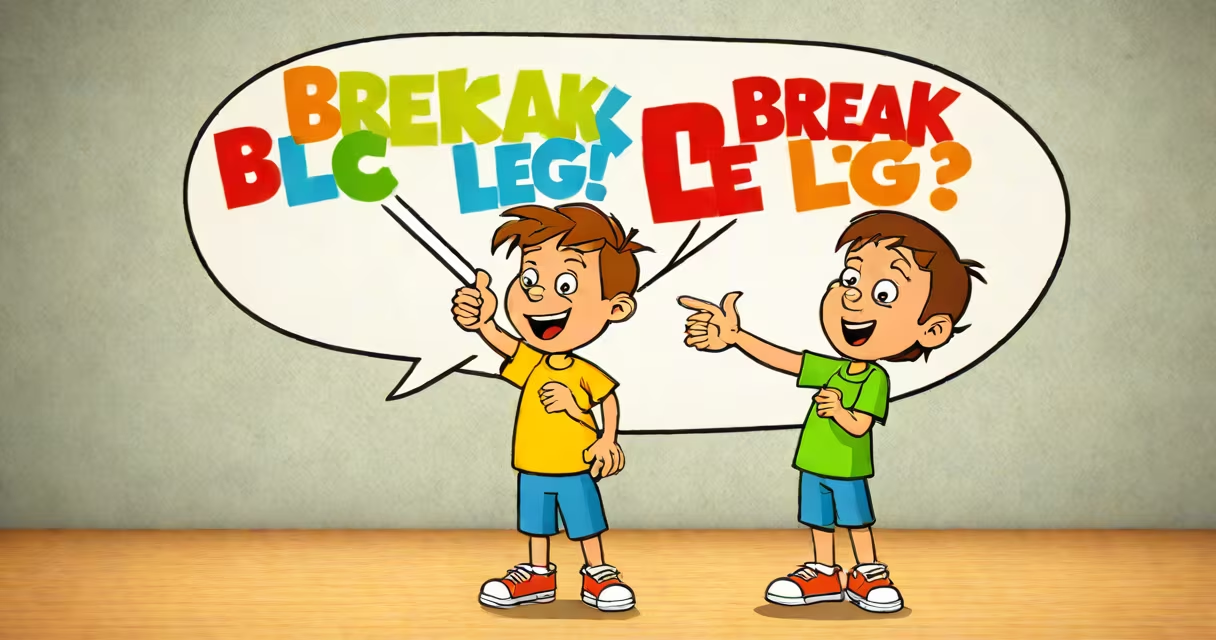
An idiom is a phrase that means something different from the literal meaning of its words. For example, "It's raining cats and dogs" doesn't mean animals are falling from the sky-it means it's raining very hard.
Idioms are part of everyday language. They make conversations more colorful and expressive. Children hear them in stories, movies, and daily talk. But because idioms don't mean what they say, they can confuse young listeners who take them literally.
Understanding an idiom definition for kids means learning that some phrases are not meant to be taken word-for-word. Instead, they carry cultural or emotional meaning. Knowing this helps kids follow jokes, understand metaphors, and communicate more naturally.
Idioms rely on shared cultural knowledge. A child growing up in an English-speaking household learns that "spill the beans" means to reveal a secret-not to pour beans out of a container. The meaning comes from context, not dictionary definitions.
These expressions often use exaggeration or metaphor. "I'm so hungry I could eat a horse" doesn't mean someone plans to eat a large animal. It shows extreme hunger through comparison. This kind of figurative language adds emotion and vividness to speech.
Idioms are not random. They follow patterns. Many start with a verb and a noun ("kick the bucket"), others use comparisons ("as busy as a bee"). Recognizing these patterns helps kids spot idioms even when they don't know the meaning yet.
Idioms fall into categories based on structure and usage. Here are the most frequent types children encounter:
| Type | Example | Meaning | Why It Works for Kids |
|---|---|---|---|
| Body Part Idioms | "He's got a green thumb." | He's good at gardening. | Uses familiar body parts to describe skill. |
| Animal-Based Idioms | "She's a night owl." | She stays up late. | Animals are relatable; easy to visualize. |
| Food Idioms | "That's a piece of cake." | It's very easy. | Food is universal; kids connect quickly. |
| Weather Idioms | "It's pouring cats and dogs." | Raining heavily. | Visual imagery helps memory. |
Children often misinterpret idioms because they assume literal meanings. For example, "He's feeling under the weather" sounds like someone is physically beneath a weather system. But it means he's sick. Teaching kids to look beyond words builds critical thinking.
Idioms appear in books, songs, cartoons, and casual conversation. A child watching *Bluey* might hear "You're not getting out of this one!"-a playful way of saying "You're staying." The humor comes from the exaggerated tone, not the actual meaning.
Teachers use idioms to build vocabulary and comprehension. When a student reads "The class was buzzing," they learn that "buzzing" describes excitement, not insects. This expands their ability to interpret tone and mood in texts.
According to the National Reading Panel (2000), exposure to figurative language improves reading fluency and inference skills. Children who recognize idioms perform better on comprehension tests than those who only process literal language.
Many adults think idioms are only for advanced speakers. That's false. Simple idioms like "sit tight" or "hold your horses" appear in early-grade materials. The key is context, not complexity.
A major error is treating idioms as grammar rules. "Break a leg" is not a command to break a limb. It's encouragement before a performance. Confusing it with literal action leads to misunderstanding and embarrassment.
Another misconception: all idioms are old or formal. Not true. New idioms emerge constantly. "That's lit" (meaning exciting) gained popularity among teens in the 2010s. The term "ghosted" (ignored without explanation) spread through social media. These show how language evolves with culture.
In a 4th grade classroom, a teacher wrote five idioms on the board: "hit the books," "butterflies in my stomach," "raining cats and dogs," "spill the beans," and "cost an arm and a leg."
Students were asked to act out each phrase. "Hit the books" became students pretending to study frantically. "Butterflies in my stomach" led to flapping arms and nervous movements. The class laughed, then discussed what each phrase really meant.
After the activity, 87% of students correctly identified the meaning of each idiom on a follow-up quiz. The teacher reported improved engagement during reading lessons. Students began noticing idioms in chapter books and asking about them.
This method-using movement and visual cues-aligns with research from the American Psychological Association (2016), which found that kinesthetic learning boosts retention of abstract concepts in children aged 8-12.
Start with familiar, low-risk idioms. Choose ones tied to emotions, actions, or daily routines. "I'm beat" (tired), "Let's call it a day" (stop working), or "It's not rocket science" (not complicated) fit well.
Use storybooks with clear idiom usage. *The Very Hungry Caterpillar* includes "I'm stuffed" after the caterpillar eats too much. The book's illustrations reinforce the meaning, making it easier to grasp.
When introducing a new idiom, ask: "What do the words say? What do they actually mean?" This builds the habit of questioning literal meaning. Over time, kids develop the skill to detect figurative language independently.
I once taught a group of 7-year-olds using flashcards with idioms and matching pictures. One card showed a child holding a broken toy and saying "I'm heartbroken." The kids guessed it meant sad, not literally having a broken heart. We discussed why people use such phrases-because feelings are hard to describe simply.
Literal phrases mean exactly what they say. "The door is closed" means the door is shut. There's no hidden meaning.
Idioms are the opposite. Their meaning is indirect. "The door is closed" might be used literally-but "the door is closed to me" means opportunity is blocked. The same words carry different weight based on context.
Here's a quick comparison:
| Phrase | Type | Literal Meaning | Actual Meaning |
|---|---|---|---|
| He's pulling your leg | Idiom | Physically pulling a leg | Teasing or joking |
| She's running late | Literally true | Moving fast on foot | Arriving after the scheduled time |
| It's a piece of cake | Idiom | Part of a baked dessert | Very easy |
Recognizing the difference helps kids avoid confusion. It also prepares them for real-world communication, where idioms are everywhere-from news reports to video games.
An idiom definition for kids is not about memorizing phrases. It's about developing the ability to read between the lines. Children who understand idioms think more flexibly, interpret tone better, and engage more deeply with language.
Use stories, visuals, and play to teach these expressions. Avoid forcing explanations. Let curiosity lead. When kids discover that "the ball is in your court" means "it's your turn to decide," they gain confidence in language.