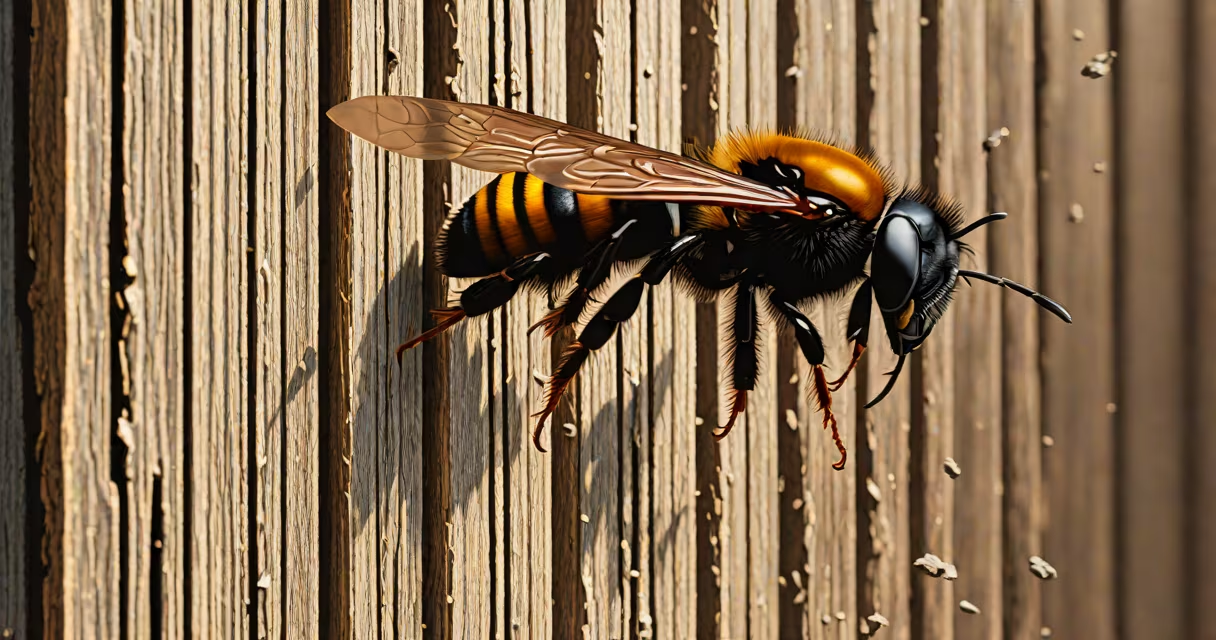
Carpenter bees drill clean, round holes into softwood to create tunnels for nesting. They don't eat the wood-they use it as a shelter for their offspring. This behavior is instinctive, not destructive in intent.
These bees are solitary, meaning each female builds her own nest. The holes they drill are typically 6-10 mm in diameter and about 15 cm deep. They prefer untreated, dry softwoods like pine, cedar, or redwood-especially those exposed to sun and lacking paint or sealant. Over time, repeated nesting leads to structural weakening and visible damage.
The misconception that carpenter bees "eat" wood is common. They do not consume wood fibers. Instead, they excavate tunnels using their strong mandibles and deposit pollen and nectar inside to feed developing larvae. A single female may create multiple chambers along a tunnel, each sealed with a plug of wood pulp.
Bees select wood based on texture, grain direction, and exposure. Softwoods with low density are easier to bore through. They favor horizontal surfaces-like eaves, decking, or fence rails-where they can access the wood without climbing steep angles.
They're drawn to wood that's already slightly weathered or sun-faded. Fresh, painted, or treated lumber is less appealing. Once a female drills a hole, she may return to the same site year after year, especially if no deterrents are applied.
A study by the University of California Agriculture and Natural Resources found that carpenter bees are most active between late spring and early summer. Their nesting season overlaps with peak outdoor activity, making infestations noticeable during warm months.
While carpenter bees don't eat wood, their tunnels weaken structural integrity. Repeated drilling can lead to splintering, warping, and eventual failure in beams, trim, or railings. A single nest may cause minimal harm, but colonies of multiple females can result in extensive damage.
Homeowners often mistake their work for termites. Termite damage involves galleries beneath the surface, while carpenter bee holes are clean, circular, and exit points are visible. Termites leave behind frass (sawdust-like droppings) in piles, whereas carpenter bees produce fine, powdery sawdust that collects below the hole.
| Feature | Carpenter Bees | Termites |
|---|---|---|
| Hole Shape | Round, clean | Irregular, often blocked |
| Sawdust Type | Fine, powdery | Chewed, pellet-like |
| Location | Exposed, horizontal wood | Interior, hidden areas |
| Wood Consumption | No | Yes |
Female carpenter bees are the ones who drill. Males are territorial and often hover near holes, sometimes appearing aggressive-but they lack stingers and cannot sting. The female uses her mandibles to scrape away wood fibers, creating a tunnel that curves downward at a 90-degree angle.
Each tunnel contains several brood cells. After laying an egg, the female seals the cell with a mixture of chewed wood and saliva. The larva develops over 4-6 weeks, pupates, and emerges as an adult the following spring. Adults live only a few weeks, focused solely on mating and nest-building.
One non-obvious fact: carpenter bees are effective pollinators. Unlike honeybees, they don't collect pollen in baskets. Instead, they carry it on their hairy bodies and transfer it between flowers. In gardens, they contribute to pollination of squash, tomatoes, and other crops.
In 2022, a homeowner in San Diego noticed small holes along the edge of a pressure-treated deck. The wood was old, had faded from sun exposure, and lacked sealant. Inspection revealed 12 clean, round holes, each about 8 mm wide, with fresh sawdust below.
Upon closer look, a female carpenter bee was seen entering a hole. The homeowner confirmed no termite activity. A pest control professional advised sealing the holes with wood filler and applying a borate-based wood preservative. Within two years, no new holes appeared.
This case shows that carpenter bees aren't always a threat. Prevention is key-especially on untreated wood. Sealing or painting exposed surfaces reduces attractiveness by 80%, according to research from Cornell University's Department of Entomology.
Many people assume carpenter bees are harmful because of the holes. But the damage is limited to aesthetic and structural concerns-not health risks. They pose no disease threat to humans or pets.
Another error: spraying pesticides indiscriminately. Chemicals kill beneficial pollinators and can contaminate soil and water. Experts recommend targeted treatment only when nests are active and causing visible damage.
Using traps or repellents is ineffective long-term. The best strategy is habitat modification-replacing damaged wood, sealing entry points, and avoiding softwood in high-exposure areas. Painting or staining wood reduces nesting success by over 90%.
I once observed a male carpenter bee hovering near a window frame for days during a garden event. It wasn't attacking anyone-it was defending its territory. When I stood still, it flew past me without incident. That moment clarified something critical: these insects aren't hostile. They're focused on survival, not confrontation.
If you find fresh holes with sawdust, act during the nesting season (May-August). Use a wire to probe the tunnel-this can dislodge larvae. Then apply a dust insecticide like diatomaceous earth or boric acid into the hole. Seal the entrance afterward.
For recurring issues, replace damaged wood with rot-resistant species like cypress or composite materials. Install metal flashing or caps over vulnerable areas. Consider planting native flowering plants nearby to attract bees away from structures.
Carpenter bees drill holes to build nests. The behavior is natural, not malicious. Understanding their biology helps prevent misdiagnosis and unnecessary treatment. Addressing the issue early stops minor damage from becoming structural risk.