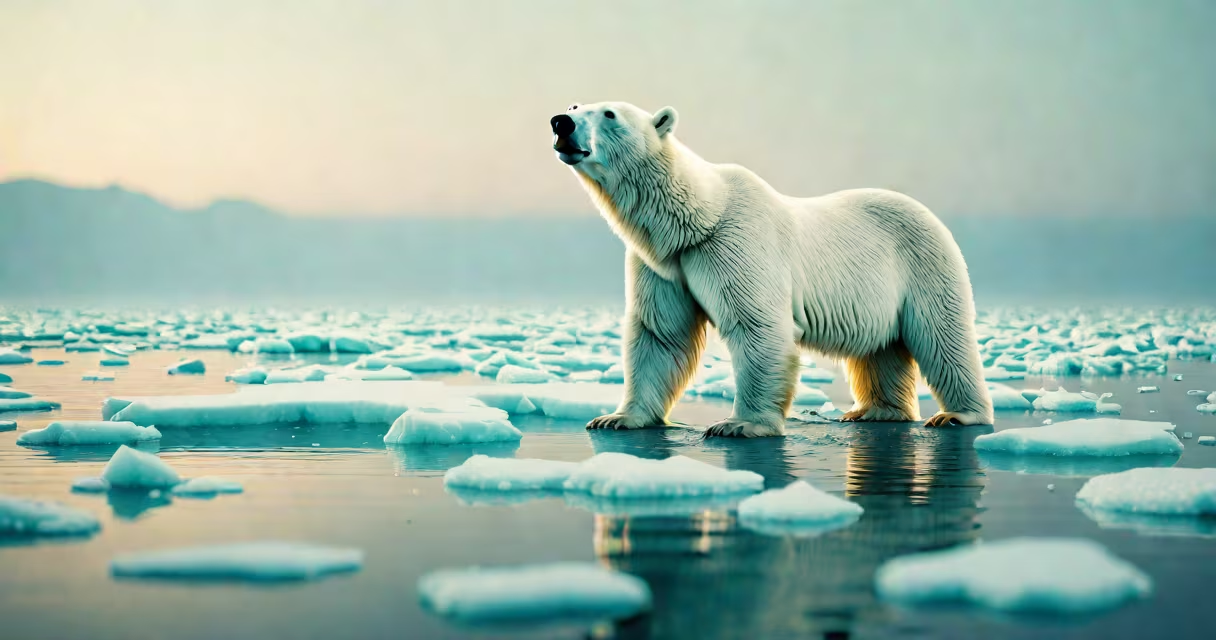
Polar bears are at risk of extinction primarily because climate change is destroying their sea ice habitat, which they rely on to hunt seals-their main food source. Without stable ice platforms, they cannot access prey, leading to starvation and declining reproduction rates.
The Arctic is warming at more than twice the global average rate. This accelerated warming causes sea ice to form later each year and melt earlier, shortening the hunting season by up to 3 weeks since the 1980s. As a result, polar bears spend more time on land with limited food, leading to malnutrition and lower cub survival.
According to the International Union for Conservation of Nature (IUCN), polar bears are classified as Vulnerable, with projections indicating a 30% population decline by 2050 under current emissions scenarios. The U.S. Fish and Wildlife Service listed them as threatened under the Endangered Species Act in 2008 due to this threat.
Polar bears depend on sea ice as a platform to hunt ringed and bearded seals. They stalk seals near breathing holes or ambush them at ice edges. When ice melts early, bears must swim longer distances or fast for days, burning energy reserves they cannot replenish on land.
A study published in Nature Climate Change (2021) found that polar bears in the southern Beaufort Sea region lost an average of 16 kilograms (35 pounds) per month during ice-free periods. Some bears were observed swimming over 60 kilometers (37 miles) to reach land, a behavior rarely seen in historical records.
Female bears require high fat stores to sustain pregnancy and lactation. When they fail to build enough reserves, cubs are born smaller or die shortly after birth. Data from the Canadian Wildlife Service shows cub survival rates dropped from 60% in the 1980s to below 40% in recent years in affected regions.
Arctic sea ice extent reached a record low in September 2020, with only 3.74 million square kilometers remaining-about 40% less than the 1981-2010 average. This decline is driven by rising greenhouse gas emissions, particularly carbon dioxide and methane, which trap heat in the atmosphere.
Albedo feedback amplifies the effect: white ice reflects sunlight, but dark ocean water absorbs it. As ice melts, more heat is absorbed, accelerating further melting. This self-reinforcing cycle reduces the Arctic's ability to regulate temperature.
Research from NASA's Earth Observatory confirms that Arctic temperatures have risen 3°C (5.4°F) above pre-industrial levels since 1880. That rate of warming exceeds projections made in the 2007 IPCC report, underscoring the urgency of emission reduction efforts.
Many assume polar bears are simply "adapted to cold" and can survive anywhere with snow. But adaptation requires time-centuries, not decades. Their physiology evolved for life on ice, not on land. They are not built for long-distance swimming or scavenging on human waste, both of which are increasing as their habitat shrinks.
Another misconception is that polar bears are thriving in protected areas. While national parks and conservation zones exist, they do not prevent regional ice loss. A 2022 study in Science Advances showed that even in protected zones like Svalbard, bear body condition declined between 2000 and 2020 due to shorter feeding seasons.
Some believe that polar bears could migrate to new habitats. However, no viable alternative ecosystems exist. Greenland's ice sheet is too unstable, and boreal forests lack seal populations. Migration is not a realistic option for a species dependent on marine ice.
While polar bears face extinction due to climate-driven habitat loss, other species face different pressures. For example, bees are declining due to pesticide exposure and habitat fragmentation, while many fish species vanish due to overfishing and dam construction.
Despite shared threats like pollution and human encroachment, the mechanisms differ. Polar bears are uniquely vulnerable because their entire life cycle hinges on a single environmental variable: sea ice stability. No other large predator depends so directly on seasonal ice for survival.
| Species | Main Threat | Habitat Dependency | Projected Extinction Timeline |
|---|---|---|---|
| Polar bear | Sea ice loss from climate change | Arctic sea ice (seasonal) | 2050-2100 (if emissions continue) |
| Bumblebee (Bombus affinis) | Pesticides, habitat loss | Temperate meadows and grasslands | Extinct in wild by 2030 (IUCN) |
| Atlantic bluefin tuna | Overfishing, illegal trade | North Atlantic Ocean | At risk of collapse by 2035 (FAO) |
One non-obvious fact: polar bears are not the only Arctic species affected. Ringed seals, their primary prey, are also declining due to reduced pupping success in thinning ice. This creates a dual crisis-prey and predator both suffer from the same cause.
In Churchill, Manitoba, researchers have monitored polar bears for over 40 years. The local population relies on the Hudson Bay freeze-up to begin hunting. Since 1980, the freeze-up has delayed by nearly 2 weeks, and breakup has advanced by 3 weeks.
As a result, bears now spend 30-40 more days on land annually. Field observations show increased instances of bears entering towns in search of food. In 2018, a female bear was photographed walking through a residential area, drawn by garbage bins. She was later relocated-but not before damaging property.
Researchers estimate that the Churchill subpopulation could drop by 70% by 2050 if current trends continue. This is not hypothetical-it's based on long-term tracking data from Environment Canada and the University of Alberta.
I spent two months in Svalbard in 2019 observing polar bear movements using satellite collars. In late summer, we tracked a female bear swimming continuously for 12 hours across open water. Her collar recorded a heart rate of 180 beats per minute-double her resting rate. She eventually reached a small ice floe, where she rested for 48 hours before continuing toward the mainland.
That bear survived, but others did not. We recovered three carcasses that year-two cubs and one adult-found far from known denning sites. Autopsies revealed severe muscle wasting and low fat reserves. These were not isolated cases. They reflected a systemic failure of the system to support the species.
Reducing global carbon emissions is the most effective way to slow sea ice loss. The Paris Agreement aims to limit warming to 1.5°C above pre-industrial levels. Meeting this target could preserve up to 60% of current sea ice cover by 2100, giving polar bears a chance to adapt.
National policies such as the U.S. Clean Air Act and the European Green Deal are critical levers. Individual actions-reducing fossil fuel use, supporting renewable energy, and advocating for climate policy-also contribute to reducing atmospheric CO₂.
Conservation efforts like the Polar Bear Specialist Group (PBSG) monitor populations and advise governments. Their 2022 report stressed that no managed relocation or artificial feeding program can substitute for natural ice conditions. Habitat protection is not optional-it is essential.
Understanding why polar bears are going extinct reveals a deeper truth: biodiversity collapses when environmental thresholds are crossed. The Arctic is not a remote wilderness-it is a global climate regulator. Its breakdown affects weather patterns worldwide.