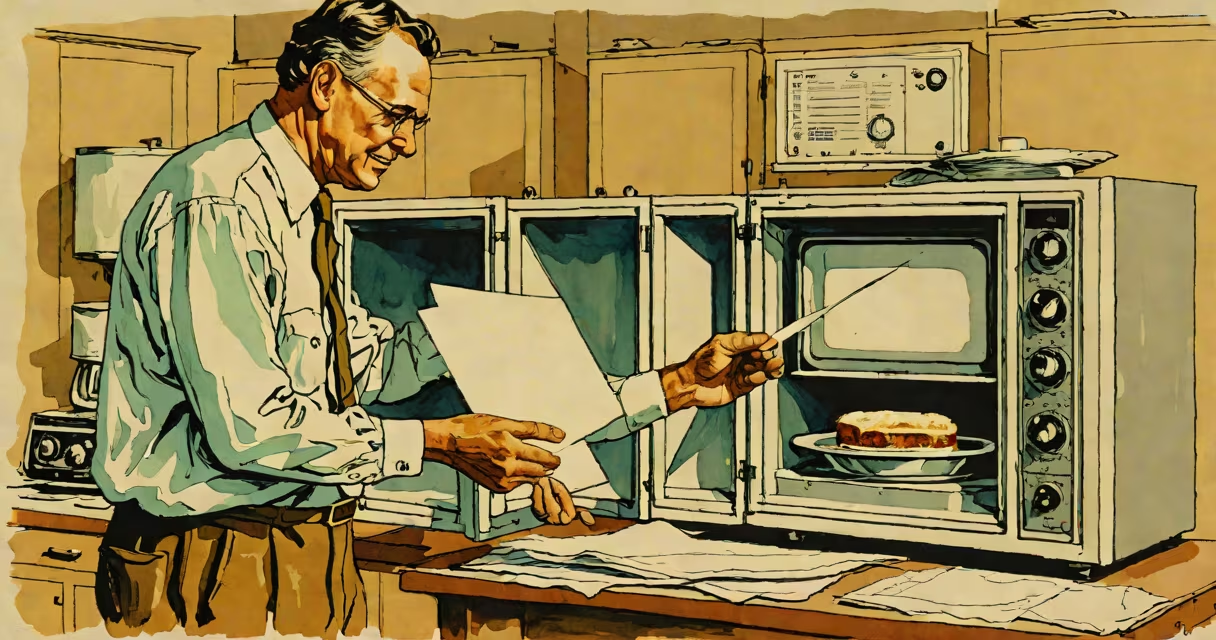
Percy Spencer, an American engineer working for Raytheon, invented the microwave oven in 1945 after observing that a candy bar melted in his pocket while he stood near an active radar magnetron. The device uses electromagnetic waves at 2.45 GHz to agitate water molecules in food, generating heat through dielectric heating.
Spencer's discovery stemmed from his work on magnetrons-vacuum tubes that generate high-power microwaves for radar systems during World War II. While testing a magnetron, he noticed that the intense radiation caused a nearby chocolate bar to melt. He then tried directing the beam at popcorn kernels, which popped instantly. This led him to test a raw egg, which exploded due to rapid internal pressure buildup. These experiments confirmed that microwave energy could cook food quickly and efficiently.
Raytheon filed a patent for the microwave cooking process in October 1945, and the first commercial microwave oven, the Radarange, was released in 1947. It weighed 750 pounds, stood six feet tall, and cost $5,000-far too large and expensive for home kitchens. It was initially used in restaurants, railcars, and military mess halls.
Inside a microwave oven, a magnetron produces microwaves at a frequency of 2.45 gigahertz. This frequency targets water, fat, and sugar molecules, causing them to vibrate rapidly. The vibration generates friction, which produces heat within the food itself-not just on the surface. This allows for faster cooking compared to conventional ovens, which rely on external heat transfer.
The oven cavity reflects microwaves using metal walls, ensuring even distribution. A turntable rotates food to minimize cold spots. The door contains a metal mesh screen that blocks microwaves from escaping while allowing visibility. Safety interlocks cut power when the door opens.
Unlike conventional ovens, microwaves do not brown or crisp food because they don't heat surfaces to high enough temperatures. They also don't alter the chemical structure of food beyond what boiling or steaming would do. Nutrient retention in microwaved vegetables often exceeds that of boiled ones due to shorter cooking times and less leaching into water.
Modern microwave ovens fall into three primary categories based on function and design:
| Type | Key Features | Typical Use Case |
|---|---|---|
| Conventional Microwave | Single-frequency operation (2.45 GHz), basic timer controls | Reheating leftovers, defrosting, simple cooking |
| Convection Microwave | Combines microwave energy with a heating element and fan for browning and crisping | Baking, roasting, grilling-replaces traditional ovens for small tasks |
| Smart Microwave | Wi-Fi connectivity, app control, voice commands, automated cooking profiles | Integration with home automation systems, recipe guidance |
Convection microwaves are especially useful for preparing dishes like pizza or roasted chicken, where texture matters. Smart models allow users to start cooking remotely or adjust settings via smartphone apps. However, most home users still rely on standard models due to lower cost and simplicity.
Many people assume that microwave ovens were developed in the 1950s or 1960s. In reality, the core invention occurred in 1945. The first mass-market domestic model-the Amana Radarange-did not appear until 1967, and adoption remained slow until the 1980s. By 1990, over 90% of U.S. households owned a microwave, according to the U.S. Department of Energy.
Another myth is that microwaves make food radioactive. This is false. Microwaves are non-ionizing radiation-they excite molecules but do not alter atomic nuclei. The energy level is far below what's needed to cause ionization. Food cooked in a microwave remains safe and chemically unchanged beyond normal thermal effects.
A lesser-known fact: Spencer did not patent the microwave oven himself. Raytheon, his employer, held the patent and licensed the technology widely. Spencer received a bonus and recognition but no direct financial reward from sales. His contribution was foundational, yet corporate ownership limited personal profit.
In 1945, Spencer walked into a Raytheon lab where a magnetron was operating. A candy bar in his pocket melted. He later documented the event: "I had a piece of candy in my pocket, and when I reached in, it was soft." He tested the effect on popcorn and eggs. Within weeks, Raytheon engineers built a metal box lined with insulation to contain the microwaves. They placed a turkey inside and cooked it in 8 minutes-faster than conventional methods.
By 1947, Raytheon sold the first commercial unit. It required a dedicated electrical circuit and cooling fans. The unit ran on 220 volts and drew 1,500 watts. Despite its size, it was used in military field kitchens and airline galleys. Over time, improvements reduced size, weight, and cost. By 1975, countertop models became affordable for average homes.
Today, over 95% of U.S. homes have a microwave. The average household uses it 15 times per month for reheating, defrosting, and quick meals. According to the National Institute of Standards and Technology (NIST), microwave ovens consume about 1,000 watts during operation-similar to a toaster-but deliver results in seconds rather than minutes.
Spencer's accidental observation highlights how breakthroughs often emerge from unrelated research. Radar development during wartime created the conditions for a consumer appliance that reshaped daily life. The microwave didn't replace the stove or oven-it added a new layer of speed and convenience.
One detail often missed: Spencer was not a physicist or a materials scientist. He was an electronics technician with a knack for experimentation. His success came not from formal training but from hands-on curiosity. He once said, "I've always believed that if you're interested in something, you'll find a way to learn it."
His story underscores that innovation doesn't require a lab coat. It requires attention to anomalies. The microwave wasn't designed-it was discovered. That same principle drives modern tech: unexpected patterns lead to new applications.
For context on another major invention, see how Alexander Graham Bell's work laid the foundation for global communication.