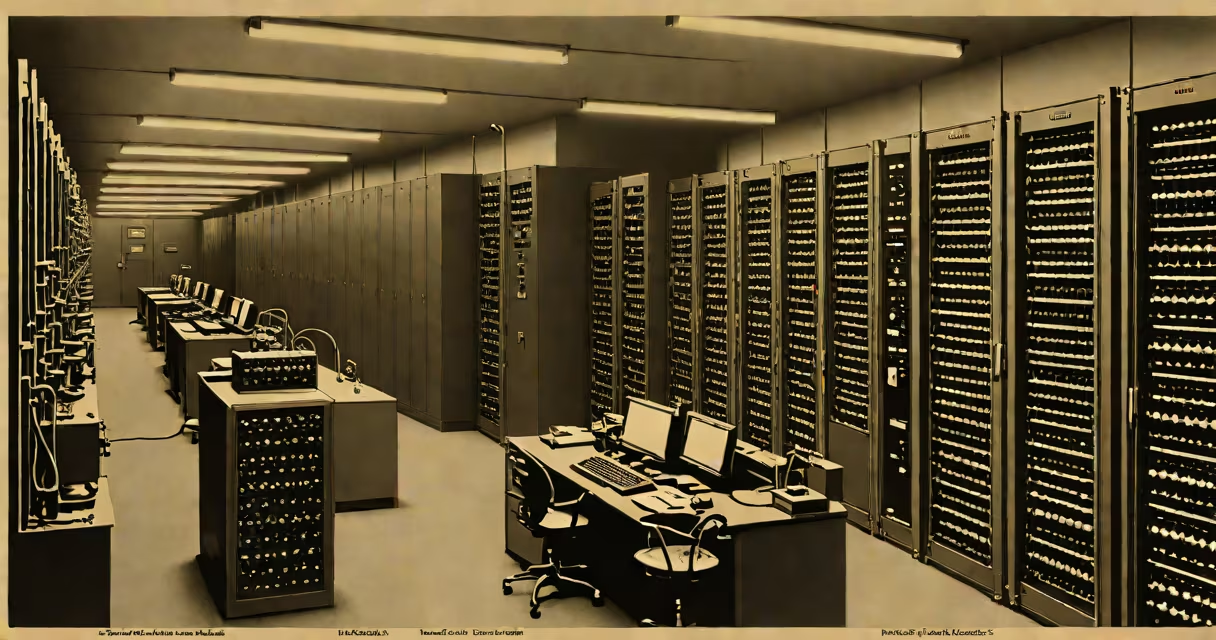
The first general-purpose electronic digital computer made was ENIAC (Electronic Numerical Integrator and Computer), completed in 1945 at the University of Pennsylvania. It processed mathematical problems using electronic circuits instead of mechanical parts, marking the start of modern computing.
ENIAC was designed to calculate artillery firing tables for the U.S. Army during World War II. Before its creation, such tasks took days or weeks using electromechanical calculators. ENIAC reduced the time to minutes. It could perform 5,000 additions per second and 385 multiplications per second-speeds unmatched by any prior machine.
Unlike later computers, ENIAC had no stored program. Operators rewired its internal circuitry to change tasks. Programming required physically plugging cables and setting switches. This process took hours. The machine's design relied entirely on vacuum tubes-over 17,000 of them-to represent binary states and perform logic operations.
ENIAC operated on electrical signals passing through vacuum tubes, which acted as switches. Each tube could be either on (representing 1) or off (representing 0). These binary states formed the basis of computation. The machine used decimal arithmetic, storing numbers in 10-digit registers made of flip-flop circuits.
Input came via punched cards and paper tape. Output appeared on a printer and a panel of lights. The entire system occupied 1,800 square feet of floor space and consumed 150 kilowatts of power-enough to run a small town. Its cooling system required constant airflow due to heat generated by the tubes.
One operator, Betty Holberton, helped develop programming methods for ENIAC. She and six other women programmed the machine by manually configuring its components. Their work laid the foundation for software engineering, though their contributions were overlooked for decades.
ENIAC's core components included vacuum tubes, resistors, capacitors, and relays. Vacuum tubes were the primary computational elements. They were fragile and prone to failure-tubes burned out every few hours, requiring constant maintenance.
The machine used 1,500 relays for control functions and 10,000 resistors. Wires connected components in complex arrays. A single wire ran up to 100 feet between cabinets. The entire system weighed 27 tons and required a dedicated air conditioning unit to prevent overheating.
Despite its size and complexity, ENIAC had limited memory. It held only 20 numbers internally, each stored in a register. Programs weren't saved on disk-they were hardwired into the machine's structure. Changing tasks meant reconfiguring physical connections.
| Component | Quantity | Function |
|---|---|---|
| Vacuum tubes | 17,468 | Logic and arithmetic processing |
| Relays | 1,500 | Control and switching |
| Capacitors | 1,000 | Memory storage |
| Resistors | 10,000 | Circuit regulation |
ENIAC was used primarily for military calculations. It solved differential equations related to ballistics trajectories. The U.S. Army needed faster ways to predict shell paths under varying wind and gravity conditions. Manual methods failed under wartime demand.
After the war, ENIAC tackled scientific problems. In 1951, it simulated atomic bomb detonation effects. It also modeled weather patterns and nuclear fusion reactions. These applications demonstrated that electronic computers could handle complex simulations beyond human calculation speed.
ENIAC ran continuously for nine months in 1947 to calculate neutron diffusion in fission reactions. It produced results that helped refine the design of the hydrogen bomb. This marked the first major use of a computer in nuclear research.
Many assume the first computer was a small, sleek device. ENIAC disproves that. It filled a large room, required teams of technicians, and had no keyboard or screen. It looked more like industrial machinery than a modern laptop.
Another myth is that ENIAC was the first programmable computer. While it could run different programs, it wasn't stored-program. That distinction belongs to EDVAC, developed shortly after ENIAC. EDVAC introduced the concept of storing instructions in memory-a design principle now known as the von Neumann architecture.
A lesser-known fact: ENIAC's original purpose was classified. The U.S. Army restricted access to its specifications until 1951. Even then, details about its performance were released slowly. This secrecy delayed public understanding of early computing capabilities.
In 1944, ENIAC was tasked with calculating firing tables for the M101 howitzer. The problem involved solving 15 differential equations for each shell trajectory. Manual computation took 30 hours per table. ENIAC completed the same task in 30 seconds.
For comparison, a team of 100 human "computers" (people hired to do math by hand) would have taken weeks. ENIAC's speed enabled rapid adjustments to gun settings based on wind, temperature, and elevation. This precision improved battlefield accuracy.
When ENIAC ran its first test in February 1946, it calculated the trajectory of a projectile in 20 seconds-faster than the projectile itself would take to reach its target. The event was documented in the Philadelphia Inquirer and marked the beginning of public awareness of electronic computation.
Before ENIAC, machines like Charles Babbage's Analytical Engine (1837) were conceptual. They used mechanical gears and punch cards but never built. The Harvard Mark I, operational in 1944, was electromechanical-using rotating shafts and relays-but still slower than ENIAC.
ENIAC differed from earlier systems in speed and scale. It processed data electronically rather than mechanically. Where the Mark I took 6 seconds per multiplication, ENIAC did it in 200 nanoseconds. That's 30,000 times faster.
Modern computers trace their lineage to ENIAC's design. The idea of using electronics for logic and arithmetic became standard. Later machines adopted stored programs, smaller components, and integrated circuits. But the core principle-electronic computation-began with ENIAC.
ENIAC's legacy lives on in today's processors. The transistor, invented in 1947, replaced vacuum tubes. But the logic gates used in microchips still operate on the same binary principles ENIAC pioneered. Even smartphones rely on the same fundamental concepts.
Understanding what was the first computer made reveals how far computing has come. ENIAC wasn't a consumer device-it was a tool for national defense and science. Yet its impact shaped every digital system we use today.