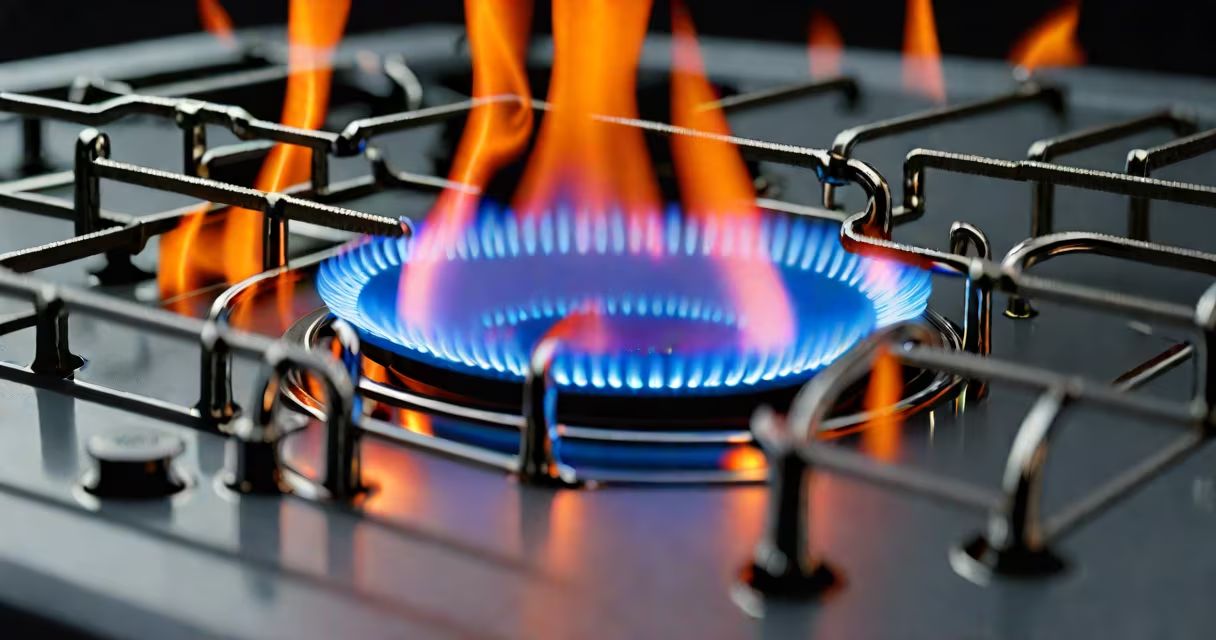
Natural gas is a fossil fuel energy source derived from organic matter buried underground over millions of years. Its primary component, methane (CH₄), releases thermal energy when burned. This process generates heat used for electricity generation, heating, and industrial processes.
Natural gas falls under the category of thermal energy-energy released as heat during chemical reactions. Unlike solar or wind, which convert kinetic or radiant energy, natural gas relies on combustion. The reaction between methane and oxygen produces carbon dioxide, water vapor, and heat. This makes it a form of stored chemical energy converted into usable thermal energy.
According to the U.S. Energy Information Administration (EIA), natural gas accounted for 38% of U.S. electricity generation in 2023. It's widely used because it burns cleaner than coal or oil, producing fewer emissions per unit of energy. Still, it remains a finite resource formed over geological time, not renewable.
When natural gas combusts, the chemical bonds in methane break and reform with oxygen. This exothermic reaction releases energy in the form of heat. A typical gas furnace converts about 90% of the fuel's chemical energy into usable heat, with the rest lost as exhaust.
Power plants use natural gas in combined-cycle turbines. Here, gas burns to spin a turbine, then waste heat powers a secondary steam turbine. This increases efficiency to around 60%, higher than older single-cycle systems.
In homes, gas stoves and water heaters rely on controlled combustion. A pilot light or electronic igniter triggers the burn. The flame emits infrared radiation and convective heat, warming food or water directly.
Natural gas is not a single substance. It's a mixture of hydrocarbons, with methane making up 70-95% by volume. Other components include ethane, propane, butane, and trace amounts of nitrogen and carbon dioxide.
| Component | % by Volume | Energy Contribution |
|---|---|---|
| Methane (CH₄) | 70-95% | Primary source of heat |
| Ethane (C₂H₆) | 0-15% | Used in petrochemicals |
| Propane (C₃H₈) | 0-5% | Can be separated for fuel |
| Butane (C₄H₁₀) | 0-2% | High energy density |
| Other gases | <1% | Minimal contribution |
Gas extracted from wells undergoes processing to remove impurities and separate heavier hydrocarbons. The remaining pipeline-quality gas is mostly methane, suitable for residential and commercial use.
Natural gas powers over 60 million U.S. households for heating and cooking. It's favored for its high energy density-about 50 megajoules per kilogram-and clean-burning properties. Compared to coal, it emits 50% less CO₂ per kilowatt-hour of electricity.
Industrial users rely on natural gas for high-temperature processes. Steel manufacturing uses gas-fired furnaces reaching 1,500°C. Chemical plants use it as feedstock for ammonia and methanol production.
Power plants increasingly favor natural gas over coal due to lower emissions and faster startup times. A gas plant can reach full output in under 30 minutes, compared to several hours for coal. This flexibility supports grid stability when paired with intermittent renewables.
Natural gas is often mistaken for renewable energy. It is not. While it burns cleaner than other fossil fuels, it still releases greenhouse gases. Methane itself is 25 times more potent than CO₂ over a 100-year period, according to the Intergovernmental Panel on Climate Change (IPCC).
Another confusion arises from labeling natural gas as "clean." It reduces sulfur dioxide and particulate emissions, but it still contributes to climate change. The EIA reports that U.S. natural gas-related methane emissions totaled 1.3 million metric tons in 2022-equivalent to 14 million cars' annual emissions.
A lesser-known fact: natural gas is not inherently flammable. Pure methane is odorless and colorless. Utilities add mercaptan-a sulfur-based compound-to give it a rotten-egg smell. This safety measure allows leaks to be detected before ignition occurs.
Consider a 2,000-square-foot home in Minnesota using natural gas for winter heating. The furnace consumes 100 therms of gas over a season. One therm equals 100,000 British Thermal Units (BTUs).
At 50,000 BTU per hour, the furnace runs 200 hours total. With a 90% efficiency rating, 90,000 BTU of useful heat is produced per therm. The system delivers about 18 million BTU of heat energy to the house.
For comparison, electric resistance heating would require roughly 1.8 million kWh to produce the same output-over twice the cost and energy input. Natural gas provides more usable heat per dollar spent.
I once installed a gas line for a new home in Colorado. The contractor emphasized proper venting and gas meter calibration. During testing, a small leak was detected near a joint. The odorant made it obvious. After tightening the connection, the system passed inspection. This confirmed how critical safety protocols are-even minor leaks pose fire risks.
Natural gas is a thermal energy source derived from ancient organic deposits. Its primary use lies in combustion-driven heat and electricity. It is not renewable, despite lower emissions than coal. The correct classification is fossil fuel energy, specifically chemical-to-thermal conversion via combustion. This understanding is essential for evaluating energy choices, environmental impact, and infrastructure planning.