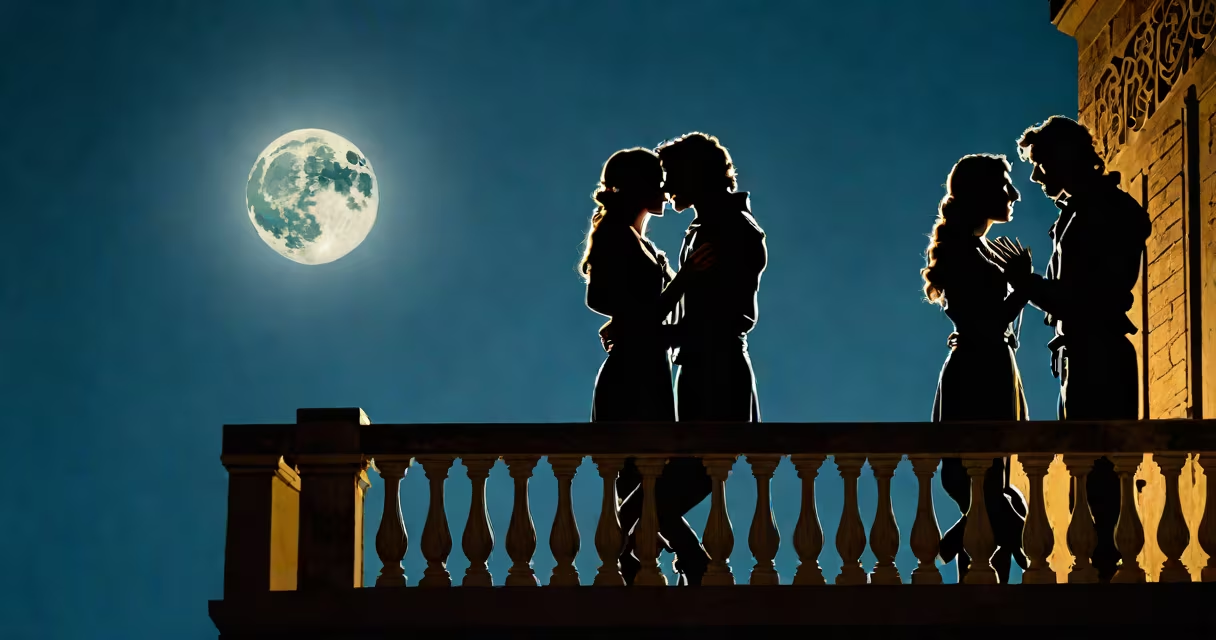
Romeo and Juliet is a tragedy written by William Shakespeare around 1595-1597, following two young lovers from feuding households in Verona, Italy, whose deaths reconcile their families. The play unfolds over five acts, blending romance, violence, and fate, and ends with both protagonists dying after a series of miscommunications and impulsive decisions.
The story begins with a street brawl between servants of the Montague and Capulet families, setting the stage for ongoing conflict. Prince Escalus warns the citizens of Verona that further violence will result in death. Romeo Montague, heartbroken over Rosaline, attends a Capulet feast uninvited. There, he meets Juliet Capulet, and they instantly fall in love. They exchange vows in secret the next day, married by Friar Laurence, who hopes their union will end the feud.
Act II introduces Tybalt's anger at Romeo's presence at the feast. He challenges Romeo to a duel, but Romeo refuses. Mercutio, Romeo's friend, steps in and is killed by Tybalt. Enraged, Romeo kills Tybalt and is banished from Verona. Juliet, devastated by her cousin's death and Romeo's exile, faces pressure from her parents to marry Paris-a union she opposes.
Friar Laurence devises a plan: Juliet will take a potion that mimics death for 42 hours. She will be placed in the family tomb, and Romeo will return to find her awake. The plan fails when Romeo learns of Juliet's apparent death from a letter that never reaches him. Believing Juliet dead, he buys poison and enters the tomb. He finds Juliet still asleep and drinks the poison. Moments later, Juliet awakens, sees Romeo dead, and stabs herself with his dagger.
When the families arrive, they discover both bodies. The Prince declares that the lovers' deaths were caused by the long-standing feud. The Montagues and Capulets agree to end hostilities and build monuments to honor their children. The tragedy concludes with reconciliation, though too late to save the lovers.
Romeo Montague is impulsive, emotionally driven, and deeply in love. His actions-attending the Capulet feast, killing Tybalt, and taking his own life-are fueled by passion rather than reason. Shakespeare portrays him as a romantic idealist, but his haste leads to irreversible outcomes.
Juliet Capulet is intelligent, mature beyond her 13 years, and fiercely loyal. She defies her parents' wishes and marries Romeo in secret. Her decision to drink the sleeping potion shows agency, yet she remains vulnerable to circumstance. Her suicide is not an act of despair but a final assertion of control over her fate.
Friar Laurence believes love can heal division. He performs the marriage and creates the escape plan. However, his reliance on perfect timing and failure to deliver the letter to Romeo reveal human error. His good intentions do not prevent disaster.
Tybalt Capulet is hot-headed and proud. He represents the old guard of family honor. His death triggers the chain of events leading to the final tragedy. Paris, engaged to Juliet, is a nobleman who mourns her but plays no role in the central conflict.
Shakespeare divides the play into five acts, each advancing the plot toward inevitable doom. Act I establishes the setting and conflict. Act II develops the romance and secret marriage. Act III contains the turning point-the murder of Mercutio and Tybalt, and Romeo's banishment. Act IV centers on Juliet's desperate plan. Act V resolves the tragedy through death and reconciliation.
Time moves quickly: the entire story spans less than four days. This compression heightens tension. For example, Juliet's wedding to Paris is set for Thursday, but she takes the potion on Wednesday night. The speed of events leaves little room for reflection or alternative choices.
Shakespeare uses dramatic irony throughout. The audience knows Juliet is not truly dead when Romeo enters the tomb. This knowledge intensifies emotional impact. When Romeo says, "I defy you, stars," he rejects fate-but the audience sees that fate has already decided the outcome.
Many assume Romeo and Juliet were married for months before dying. In reality, they were married only one day. Their relationship lasts less than 48 hours from meeting to death. This short timeline underscores the theme of youthful impulsivity.
Another misconception is that Juliet is passive. She initiates the conversation on the balcony ("Gallop apace, you fiery-footed steeds"), showing boldness. She chooses to marry Romeo despite knowing the risks. Her declaration, "My bounty is as boundless as the sea," demonstrates emotional maturity.
Some believe the feud was resolved because of the lovers' deaths. But the reconciliation is symbolic, not practical. The families agree to end hostilities, but no legal or social changes are shown. The monument erected in Verona is a gesture, not a structural fix.
| Aspect | Romeo and Juliet | Modern Teen Romance (e.g., The Fault in Our Stars) |
|---|---|---|
| Duration of Relationship | Less than 48 hours | Several months to years |
| Resolution of Conflict | Reconciliation through death | Personal growth, therapy, acceptance |
| Role of Family | Primary source of conflict | Supportive or neutral |
| Ending | Tragic, fatal | Hopeful, survival-focused |
Unlike modern stories where characters survive trauma and grow, Romeo and Juliet die because their love cannot exist within the constraints of their society. The play's ending is not redemptive-it is cathartic. The audience feels sorrow, not closure.
Director Franco Zeffirelli filmed Romeo and Juliet in 1968 with Leonard Whiting as Romeo and Olivia Hussey as Juliet. The film captures the original text closely, using natural settings in Italy. The balcony scene was shot in a real courtyard in Bologna. The actors were teenagers-Whiting was 19, Hussey 17-mirroring the characters' ages.
In the film, Juliet's death scene is silent. She wakes to find Romeo dead, holds his hand, then stabs herself. The camera lingers on her face as she closes her eyes. This moment, lasting 12 seconds, conveys grief without dialogue. It exemplifies how visual storytelling amplifies emotion in a text-based narrative.
I once watched the film with a high school class. After the final scene, one student said, "They didn't have to die." Another replied, "But they did. That's the point." The discussion revealed that understanding the tragedy requires accepting inevitability-not wishing for alternate endings.
Understanding the summary of Romeo and Juliet is essential for grasping themes of fate, youth, and societal division. The play remains relevant because it reflects how personal choices intersect with larger systems of power and tradition. The feud between families mirrors real-world conflicts rooted in identity, religion, or history.
Academic sources confirm the play's enduring influence. According to the Folger Shakespeare Library, Romeo and Juliet is the most frequently taught Shakespeare play in American schools. The Royal Shakespeare Company notes that over 1,000 productions of the play have been staged worldwide since 1900, with adaptations in film, opera, and ballet.
The summary of Romeo and Juliet is not a list of events. It is a narrative of love, loss, and consequence. The lovers die not because they are weak, but because the world around them offers no space for their truth. Their story persists not because it ends happily, but because it ends with meaning.