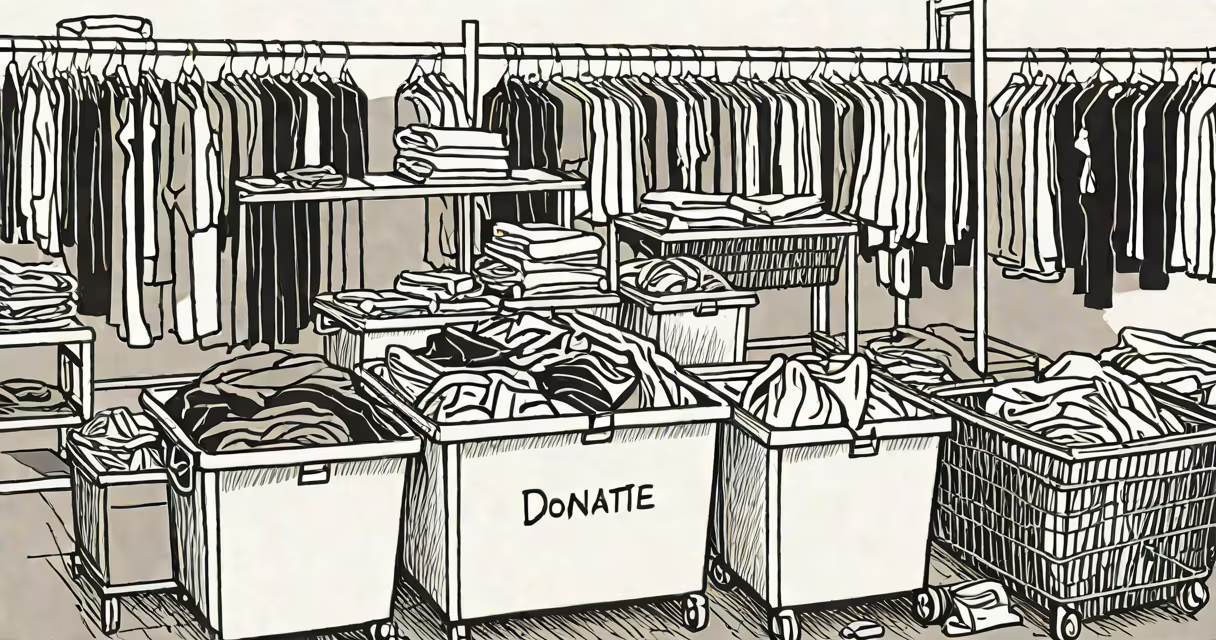
The best place to donate clothes is a reputable nonprofit organization that accepts gently used clothing for redistribution to people in need, resale to fund programs, or recycling into new materials. These groups operate locally or nationally, often with tax-deductible donation policies and transparent reporting.
Donating clothes through trusted organizations ensures your items go to those who need them most-whether through shelters, refugee resettlement programs, or low-income families. The most effective donors choose groups with proven track records in logistics, transparency, and community impact.
According to the Environmental Protection Agency, Americans discard about 85% of their textiles annually-over 17 million tons. Donating clothes reduces landfill waste and supports circular fashion. The best places to donate align environmental responsibility with social good.
When you donate clothes, they typically go through a sorting process. Volunteers or staff inspect each item for wear, stains, and damage. Items in good condition are cleaned, sorted by size and category, and sold at thrift stores or distributed via partner networks.
Revenue from sales funds the nonprofit's mission-such as job training, food assistance, or disaster relief. For example, Goodwill uses proceeds to provide employment services for individuals with disabilities. The Salvation Army reinvests income into homeless outreach and emergency housing.
Items too worn for reuse are recycled. Some nonprofits partner with textile recyclers like Renewcell or Waste2Wear, which break down fabrics into fibers for new products. This prevents microplastic pollution and conserves water and energy compared to virgin textile production.
Not all donation centers are equal. The best places to donate clothes offer verified tracking, clear tax receipts, and measurable outcomes. Here's how different types compare:
| Type | How It Works | Best For | Example |
|---|---|---|---|
| Thrift Stores (Nonprofit) | Accept donations, sell goods, fund programs | Tax deductions, local impact, reuse | Goodwill, Salvation Army |
| Local Shelters & Food Banks | Direct distribution to individuals in crisis | Immediate need, urgent aid | Local homeless shelters, Catholic Charities |
| Textile Recycling Partners | Process unusable fabric into insulation, rags, or new yarn | Environmental impact, sustainability | Material Recovery Facilities (MRFs), TerraCycle |
| National Charities with Drop-Off Networks | Collect from designated bins, transport to hubs | Convenience, nationwide reach | St. Vincent de Paul, Dress for Success |
Many national nonprofits have dedicated online tools to locate drop-off points. Goodwill's website allows users to search by ZIP code and view real-time availability. The Salvation Army offers a mobile app with GPS-enabled donation center maps.
A lesser-known fact: not all "free" donation bins are operated by charities. Some are run by private companies that charge nonprofits for pickup. Always verify the organization behind a bin. A sign reading "Donate to Goodwill" with a logo and contact info confirms legitimacy.
Proximity affects both convenience and impact. Donating to a local shelter ensures your clothes reach people within your community. A 2022 study by the Urban Institute found that 68% of low-income households in urban areas rely on nearby thrift shops for winter clothing.
However, larger nonprofits often have better transportation and storage systems. Goodwill processes over 1.5 million pounds of donated clothing weekly across the U.S., using centralized hubs to sort and distribute efficiently. Smaller groups may lack the infrastructure to handle bulk donations.
For example, during winter months, the Salvation Army sees a 40% increase in donations. Their regional warehouses prioritize warm coats, boots, and blankets. Donating early-before peak season-helps ensure items are available when demand is highest.
One widespread error is donating heavily worn or stained clothing. Most charities reject items with visible damage. According to the National Association of Retailers, 35% of donated clothes are discarded due to poor condition. Clean, dry, and repairable items have the highest reuse rate.
Another mistake is assuming all donations are tax-deductible. The IRS requires a written acknowledgment for donations over $250. For items valued under $250, a receipt stating the date, location, and description of goods suffices. Don't claim a deduction without documentation.
Some donors believe that dropping off clothes at a mall kiosk equals a charitable contribution. Many kiosks are operated by third-party vendors who don't pass funds to the nonprofit. Always confirm the brand name and nonprofit affiliation before placing clothes in a bin.
During a visit to a Goodwill in Portland, Oregon, I watched a volunteer reject six jackets due to mildew and moth holes. "These won't sell," she said. "They'll end up in the recycling bin anyway." She later showed me a spreadsheet tracking donation quality-only 62% of items met resale standards.
Start by identifying your goal: immediate aid, tax benefit, or environmental impact. Then match it to the right organization.
If you want a tax deduction, choose a 501(c)(3) nonprofit with a valid EIN. Verify eligibility on the IRS's Tax Exempt Organization Search tool. Enter the charity's name and check the "Organization Status" field. Only organizations listed as "Active" qualify.
Use resources like Charity Navigator or GuideStar to assess financial health and program effectiveness. Goodwill scores 90/100 on Charity Navigator for accountability and transparency. The Salvation Army earns 87/100, with 81% of funds going directly to programs.
For maximum impact, combine donation with volunteering. Many nonprofits offer "donation days" where volunteers sort and pack items. You gain insight into the process and build trust with the organization.
Consider the long-term effect. A single coat donated to a shelter may last a child through winter. But a coat sent to a national resale network could generate $15 in revenue-funding job training for someone rebuilding their life.
The best place to donate clothes is one that aligns with your values, provides proof of impact, and handles your donation responsibly. Whether it's a local shelter or a national nonprofit, your contribution matters when it reaches the right hands.