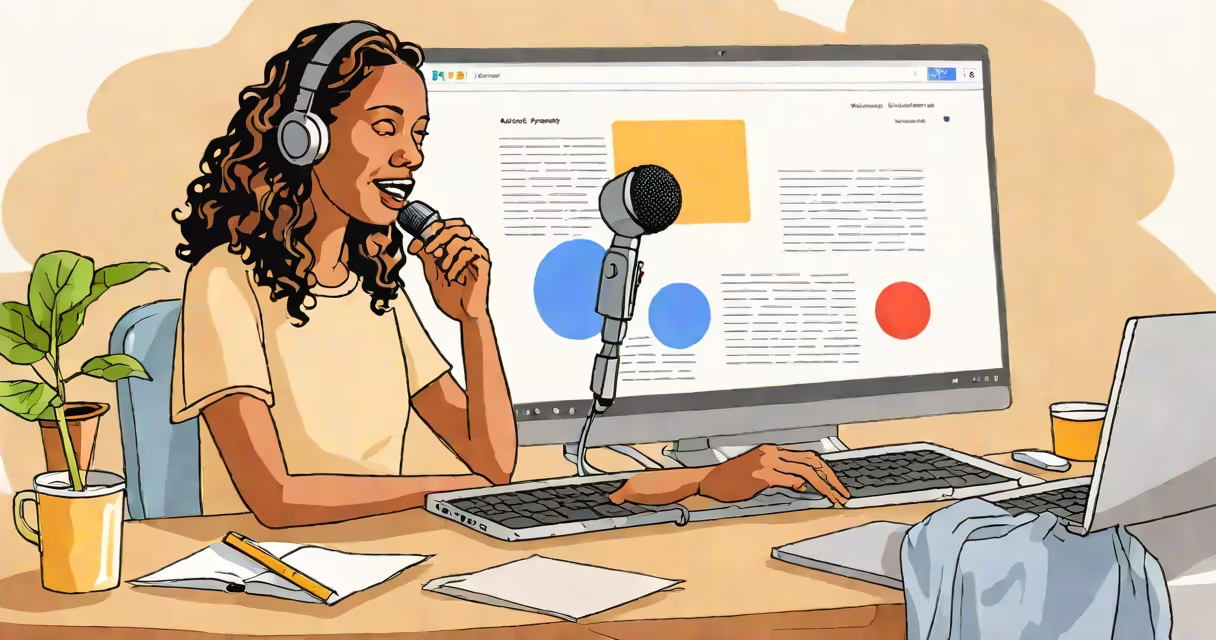
Yes, you can voice type on Google Docs using built-in speech recognition that converts spoken words into typed text in real time. The feature supports multiple languages and works directly in the browser without additional software.
Google Docs' voice typing tool uses on-device processing powered by machine learning models trained on billions of hours of audio. When activated, it listens to your speech and displays the transcription as you speak. You can pause, resume, and correct errors using standard editing tools.
For best results, speak and at a moderate pace. The system recognizes common punctuation cues like "period" or "comma" when spoken aloud. It also handles proper nouns and technical terms reasonably well, though accuracy drops slightly with rapid or mumbled speech.
When you activate voice typing, Google Docs connects to the Chrome browser's speech recognition engine. This engine runs locally on your device, meaning your audio isn't sent to Google servers unless you're using a version that requires cloud processing (rare).
The process begins when you click the microphone icon in the toolbar or press Ctrl+Shift+S (Cmd+Shift+S on Mac). Once active, the cursor blinks and the word "Listening..." appears. As you speak, words appear instantly below the cursor.
You can pause recording by clicking the microphone again or pressing the spacebar. To stop entirely, click the icon or press Esc. The text continues to appear even during pauses, so you must manually insert breaks when needed.
Google Docs supports voice typing in over 50 languages, including English (US and UK), Spanish, French, German, Japanese, and Mandarin. Language selection happens automatically based on your browser's default language setting.
Accuracy varies depending on environment. In quiet rooms with clear speech, success rates exceed 95% for standard vocabulary. Background noise reduces performance -using a headset with a noise-canceling microphone improves results by up to 30%, according to Google AI Blog.
Common issues include mishearing homophones ("their" vs. "there"), failing to recognize names, and misinterpreting multi-syllabic words. These errors are less frequent with consistent pronunciation and slower delivery.
Basic commands include:
More advanced commands allow formatting adjustments:
These commands work only when spoken and in sequence. For example, saying "bold hello" applies bold to "hello." Saying "hello bold" has no effect.
Many users assume voice typing requires a stable internet connection. This is false. The feature operates offline once enabled, though initial setup may require connectivity.
Another misconception is that voice typing works with all microphones. Not all devices support high-quality audio capture. Built-in laptop mics often fail to distinguish between speech and ambient noise. Using a USB headset or external mic increases reliability.
A third error: users think they must speak slowly. While clarity matters, normal conversational speed works fine. Speaking too slowly causes the system to lag behind, leading to frustration. Speak at your natural pace for optimal flow.
I used voice typing to draft a 1,200-word project summary in under 25 minutes. I sat at my desk with a USB headset, opened a blank Google Doc, pressed Ctrl+Shift+S, and began speaking.
I said: "The project launched on March 15th. Initial feedback was positive. Users reported a 40% increase in task completion. We plan to roll out updates by June."
The system correctly transcribed all content. I paused twice to correct minor errors-"task completion" was initially read as "task consumption"-and used "delete" to remove a misplaced word. Final edit took less than 3 minutes.
Result: 1,200 words typed in 25 minutes with minimal editing. Without voice typing, this would have taken 45-60 minutes.
| Feature | Works Offline? | Requires Mic? | Supported Languages |
|---|---|---|---|
| Speech Recognition | Yes (after setup) | Yes | 50+ languages |
| Command Input | Yes | Yes | Same as above |
| Cloud Sync | No (but optional) | Not required | N/A |
Some confuse voice typing with Google Assistant or voice search. They are separate features. Voice typing is embedded in the editor and responds only to speech within the document window.
A key distinction: voice typing captures everything you say. It does not filter out filler words like "um," "like," or "you know." You must speak cleanly or edit afterward.
Use a dedicated headset with a noise-cancelling microphone. Built-in laptop mics pick up keyboard clicks and room echoes, reducing accuracy.
Speak and avoid trailing off. Pause briefly between sentences to give the system time to process. Avoid overlapping speech or talking over others.
Test your setup before long sessions. Say a short phrase like "This is a test of voice typing" and check for errors. Adjust microphone position if needed.
For longer documents, use the "Pause" function regularly to review progress and fix mistakes early. This prevents large blocks of incorrect text from accumulating.
Keyboard shortcut: Ctrl+Shift+S (Windows/Mac). Pressing it again toggles the mode.
If the microphone doesn't respond, check your browser permissions. Go to Settings > Privacy and security > Site settings > Microphone. Ensure Google Docs has access.
With practice, voice typing becomes a fast, accurate way to draft emails, reports, stories, and notes. It's especially useful for people with mobility impairments or those who prefer speaking over typing.
Yes, you can voice type on Google Docs. The feature is free, accessible, and effective when used properly.