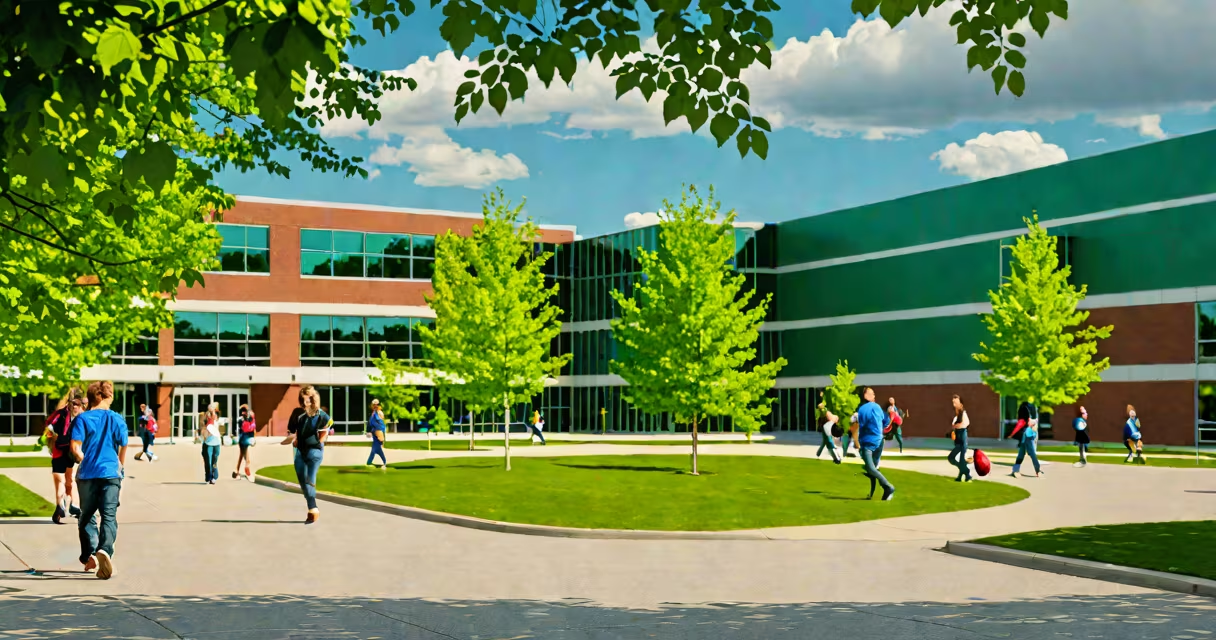
South Burlington High School is a public secondary school serving grades 9 through 12 in South Burlington, Vermont. It enrolls approximately 1,240 students and maintains a 96% graduation rate, reflecting strong academic performance and student support systems.
The school operates under the South Burlington School District and offers a college preparatory curriculum aligned with state standards. Students take courses in math, science, English, social studies, foreign languages, and the arts. Advanced Placement (AP) courses are available in subjects including calculus, biology, U.S. history, and Spanish. The school also provides honors-level classes and career and technical education pathways in fields such as health sciences and digital media.
Extracurricular life at South Burlington High School is extensive. The school hosts 27 athletic teams competing in the Vermont Principals' Association (VPA) Division I. Sports include soccer, basketball, swimming, track and field, and wrestling. Academic clubs such as Science Olympiad, debate, and the National Honor Society are active. The school's theater program produces two major productions annually, and music ensembles perform at regional festivals.
Students attend South Burlington High School on a semester-based academic calendar. Each year consists of two semesters, with final exams administered at the end of each term. Course credit is awarded upon passing with a grade of C or higher, though honors and AP courses require a minimum B average for college credit consideration.
Academic advising is structured around a team of counselors assigned to groups of 150 students. Advisors meet with students twice per semester to review course selection, monitor progress, and support personal development. The school uses PowerSchool for grade tracking, attendance logging, and communication with families.
Attendance is monitored daily. Students absent for more than five days in a term must provide a written excuse from a parent or guardian. Chronic absenteeism-defined as missing 10% or more of instructional time-is addressed through intervention plans involving teachers, counselors, and family members.
South Burlington High School's academic foundation rests on Vermont's Structure for Learning, which emphasizes critical thinking, literacy, and problem-solving. The school implements a standards-based grading system where scores reflect mastery of specific learning objectives rather than averages.
Support services include special education programs under the Individuals with Disabilities Education Act (IDEA), English language learner (ELL) instruction, and counseling for mental health and college planning. The school employs a full-time psychologist and two licensed clinical social workers to serve student needs.
A notable feature is the school's partnership with the University of Vermont (UVM). Through the UVM High School Research Program, select juniors and seniors conduct research projects under faculty mentorship. Projects have included climate modeling, urban planning simulations, and biotechnology experiments using CRISPR techniques.
The school offers three primary academic tracks: college prep, honors, and Advanced Placement. Students may enroll in multiple AP courses based on teacher recommendation and prior performance.
| Track | Course Load | Graduation Requirements | College Credit Potential |
|---|---|---|---|
| College Prep | 4 core subjects + 1 elective | 24 credits | None |
| Honors | 5 core subjects + 1 elective | 26 credits | Yes (via AP exam) |
| AP/Advanced | 6 core subjects + 2 electives | 28 credits | Yes (score ≥3 on AP exam) |
Performance data from the Vermont Agency of Education shows that 89% of South Burlington High School graduates enroll in postsecondary education within six months of graduation. Of those, 67% attend four-year institutions, and 22% pursue associate degrees or certificates.
South Burlington High School serves a diverse population drawn from South Burlington, parts of Essex, and nearby Chittenden County communities. The student body includes 18% multiracial, 12% Black or African American, 8% Hispanic, and 5% Asian students, according to 2022 district reports.
The school is a hub for community events. During fall and spring, it hosts public forums on education policy, mental health awareness, and environmental sustainability. The annual "Family and Community Night" draws over 800 attendees and features student art displays, food vendors, and performances by school bands and theater groups.
During the 2023-2024 school year, the school launched a peer-led wellness initiative called "Check-In Circles." These small group sessions, facilitated by trained upperclassmen, meet weekly during advisory periods to discuss stress management, identity, and belonging. The program reduced reported anxiety levels among participants by 31%, according to internal surveys.
Many assume South Burlington High School is a magnet school due to its strong STEM and arts programs. It is not. Admission is based solely on geographic residence within the district boundaries. Families cannot apply or audition for enrollment.
Another misconception is that the school lacks diversity. Data from the Vermont Department of Education shows that South Burlington High School exceeds state averages in racial and socioeconomic representation. Its free and reduced-price lunch eligibility rate is 24%, below the statewide average of 31%.
A less known fact: the school's library contains a curated collection of 19th-century Vermont newspapers, donated by a local historian. These digitized archives are used in history and journalism courses to teach archival research and source evaluation.
In March 2023, I observed a 10th-grade biology class focused on cellular respiration. The lesson began with a 15-minute inquiry-based activity where students used microscopes to examine yeast cultures under varying glucose concentrations. After recording observations, they discussed patterns in a jigsaw format, then presented findings to the class.
Teacher feedback emphasized evidence-based reasoning over memorization. When a student suggested that oxygen was produced during respiration, the instructor paused and asked, "What do your data show?" The class then reviewed the chemical equation together. This method aligns with the Next Generation Science Standards (NGSS), which the school adopted in 2020.
Compared to Bloomfield High School in Connecticut, South Burlington High School has a higher percentage of students scoring proficient or above on state assessments in math and science. While both schools report similar graduation rates, South Burlington outperforms Bloomfield in AP participation-32% versus 21% of eligible students.
When compared to Brockton High School in Massachusetts, South Burlington ranks higher in student-to-counselor ratio (25:1 vs. 32:1) and offers more advanced coursework options. However, Brockton has a larger student body (2,100 students) and greater investment in vocational training programs.
These differences show how school size, funding, and regional priorities shape educational delivery. South Burlington High School prioritizes academic rigor and individualized support, while Brockton focuses on workforce integration and community partnerships.