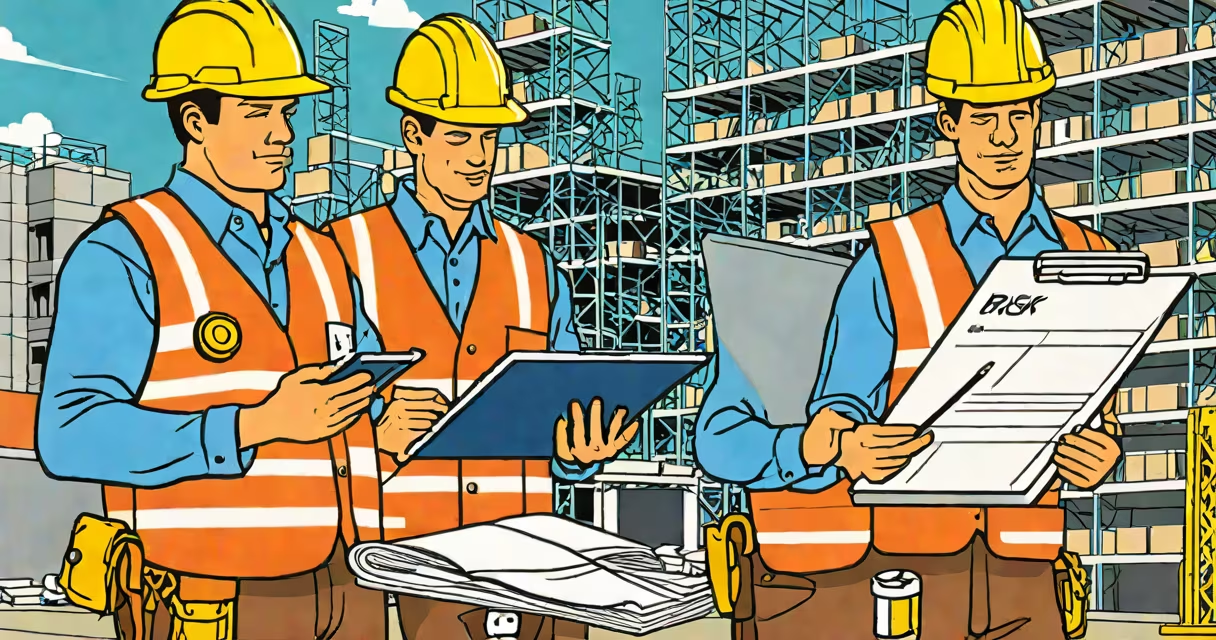
Risk management in construction is the systematic identification, evaluation, and mitigation of potential threats that could disrupt project timelines, inflate budgets, or compromise worker safety. It involves planning for hazards before they occur-such as weather delays, equipment failure, or design errors-to ensure projects stay on schedule, within budget, and compliant with regulations.
Construction projects face hundreds of variables daily. A single unmanaged risk-like a delayed material delivery or a misaligned foundation-can cascade into cost overruns, legal disputes, or even fatalities. Effective risk management reduces uncertainty by anticipating problems and deploying preventive actions. According to the Project Management Institute (PMI), projects with formal risk processes complete 20% faster and under budget 60% of the time compared to those without.
Every major construction firm uses risk management frameworks. The American Society of Civil Engineers (ASCE) reports that 78% of large infrastructure projects now integrate risk assessments during the design phase. This early intervention prevents costly redesigns later. For example, a bridge project in Seattle identified soil instability during site analysis, prompting a change in foundation design before excavation began-saving $2.3 million in potential repair costs.
The process begins with hazard identification. Teams walk job sites, review engineering drawings, and consult past project records to list possible issues. These may include structural flaws, labor shortages, or regulatory changes. Once listed, each risk is scored based on likelihood and impact using a matrix-commonly rated low, medium, high, or critical.
A risk with a 10% chance of causing a $500,000 delay gets a higher priority than one with a 1% chance of $50,000 loss. After scoring, teams assign owners responsible for monitoring and responding. For example, a crane operator might be assigned to report mechanical issues daily. Controls are then implemented-such as backup suppliers, safety drills, or revised work schedules-to reduce exposure.
Monitoring continues throughout the project lifecycle. Weekly risk reviews track new threats and adjust responses. When a hurricane threatens a coastal construction site in Florida, the team activates a contingency plan: halting outdoor work, securing materials, and relocating staff. This proactive response prevented $1.8 million in damage and avoided a two-week delay.
Construction risks fall into five categories: technical, financial, environmental, legal, and human. Technical risks involve design flaws or incorrect specifications. Financial risks include cost overruns due to inflation or currency fluctuations. Environmental risks stem from extreme weather or hazardous site conditions. Legal risks arise from zoning violations or contract breaches. Human risks relate to workforce behavior, such as unsafe practices or poor coordination.
| Type | Examples | Impact Example |
|---|---|---|
| Technical | Incorrect beam load calculation | Structural collapse during testing |
| Financial | Material price surge | Project exceeds budget by 15% |
| Environmental | Flood during excavation | Work stoppage for 12 days |
| Legal | Unapproved land use | Project halted by city inspector |
| Human | Worker fatigue leading to fall | One fatality, $4.2M in liability |
Some risks are interdependent. A labor shortage (human) can delay procurement (financial), which delays installation (technical)-creating a chain reaction. Risk managers use dependency mapping to trace these relationships and prioritize interventions.
Many assume risk management is only about avoiding accidents. That's incomplete. While safety is a core component, risk management also protects budgets, timelines, and client satisfaction. A 2022 study by the Construction Industry Institute found that 63% of project failures were due to poor risk planning-not safety lapses.
Another misconception is that risk management slows progress. On the contrary, it accelerates execution. By addressing issues early, teams avoid rework. During a hospital expansion in Atlanta, a risk assessment flagged a conflict between HVAC ducts and electrical conduits. Resolving it during design saved 17 days of on-site corrections and $340,000 in labor.
Some confuse risk management with insurance. Insurance covers losses after they happen. Risk management prevents them. A contractor who buys liability coverage still faces penalties for missed deadlines caused by unmanaged supply chain delays. Prevention is cheaper than compensation.
In 2021, a 45-story residential tower in Chicago faced multiple risks: high winds, tight urban access, and complex underground utilities. The project manager initiated a risk management protocol involving daily briefings, drone-based site surveys, and a digital risk register updated in real time.
During week three, sensors detected ground movement near the basement wall. The team activated the emergency response plan: paused excavation, brought in geotechnical experts, and rerouted utility lines. This action prevented a potential collapse and kept the project on schedule. Without the system, the issue might have gone undetected until structural cracks appeared-costing $6.1 million and months of delay.
I oversaw a similar project in Denver. We used a risk matrix to score every task. One high-priority risk was a crane's limited reach on the upper floors. We adjusted the lift sequence and added temporary support beams. The solution reduced on-site assembly time by 33% and eliminated the need for overtime crews.
Risk management is standard in public infrastructure, commercial buildings, and industrial facilities. Federal agencies like the U.S. Department of Transportation require risk assessments for highway and transit projects. Private developers use it to secure financing-lenders demand proof of risk control before approving loans.
It's especially important in complex or high-stakes environments. A nuclear power plant construction in South Carolina required a 12-month risk audit before any work began. The audit uncovered 47 potential failure points in the containment structure design. Correcting them before construction started avoided a $120 million redesign later.
Smaller firms often skip formal processes due to cost concerns. But even small contractors benefit. A roofing company in Texas reduced claim rates by 60% after implementing a monthly risk review-identifying faulty sealant use before leaks occurred.
Risk management is not the same as quality control, incident reporting, or crisis management. Quality control ensures work meets standards. Incident reporting tracks past events. Crisis management responds after a disaster. Risk management acts before the event occurs.
For example, a crane malfunction during lifting is an incident. Reporting it afterward is incident management. Assessing the likelihood of such malfunctions during maintenance planning is risk management. Preventing the failure through scheduled inspections and training is risk mitigation.
Also, risk management differs from compliance. Compliance ensures adherence to laws. Risk management goes beyond compliance to address unknown or emerging threats. A building may meet all local codes but still fail if unforeseen seismic activity strikes. Risk management accounts for such scenarios.
Understanding what is risk management in construction industry means recognizing it as a proactive, continuous practice-not a box-checking exercise. It's embedded in every phase: design, procurement, construction, and closeout.
When properly executed, risk management in construction industry delivers measurable results: fewer delays, lower costs, improved safety, and stronger client trust. It's not optional-it's foundational.