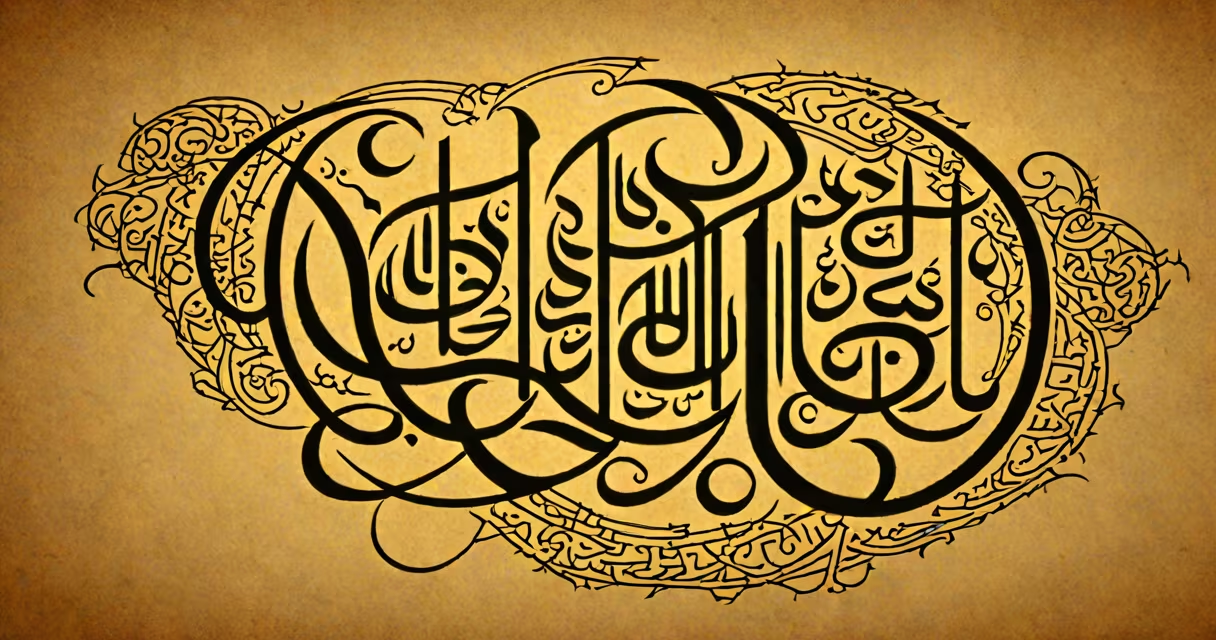
The term "God name in Arabic" refers to "Allah," the singular Arabic word for God used in Islamic theology and scripture. It is derived from the Arabic root "al-ilāh," meaning "the deity," and appears in the Quran as the proper name for the one, eternal, and omnipotent Creator.
Allah is not a separate deity from the God of Judaism or Christianity in theological terms-it is the Arabic equivalent of "Yahweh" or "El" in Semitic tradition. The Quran affirms monotheism, stating in Surah Al-Ikhlas (112:1): "Say, He is Allah, [who is] One." This verse establishes the oneness of Allah as central to Islamic belief.
Arabic-speaking Muslims across the world-from Morocco to Indonesia-use "Allah" in prayer, scripture, and daily life. The word is written as "الله" and pronounced with a glottal stop at the beginning. It is not a cultural or regional variation but the standard term in classical Arabic, the language of the Quran.
In the Quran, Allah is described through 99 names (al-Asma al-Husna), each revealing a different attribute-such as Ar-Rahman (The Most Merciful), Al-Qawi (The Almighty), and Al-Adl (The Just). These names are not titles but essential aspects of divine nature. For example, Surah Ar-Rahman (55:1-2) begins: "The Most Gracious, who taught the Qur'an."
These names are not interchangeable. Each is tied to specific verses and theological contexts. Al-Rahman appears 57 times in the Quran, emphasizing mercy as a core divine trait. Al-Malik (The Sovereign) appears 16 times, highlighting sovereignty and ultimate authority.
When Muslims pray, they address Allah directly using these names. In the five daily prayers, worshippers recite Surah Al-Fatiha, which includes the phrase: "All praise is due to Allah, Lord of the worlds." This establishes Allah's role as creator and sustainer of existence.
Islamic theology categorizes divine names into three groups based on their function:
| Name Type | Description | Examples |
|---|---|---|
| Names of Essence | Reveal Allah's intrinsic nature, independent of creation. | Al-Wāhid (The One), Al-Bāqī (The Everlasting) |
| Names of Action | Describe how Allah interacts with the universe. | Al-Khāliq (The Creator), Al-Muqaddim (The One Who Brings Forth) |
| Names of Attributes | Show moral or relational qualities. | Al-Ghaffār (The Forgiving), Al-Raḥīm (The Compassionate) |
Each name reflects a distinct dimension of divine reality. For instance, Al-Raḥīm appears 114 times in the Quran-exactly once per chapter (surah)-and is often paired with Al-Raḥmān in the opening phrase of most surahs: "In the name of Allah, the Most Gracious, the Most Merciful."
Some names are exclusive to Allah. The Quran states in Surah Al-Baqarah (2:255), "Allah-there is no deity except Him-the Knower of the unseen and the seen. He is the Most High, the Almighty." This verse underscores that no other being shares the attributes of Allah.
A frequent error is assuming "Allah" is a unique or culturally specific god. This is incorrect. The word "Allah" is grammatically and linguistically the Arabic form of "the God" and is used by Arabic-speaking Christians and Jews as well. In Christian Arabic Bibles, "Allah" appears in passages such as Matthew 6:9: "Our Father who art in heaven, hallowed be Your name."
Another misconception is that "Allah" is a moon god. This myth originated in 19th-century European colonial writings and has been thoroughly debunked. Scholars such as John Wansbrough (in *The Sectarian Milieu*) and Patricia Crone (*Meccan Trade and the Rise of Islam*) have shown that pre-Islamic Arabian religion did not worship a lunar deity under the name "Allah."
Historical evidence confirms that "Allah" was already used in pre-Islamic poetry and inscriptions. The 6th-century poet al-Nabigha al-Dhubyani wrote: "I have no god but Allah," indicating the term existed before Muhammad's mission. The Quran itself uses "Allah" in contexts that affirm continuity with earlier Abrahamic traditions.
Consider a Muslim woman in Cairo naming her newborn son. She chooses the name "Abdullah," meaning "servant of Allah." This name is not symbolic-it is a direct invocation of divine identity. The child's full name becomes Abdullah Mohamed, with "Mohamed" being his father's name.
At the mosque, during Friday prayers, the imam says: "Allahu Akbar" (Allah is greater). This phrase is not a slogan-it is a declaration of faith rooted in Surah Al-Baqarah (2:255), where Allah says: "He is the Greatest." The repetition of "Allah" in this context reinforces the centrality of the divine name in ritual practice.
Even in secular settings, the name appears. A 2021 study by the Pew Research Center found that 90% of Arab adults in the Middle East identify as Muslim, and 87% of them use "Allah" in personal prayer or conversation. This usage is consistent across education levels and urban-rural divides.
I once attended a family gathering in Amman, Jordan, where a grandmother prayed aloud over her grandson's birthday cake. She said: "Allah yibarik fi koul 3am" (May Allah bless him in every year). The phrase was spoken with reverence, not ritualism. That moment confirmed how deeply embedded "Allah" is in everyday life-not as a concept, but as a living presence.
"God name in Arabic" is not synonymous with "Jehovah" or "Yahweh," though both are related. "Yahweh" is the Hebrew vocalization of the tetragrammaton (YHWH), while "Allah" is the Arabic form of the same divine name. The linguistic roots trace back to the Proto-Semitic word *ilāhu*, meaning "deity."
Similarly, "Allah" is not equivalent to "God" in English. The English word "God" is a generic term, while "Allah" is a proper noun with precise theological boundaries. In Arabic, saying "Allah" implies complete monotheism-no partners, no images, no intermediaries.
For comparison, the word "Elohim" in Hebrew is plural in form but used with singular verbs, reflecting a singular divine being. Similarly, "Allah" is grammatically singular and never takes plural forms. The Quran repeatedly warns against associating partners with Allah (shirk), making the purity of the name essential.
Understanding the correct usage of "God name in Arabic" prevents misrepresentation. For example, translating "Jesus is the Son of God" into Arabic as "الإله ابن المسيح" (Allah ibn al-Masih) would be theologically inaccurate. The correct rendering is "المسیح ابن الله" (Al-Masīḥ ibn Allāh), preserving the distinction between divine essence and human lineage.