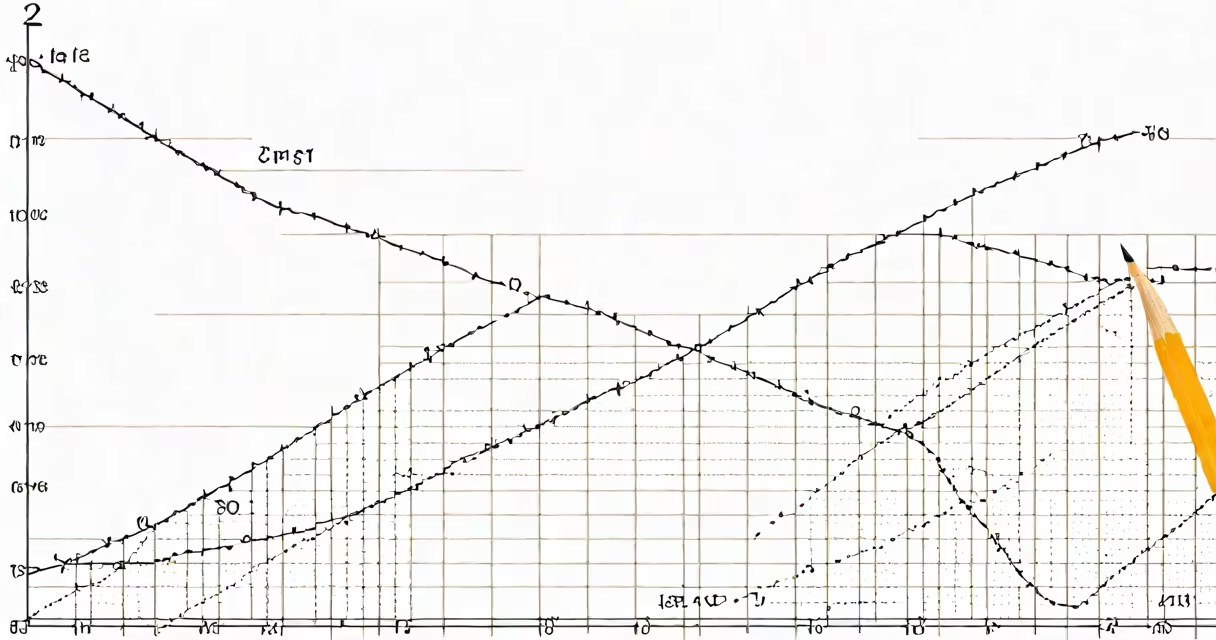
Exponential growth in math occurs when a quantity increases at a rate proportional to its current size, leading to accelerating growth over time. This pattern appears in natural processes like population expansion and financial compound interest.
This type of growth differs from linear growth, where the same amount is added each period. In exponential growth, the amount added grows larger over time. For example, doubling every hour leads to 1 unit after one hour, 2 after two, 4 after three, and 8 after four-far outpacing a constant addition of one unit per hour.
The standard form of an exponential function is y = a × b^x, where a is the initial value, b is the growth factor (greater than 1), and x is time or another independent variable. When b > 1, the function increases rapidly; when 0 < b < 1, it decreases-a process known as exponential decay.
Exponential growth happens because each new value builds on the previous one. The larger the base value, the larger the increment. This creates a feedback loop: more leads to even more.
For instance, if a single bacterium divides every 20 minutes, after one hour (three divisions), there are 8 bacteria. After two hours (six divisions), there are 64. After six hours (18 divisions), there are 262,144. The numbers grow too fast to track easily without exponential notation.
This behavior is modeled using the formula:
y = P₀ × e^(rt)where P₀ is the initial amount, r is the continuous growth rate, t is time, and e is Euler's number (~2.718). This version is common in calculus and continuous modeling.
Exponential growth appears in several domains, often with distinct applications:
| Type | Formula | Common Use Case |
|---|---|---|
| Discrete Growth | y = a × b^n |
Bacterial populations, annual compound interest |
| Continuous Growth | y = P₀ × e^(rt) |
Radioactive decay (reverse), fluid dynamics, population models |
| Logistic Growth (bounded) | y = L / (1 + Ae^(-kt)) |
Population limits due to resource scarcity |
Discrete growth applies when changes happen at set intervals-like yearly interest or cell division cycles. Continuous growth assumes change happens smoothly over time, useful in physics and engineering.
Logistic growth is often mistaken for pure exponential growth but includes a cap. It starts exponential but slows as resources deplete. This model better reflects real-world limits in biology and economics.
Mathematical models using exponential growth predict outcomes in science, finance, and public health. The World Health Organization uses such models to forecast disease spread during epidemics.
For example, during early stages of the 2020 SARS-CoV-2 outbreak, infection rates doubled roughly every 7 days in some regions. Using I(t) = I₀ × 2^(t/7), researchers estimated case counts weeks ahead, helping hospitals prepare.
In finance, compound interest follows exponential growth. A $1,000 investment at 5% annual interest compounded annually becomes $1,628.89 after 10 years. The formula:
A = P(1 + r)^tis exponential in form. Over decades, small differences in interest rates lead to massive disparities in returns.
One non-obvious fact: exponential growth can seem slow at first but then accelerate dramatically. In the famous "wheat and chessboard" parable, placing one grain on the first square, doubling each time, results in over 18 quintillion grains by the 64th square-enough to cover Earth's surface under a foot of wheat.
Many assume exponential growth always means "very fast." But in the short term, it may appear nearly flat. A 1% daily growth rate seems negligible-after 10 days, only ~1.105 times the original-but after 100 days, it exceeds 2.7 times the original.
Another mistake is confusing exponential with linear. People often expect steady progress in problems involving growth. But exponential patterns defy intuition: a doubling every year leads to 1,024 times the original value after 10 years-not 10 times.
I once observed this while teaching high school algebra. Students predicted a savings account with 10% annual compounding would reach $2,000 in 10 years from $1,000. The actual result was $2,593.74. The gap surprised them-until we graphed the growth curve and saw the acceleration near the end.
Exponential growth is not the same as quadratic or polynomial growth. While polynomials grow quickly, they don't scale as fast as exponentials. For example, n² grows faster than n, but 2^n eventually surpasses any polynomial.
Also, exponential growth doesn't imply infinite sustainability. Real systems hit limits-food, space, funding. That's why logistic models exist: they start exponential but level off.
Finally, exponential growth is not always positive. When the base is between 0 and 1, the function decays exponentially-like radioactive half-life or depreciation of assets.
Understanding exponential growth allows accurate forecasting in fields ranging from epidemiology to personal finance. It reveals how small, consistent increases compound into large effects over time.
Recognizing the pattern helps avoid misjudging risks-such as underestimating pandemic spread or overestimating investment timelines. The core idea: growth accelerates, not just continues at a steady pace.