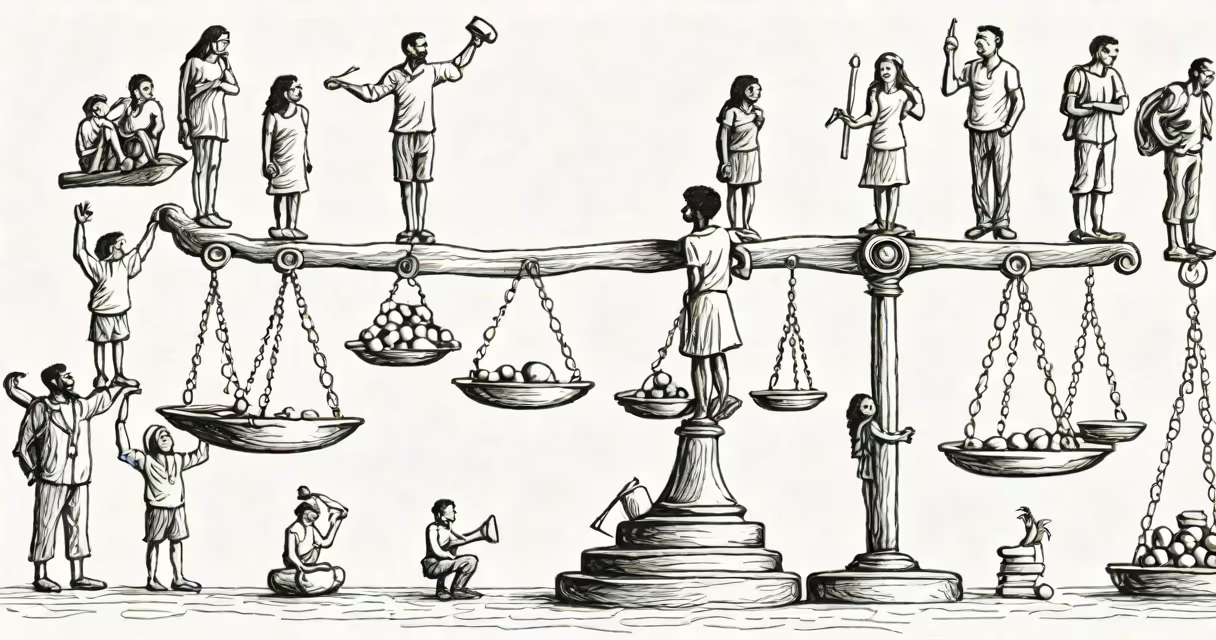
Equity means providing people with the specific support they need to achieve fair outcomes, especially when they start from unequal positions. It's not about treating everyone identically-it's about adjusting resources based on individual circumstances to reach shared goals.
Think of a classroom where students have different learning needs. Two students sit at the same desk, but one uses a wheelchair. Giving both the same chair doesn't fix the problem. Equity means providing a wheelchair-accessible desk for the student who needs it. The goal isn't identical treatment-it's fair access to success.
According to the National Equity Project, equity focuses on "removing barriers that prevent people from achieving their full potential." This isn't about favoritism. It's about recognizing that people face different challenges due to race, gender, disability, income level, or geography-and adjusting support accordingly.
Equity operates through targeted interventions. It assumes that not all people begin at the same starting line. A student from a low-income neighborhood may lack internet access at home. Simply assigning online homework without addressing connectivity creates an unfair disadvantage. Equity means offering offline materials or device loans to close the gap.
Similarly, in healthcare, a person with chronic illness may need more frequent appointments. Equity doesn't mean every patient gets the same number of visits. It means tailoring care to meet actual health needs. The U.S. Department of Health and Human Services states that equitable health systems "address disparities in access, quality, and outcomes."
A real-world example: In 2021, the U.S. government expanded nutrition assistance during the pandemic. Instead of distributing the same amount to all families, benefits were increased for households with children and those facing food insecurity. This adjustment reflected the reality that some families needed more support to maintain basic needs. That's equity-not uniformity.
Equity isn't a single concept. It appears in different forms depending on context. Here are the most common types:
| Type | Focus Area | Example |
|---|---|---|
| Health Equity | Access to medical care | Mobile clinics serving rural areas with limited hospitals |
| Educational Equity | Learning opportunities | Providing free tutoring for students in underfunded schools |
| Income Equity | Wage fairness | Pay equity audits to correct gender-based wage gaps |
| Racial Equity | Systemic bias reduction | Revising hiring practices to reduce unconscious bias |
Each type aims to correct imbalances rooted in history, policy, or social structure. For instance, Black and Latino students in U.S. public schools are more likely to attend under-resourced schools. Equity efforts focus on redistributing funding, staff, and materials to balance outcomes.
Equity is often misunderstood as reverse discrimination or special treatment. It's neither. It's not about giving someone more because they're a certain race or gender. It's about ensuring that structural disadvantages don't block progress.
Consider this: A student with dyslexia needs extra time on tests. That's not privilege-it's accommodation. The test measures understanding, not speed. Giving extra time ensures the result reflects ability, not a learning difference. The National Center for Learning Disabilities confirms that such accommodations are legally required under the Individuals with Disabilities Education Act (IDEA).
Another common confusion: equity vs. equality. Equality means treating everyone the same. Equity means adapting support to achieve fairness. A classic analogy: three people of different heights stand behind a fence. Giving each the same box to see over the fence won't help the shortest person. Equity means giving them boxes of different heights-so all can see.
I once observed a community garden project in Oakland, California, where residents from low-income neighborhoods grew fresh vegetables. The city provided tools, seeds, and training-but only to those who attended workshops. Some participants couldn't attend due to work schedules. The organizers adjusted by hosting evening sessions and offering childcare. This wasn't favoritism. It was equity: removing logistical barriers so everyone could participate.
Studies show that equitable policies improve long-term outcomes. Research from the Brookings Institution found that schools investing in equity-focused programs saw higher graduation rates among historically underserved students. When students feel seen and supported, they perform better academically and emotionally.
Equity isn't a one-time fix. It requires ongoing assessment. Regular audits of policies-like hiring, promotion, or funding allocation-can reveal hidden biases. The Harvard Business Review notes that organizations using equity metrics reduced turnover among minority employees by 22% over three years.
One myth: "Equity means taking from the successful to give to the less fortunate." That's not accurate. Equity doesn't redistribute wealth arbitrarily. It identifies systemic gaps and adjusts support to level the playing field. A wealthy person still pays taxes, but tax policy can be designed to ensure that low-income families receive credits or rebates that reduce their burden.
Another error: assuming equity undermines merit. On the contrary, equity strengthens meritocracy. If only the privileged can access elite universities, then "merit" becomes a proxy for wealth. True merit is revealed only when everyone has a fair chance to develop their talents.
Finally, equity isn't about guilt. It's about responsibility. Recognizing historical inequities-such as redlining, segregation, or discriminatory lending-isn't about blaming individuals. It's about acknowledging patterns that shaped current disparities. Addressing them isn't punishment-it's repair.
Understanding what is equity in simple words helps us build systems that work for everyone. It's not about sameness. It's about fairness. It's about making sure that opportunity isn't determined by birthplace, skin color, or zip code.