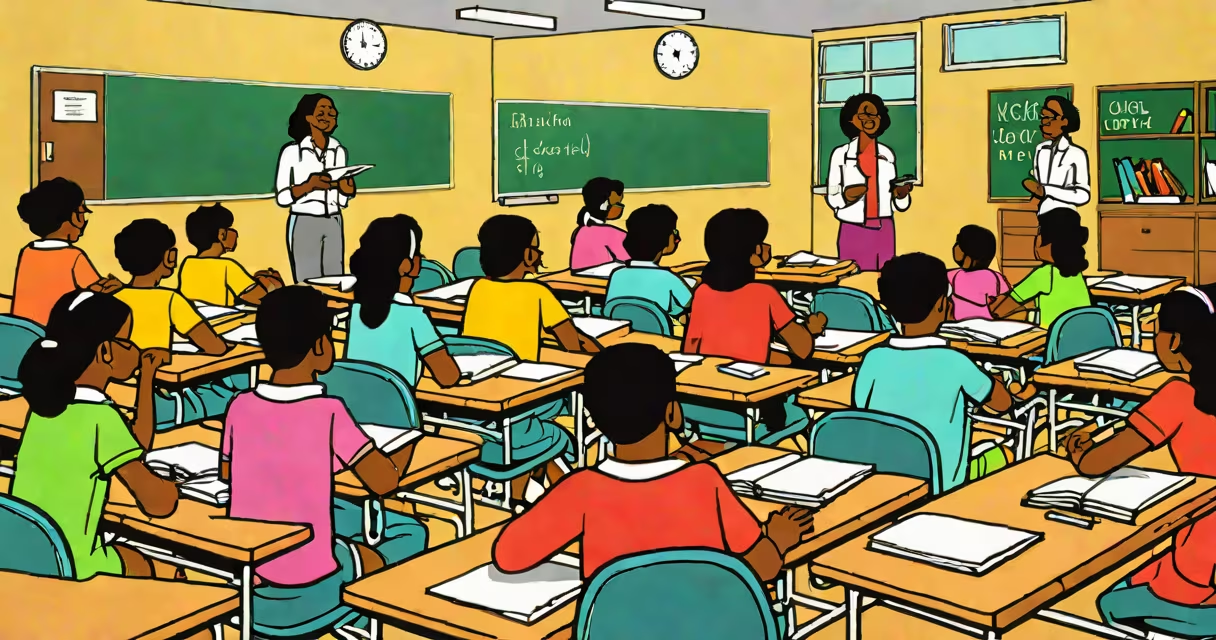
Education in sociology studies how schools function as institutions that reflect, reinforce, and sometimes challenge social structures, power relations, and cultural norms. It analyzes how access to education shapes life outcomes and how educational systems reproduce social hierarchies across generations.
Sociologists don't treat education as neutral or purely about learning facts. Instead, they examine how classrooms mirror societal values, allocate opportunities unevenly, and influence identity formation. The field draws on multiple theoretical frameworks-functionalism, conflict theory, and symbolic interactionism-to interpret patterns in schooling.
For example, a 2019 study by the National Center for Education Statistics found that students from low-income families were 30% less likely to graduate high school on time compared to their higher-income peers. This disparity isn't due to individual effort alone-it reflects systemic factors such as underfunded schools, tracking systems, and differential access to tutoring and college counseling.
Functionalism views education as a mechanism that maintains social stability by transmitting shared values and preparing individuals for roles in the economy. Durkheim, a foundational figure in sociology, argued that schools teach discipline, cooperation, and national identity-skills essential for a functioning society.
Conflict theory, rooted in Marx's analysis of class struggle, sees education as a tool for maintaining existing power structures. Schools sort students based on socioeconomic status, often channeling working-class youth into vocational tracks while reserving elite universities for the wealthy. This process reproduces inequality rather than reducing it.
Symbolic interactionism focuses on everyday interactions within classrooms. Teachers' expectations can shape student performance through the self-fulfilling prophecy. A 1968 study by Rosenthal and Jacobson showed that when teachers were told certain students were "late bloomers," those students improved -even though the labels were randomly assigned.
Different sociological perspectives show distinct ways education operates. The table below compares core approaches:
| Theory | Focus | Key Mechanism | Example |
|---|---|---|---|
| Functionalism | Social cohesion and role preparation | Transmission of shared values | Teaching patriotism through history curricula |
| Conflict Theory | Reproduction of inequality | Tracking and resource allocation | High-poverty schools receiving less funding |
| Symbolic Interactionism | Meaning-making in classroom settings | Teacher-student interactions and labeling | Labeling a student as "gifted" leading to higher expectations |
A common misconception is that education is inherently meritocratic-that success results solely from talent and hard work. But research shows that family background, race, and neighborhood quality strongly predict academic achievement. A 2021 report from the Brookings Institution confirmed that students in predominantly white school districts received 29% more per-pupil spending than those in majority-Black districts.
Another subtle point: standardized testing, often seen as objective, embeds cultural bias. Questions favor middle- and upper-class experiences. For instance, a math problem referencing a family vacation to Europe may confuse students from urban communities unfamiliar with that context.
Understanding education in sociology reveals why policies like school integration or equitable funding fail when they ignore deeper structural issues. For example, desegregation efforts in the 1970s reduced racial isolation but did little to close achievement gaps because underlying inequities in resources and teacher quality persisted.
I once observed a high school in Detroit where a single counselor served 450 students. During a college application workshop, only 12 students submitted applications. The counselor had no time to review essays or verify deadlines. This wasn't lack of motivation-it was structural failure. The system didn't support students who needed it most.
Some assume that increasing school choice through charter schools reduces inequality. But data from the U.S. Department of Education shows that charters serve disproportionately white and affluent populations in urban areas, often diverting funds from public schools without improving equity.
Education in sociology isn't about debating whether schools are good or bad. It's about recognizing that schools are sites of power. They define who belongs, who excels, and who gets left behind.
When we analyze education through a sociological lens, we see that policies like No Child Left Behind or Every Student Succeeds Act aim to improve outcomes-but they often measure success using narrow metrics like test scores, ignoring social conditions like hunger, housing instability, or trauma.
For instance, a 2020 study published in American Sociological Review found that students experiencing food insecurity scored 15% lower on standardized tests than their peers. Yet schools with high poverty rates still face punitive measures for low scores, despite environmental barriers beyond their control.
Recognizing these dynamics allows us to design better systems. Reforms that address teacher distribution, mental health services, and community-based learning programs have shown measurable improvement in student engagement and retention.
Understanding education in sociology helps dismantle myths about individual responsibility. Success isn't just about effort-it's shaped by access, opportunity, and institutional design. When we look past the surface, we see that education is both a mirror and a mold of society.