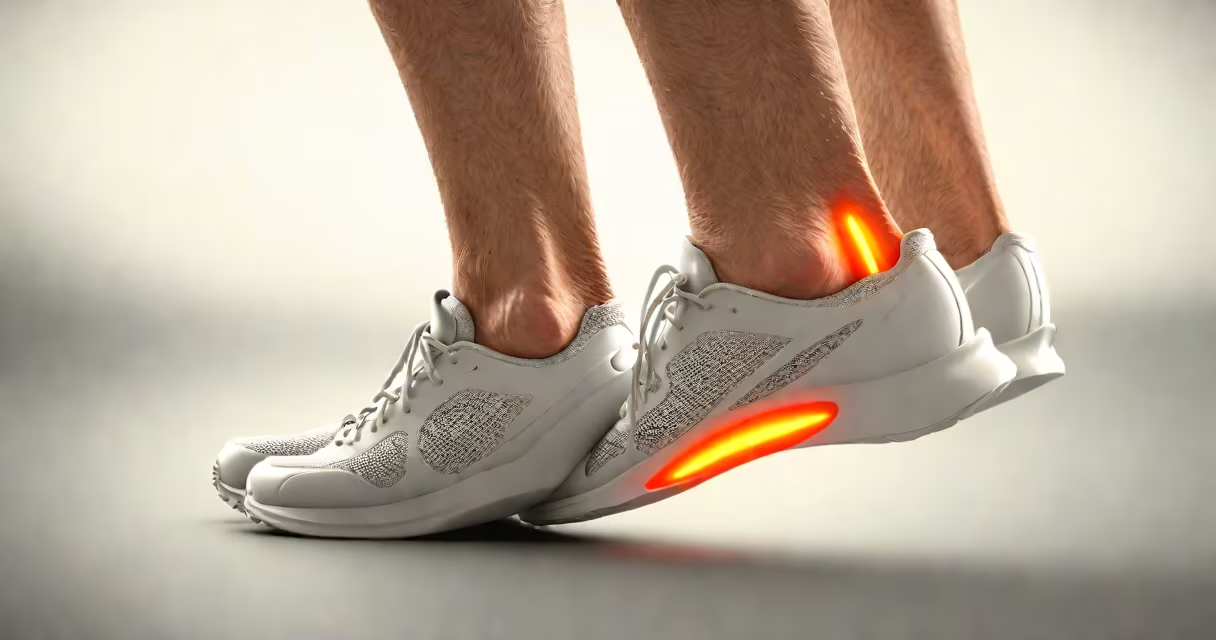
Achilles tendon sore from running occurs when the thick band connecting calf muscles to the heel becomes inflamed or strained due to repetitive stress during running, especially when training volume increases too quickly.
The Achilles tendon is the strongest tendon in the human body, capable of handling forces up to 10 times body weight during running. When subjected to sudden or excessive load-such as increasing weekly mileage by more than 10%, adding hill sprints, or switching to worn-out shoes-the tendon can develop microtears and inflammation. This leads to localized pain, stiffness, and reduced function, particularly during push-off phases of running.
Common symptoms include tenderness just above the heel bone, pain that worsens with activity and improves with rest, and morning stiffness that eases after 5-10 minutes of walking. Swelling may appear around the tendon, especially after long runs. If left unaddressed, mild soreness can progress to partial tears or chronic degeneration, requiring weeks of rehabilitation.
Running places high mechanical demands on the Achilles tendon. During each stride, the tendon stretches and recoils under tension. Over time, inadequate recovery between sessions disrupts the tendon's natural repair cycle. The body cannot keep up with tissue breakdown, leading to cumulative damage.
Key triggers include abrupt changes in training intensity-like going from 10 miles per week to 25 in two weeks-or running on hard surfaces such as asphalt, which increase impact forces. Poor footwear lacking arch support or cushioning can alter foot strike mechanics, shifting load to the Achilles. Tight calf muscles (gastrocnemius and soleus) reduce ankle dorsiflexion, increasing tendon strain during toe-off.
A 2021 study published in the British Journal of Sports Medicine found that runners who increased their weekly distance by more than 15% were 3.6 times more likely to develop Achilles tendinopathy than those who progressed gradually. The study emphasized that even small jumps in volume-just 5-10% per week-can exceed the tendon's adaptive capacity.
Achilles tendon soreness typically follows a progression from reactive tendinopathy to degenerative tendinopathy. Early stages involve acute inflammation and swelling, while later stages show structural changes like disorganized collagen fibers and vascular proliferation.
| Stage | Duration | Pain Pattern | Recovery Time |
|---|---|---|---|
| Reactive tendinopathy | Less than 3 weeks | Pain at start of run, eases with movement | 2-4 weeks with rest and load modification |
| Early degenerative | 3-6 weeks | Pain persists throughout activity, returns after rest | 6-12 weeks with rehab |
| Chronic degenerative | Over 6 weeks | Pain constant, may limit running ability | 3-6 months with targeted exercise |
Reactive tendinopathy is reversible with rest and load management. Degenerative stages require progressive loading exercises-such as slow eccentrics-to rebuild tendon strength. Ignoring early warning signs risks transitioning into chronic tendinopathy, which takes longer to resolve and may require physical therapy or imaging for diagnosis.
Many runners assume that stretching the calves will fix Achilles soreness. While tightness contributes, static stretching alone does not address the underlying issue: impaired tendon loading capacity. A 2019 review in Journal of Orthopaedic & Sports Physical Therapy concluded that static stretching had no significant effect on Achilles tendinopathy outcomes compared to eccentric strengthening programs.
Another mistake is using anti-inflammatory medications like ibuprofen to mask pain. While they reduce discomfort temporarily, they do not promote healing and may delay recognition of worsening symptoms. Corticosteroid injections are contraindicated in the Achilles tendon due to risk of rupture-this is a key difference from other tendons like the patellar or rotator cuff.
Some believe that "rest" means complete cessation of all activity. In reality, relative rest-reducing running volume while maintaining low-impact cardio-is more effective. A 2020 trial showed that runners who continued swimming or cycling during symptom flare-ups returned to running 28% faster than those who stopped all movement.
If you feel soreness behind the heel after a run, stop running for 3-5 days. Apply ice for 15 minutes twice daily during the first 72 hours. Avoid high-impact activities like jumping or sprinting until pain resolves.
Begin a structured program of isometric holds: stand on a step, rise onto toes, then hold the position for 45 seconds. Repeat 3 sets, twice daily. Isometrics reduce pain and improve tendon tolerance within days. After 1-2 weeks, progress to slow eccentric heel drops: stand on a step, lower heels below the edge, then rise slowly using both feet. Perform 3 sets of 15 reps daily.
I personally experienced this pattern during a half-marathon training cycle. After increasing my weekly mileage from 20 to 35 miles, I developed sharp pain during the last mile of long runs. I paused running, did 2 weeks of isometrics, then reintroduced running at 50% volume. By week 4, I was back to full training without pain. The key was not stopping completely, but modifying load.
Prevention centers on gradual progression-limit weekly increases to 10% or less-and choosing shoes with adequate heel cushioning. Replace running shoes every 300-500 miles. Perform daily calf stretches and strengthen the posterior chain with single-leg balance drills.
Recognizing achilles tendon sore from running early prevents long-term setbacks. Addressing it with proper load management and evidence-based exercises restores function faster than waiting for symptoms to disappear on their own.
Recovery is not about avoiding movement-it's about moving correctly. The tendon adapts to controlled stress. Return to running safely by respecting your body's signals and following a proven plan.