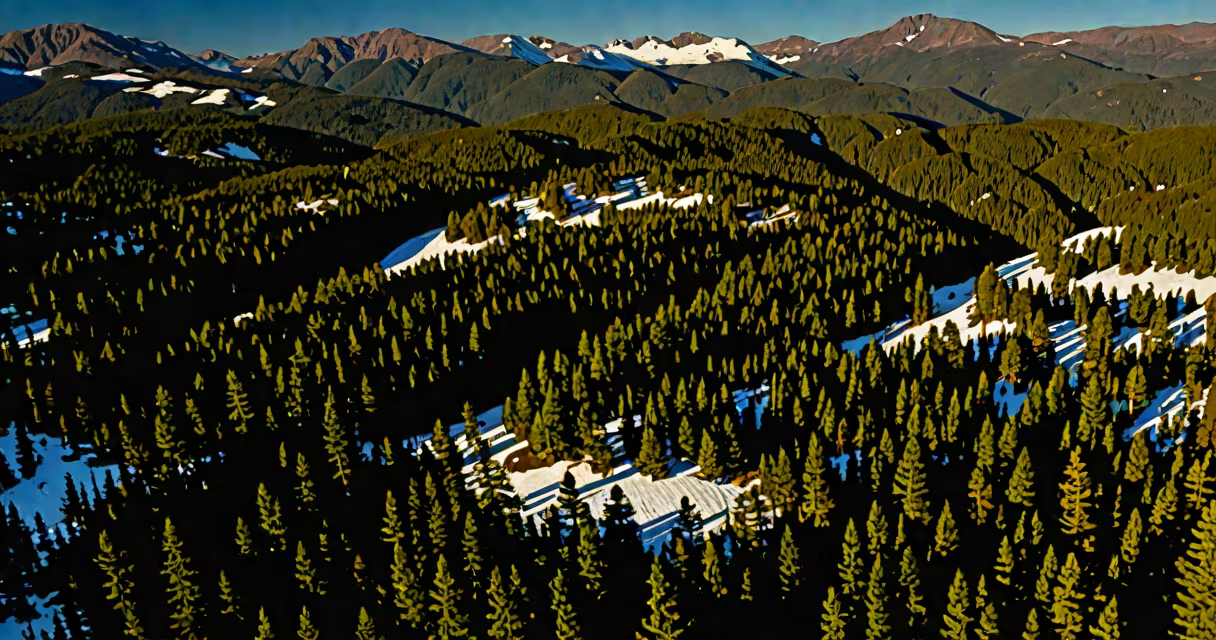
Alerce Andino National Park is a protected area in southern Chile's Los Lagos Region, established in 1934 to conserve old-growth forests dominated by the long-lived alerce tree (Fitzroya cupressoides). The park spans 26,800 hectares across rugged Andean terrain, preserving one of the last remaining stands of these millennia-old conifers.
Access requires planning. The nearest major town is Puerto Montt, about 500 km north. Most visitors arrive via the Carretera Austral, a scenic but unpaved route running through Patagonia. Trailheads start at Puyuhuapi or Chiloé, but internal roads remain limited. Only guided tours or experienced backcountry travelers enter the core zone. This isolation preserves the park's ecological integrity.
The park's high rainfall-averaging 2,500 mm annually-fuels dense moss-covered forests and slow-moving streams. These conditions support a complex web of life. Lichens, fungi, and epiphytic plants grow on alerce branches, creating microhabitats for birds and insects. The soil remains acidic and waterlogged due to low decomposition rates, slowing nutrient cycling.
Endemic species thrive here. The monito del monte, a small marsupial, nests in hollow alerce trunks. The huemul deer, endangered and culturally significant, uses the park's corridors for seasonal migration. Birds like the Andean condor and the Magellanic woodpecker rely on deadwood and mature canopy layers for nesting and feeding.
Fire suppression is critical. Natural fires are rare in this region, but human-caused ignitions threaten the slow-growing alerce. The park's management plan prohibits open flames and limits campfires to designated sites. Rangers conduct annual patrols to detect illegal activity, including unauthorized logging and off-trail travel.
The park sits atop the Andean fold-and-thrust belt, shaped by tectonic uplift over millions of years. Glacial erosion carved U-shaped valleys and cirques. Moraines and glacial till form terraces along riverbanks. Bedrock consists primarily of sedimentary sandstone and shale, fractured by past seismic events.
Vegetation zones shift with elevation. Below 800 meters, temperate rainforest dominates. Species include alerce, coihue (Nothofagus dombeyi), and lenga (Nothofagus pumilio). Above 1,200 meters, subalpine scrub takes over-low shrubs like calafate and arrayán. Alpine meadows appear above 1,800 meters, hosting cushion plants and seasonal wildflowers.
Soil profiles show minimal leaching due to constant moisture. Organic layers can exceed 1 meter in thickness. Carbon storage in these soils exceeds 1,000 tons per hectare-higher than most tropical forests. This makes the park a key carbon sink in global climate models.
Protected under Chile's National System of Protected Areas (SNASPE), Alerce Andino National Park operates under strict environmental regulations. Entry requires permits issued by the Ministry of Environment (MMA). Visitors must follow the "Leave No Trace" principle: pack out all waste, stay on marked trails, and avoid disturbing wildlife.
Recreational use centers on hiking. The most popular trail is the Sendero del Alerce, a 12-kilometer loop through primary forest. It takes 5-7 hours round trip and includes a suspension bridge over the Río Palena. No camping is permitted in the core zone. Designated campsites exist only at the park's eastern edge, near the village of Chacabuco.
Scientific research occurs under permit. Studies focus on alerce growth patterns, fungal symbiosis, and climate resilience. Researchers from the Universidad de Chile and the Centro de Estudios Ambientales de la Universidad Austral have documented alerce rings showing drought cycles from the 14th century. These records help reconstruct past climate variability in southern South America.
| Type | Location | Key Feature | Access Level |
|---|---|---|---|
| Core Zone | Central and western areas | Primary forest, alerce groves, rivers | Restricted; only guided access |
| Buffer Zone | Eastern and northern edges | Secondary forest, grazing land | Limited public access |
| Recreation Zone | Entrance near Chacabuco | Trails, visitor center, picnic areas | Open daily, fee required |
Many assume Alerce Andino National Park is part of a larger network like Torres del Paine or Patagonia National Park. It is not. It lies in a different administrative region and is managed separately by the Chilean government's National Forestry Corporation (CONAF).
Another error: thinking the alerce tree is extinct or nearly gone. While severely reduced by 19th-century logging, surviving stands remain viable. CONAF estimates 15,000 alerce trees still exist in protected areas, with Alerce Andino hosting about 30% of them. The species is listed as Endangered on the IUCN Red List, but recovery efforts are underway.
A lesser-known fact: the alerce's resin contains compounds with antifungal properties. Indigenous Mapuche people historically used it to treat skin infections. Modern pharmacological studies confirm antimicrobial activity in lab tests, though no clinical applications exist yet.
In January 2022, I walked the Sendero del Alerce with a local guide from Chacabuco. We entered at dawn. Mist clung to the canopy. The air smelled of damp earth and pine resin. After 3 kilometers, we reached a stand of alerce trees over 1,500 years old. Their trunks were wider than a car, bark deeply furrowed and gray-green with lichen.
We stopped at a clearing where a fallen alerce lay half-submerged in a stream. Its roots formed a natural arch. The guide pointed out tiny mushrooms growing on the wood-mycorrhizal fungi essential to nutrient exchange. He noted that the tree had died during a dry period in the 1300s, confirmed by dendrochronology samples taken from its rings.
At noon, we heard the call of a pudú, the world's smallest deer. It darted across the trail and vanished into the undergrowth. No camera traps had recorded it in the area for five years. That sighting underscored the park's role in preserving biodiversity beyond headline species.
Alerce Andino National Park is not a destination for casual tourism. It demands preparation, respect for remote environments, and awareness of its fragile ecosystems. Yet for those who seek untouched nature, it offers one of the most profound experiences in southern Chile-a living archive of time, silence, and ancient trees.