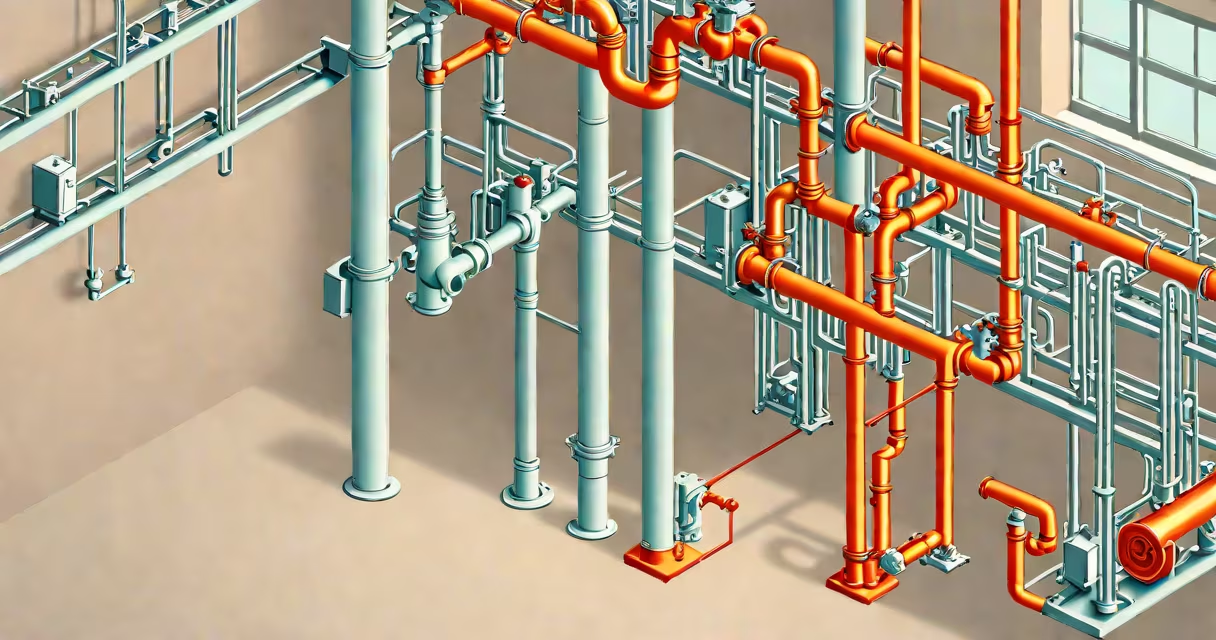
A sprinkler riser is a vertical pipe that connects a building's fire sprinkler system to the main water supply, ensuring consistent pressure and flow during a fire event. It's a critical component in high-rise and large commercial structures where water demand exceeds what standard plumbing can deliver.
Sprinkler risers are typically installed in dedicated shafts or mechanical rooms, running from the building's lowest improve through multiple floors. They serve as the primary conduit between the municipal water supply or fire pump and the horizontal branch lines that feed individual sprinkler heads. Without a properly sized and maintained riser, the entire sprinkler system may fail under pressure demands during a fire.
The National Fire Protection Association (NFPA) 13, Standard for the Installation of Sprinkler Systems, mandates specific design criteria for risers based on building height, occupancy type, and required flow rates. For example, a 10-story office building requires a riser capable of delivering 1,000 gallons per minute (gpm) at 50 psi minimum pressure at the highest sprinkler head.
When a fire triggers a sprinkler head, heat activates the fusible link, causing the head to open and release water. The water travels through the horizontal piping network and exits via the open head. But the volume and pressure needed come from the riser, which draws water from the main supply and distributes it upward through the building.
Risers are usually constructed from threaded steel pipe (Schedule 40 or 80) or copper, depending on local codes and project specifications. They're fitted with isolation valves at each floor level to allow maintenance without shutting down the entire system. A pressure-reducing valve (PRV) may be installed near the base to prevent excessive pressure in lower floors, which could damage sprinkler heads or piping.
During a fire, the riser must maintain steady flow even if multiple zones activate simultaneously. A failure in the riser-such as corrosion, blockage, or undersizing-can result in inadequate water delivery, leading to uncontrolled fire spread. This is why risers undergo regular inspection and testing per NFPA 13 and local fire codes.
There are two primary types of sprinkler risers: standpipe risers and sprinkler system risers. Standpipe risers serve firefighting personnel using hose connections, while sprinkler risers specifically serve automatic sprinkler systems. The latter is the focus here.
| Type | Use Case | Material | Code Requirement |
|---|---|---|---|
| Single Riser | Small to medium buildings (up to 6 stories) | Steel pipe (Schedule 40) | NFPA 13, Section 8.1.3 |
| Double Riser | High-rises, hospitals, large hotels | Steel pipe (Schedule 80), dual isolation valves | NFPA 13, Section 8.1.4 |
| Fire Pump-Connected Riser | Buildings exceeding 150 ft in height | Steel, reinforced with supports | NFPA 13, Section 8.1.5 |
Double riser systems are common in high-rises. Each riser serves half the building's sprinkler zones. If one fails due to a rupture or blockage, the other continues supplying water. This redundancy improves reliability and meets code requirements for life safety in dense occupancies.
Non-compliance with riser design standards can lead to system failure. In 2018, a fire in a New York City apartment building failed to contain due to a partially blocked riser caused by sediment buildup. The investigation revealed that annual flushing procedures had been skipped for five years, violating NFPA 13 Section 10.2.4.
Many people confuse a sprinkler riser with a standpipe system. While both are vertical pipes serving fire protection, they differ in function. A standpipe allows firefighters to connect hoses manually, whereas a sprinkler riser delivers water automatically to sprinkler heads without human intervention.
Another misconception is that risers are only needed in tall buildings. In reality, any structure with a sprinkler system over 100 feet in height or requiring more than 500 gpm of flow must have a riser. Even a small warehouse with high ceilings and flammable materials may require one.
One non-obvious fact: risers must be anchored at intervals to prevent sway during seismic events. According to ASCE 7-22, seismic design for fire protection systems requires risers to be secured within 10 feet of each floor connection. Failure to comply increases the risk of pipe rupture during earthquakes, especially in regions like California.
In a 22-story office tower in Chicago, the sprinkler riser runs from the basement fire pump room to the roof. It's made of Schedule 80 steel pipe, 6 inches in diameter, and includes two isolation valves per floor. The system was designed to deliver 1,800 gpm at 75 psi minimum at the top floor.
During a routine test, inspectors discovered a 30% drop in pressure between the 10th and 15th floors. Investigation revealed a collapsed support bracket allowing the pipe to sag. The sag created a low spot where air pockets formed, disrupting flow. After replacing the bracket and bleeding the system, pressure returned to specification.
This incident underscores that risers aren't passive components-they require ongoing monitoring. The building's maintenance team now performs quarterly visual inspections and annual pressure tests per NFPA 13.
I've witnessed a similar issue during a site audit for a hospital renovation. A newly installed riser had improper bracing, causing vibrations during pump startup. The noise triggered false alarms in adjacent patient rooms. Correcting the support spacing eliminated the problem. That experience confirmed that even minor installation flaws can compromise system integrity.
Understanding what is a sprinkler riser is essential for anyone involved in building safety, fire protection engineering, or facility management. It's not just a pipe-it's a lifeline during emergencies.
Properly designed and maintained sprinkler risers ensure that water reaches every corner of a building quickly and reliably. They are a foundational element of modern fire safety infrastructure, governed by strict codes and tested regularly to save lives and property.