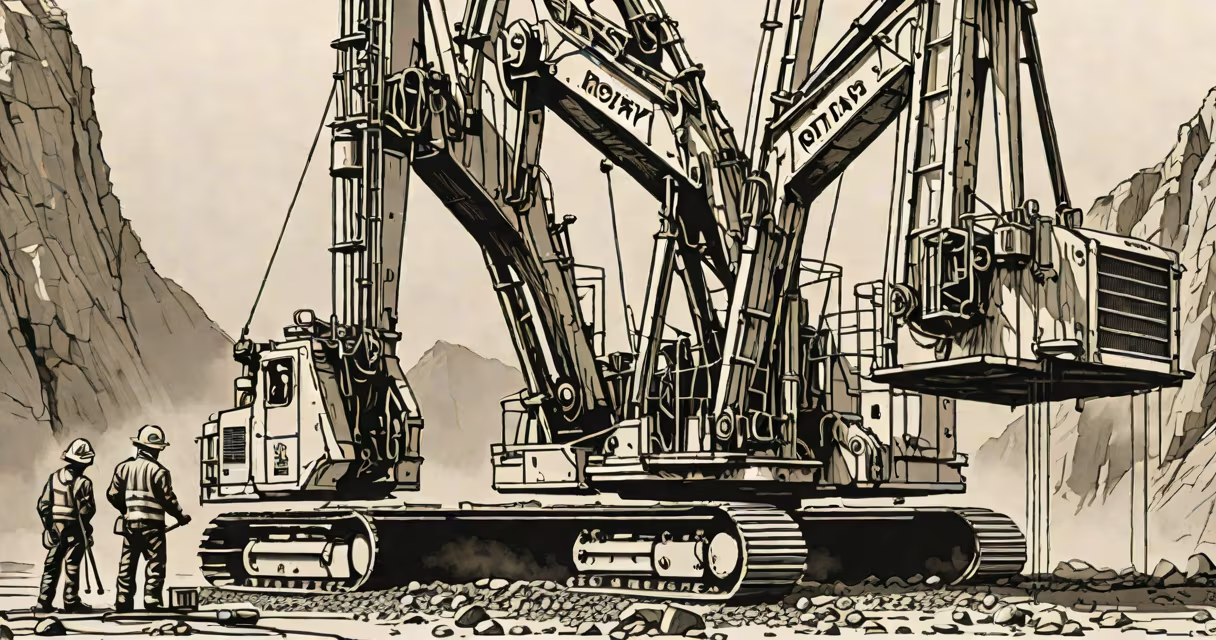
A rotary drill is a mechanical system that uses continuous rotation to drive a drill bit into rock, soil, or other subsurface materials. It applies downward pressure and rotational force through a drill string to create boreholes for oil and gas extraction, mineral exploration, foundation work, and water well installation.
Rotary drills differ from percussive or hammer drills by relying on sustained rotational motion rather than impact. They are essential in deep-hole applications where stability, precision, and continuous penetration are required. The core components include a rotary table or top drive, drill string, drill bit, and mud circulation system.
According to the U.S. Bureau of Safety and Environmental Enforcement (BSEE), rotary drilling accounts for over 90% of offshore oil well construction due to its efficiency in reaching depths exceeding 10,000 feet. This method enables consistent hole quality and reduces the risk of stuck pipe compared to older techniques.
The rotary drill operates by rotating a drill string connected to a drill bit at the bottom of a borehole. As the bit turns, it cuts into the formation, and cuttings are removed by circulating drilling fluid-commonly called "mud"-down the inside of the drill pipe and back up the annular space between the pipe and the borehole wall.
Drilling fluid serves multiple functions: it cools the bit, suspends cuttings, controls formation pressure, and stabilizes the borehole wall. Without this fluid, the bit would overheat and the hole could collapse. The flow rate and viscosity are adjusted based on rock type and depth.
For example, in shale formations at 6,000 feet depth, a rotary drill may operate at 120 revolutions per minute (RPM) with 30,000 pounds of weight on bit (WOB). The mud is pumped at 1,200 gallons per minute, maintaining a specific gravity to balance pore pressure and prevent blowouts.
Rotary drills consist of several integrated systems. The surface equipment includes the drawworks (hoist), rotary table or top drive, kelly, swivel, and mud pumps. The downhole assembly comprises the drill string (drill pipe, drill collars), drill bit, and casing.
There are two primary configurations:
| Type | Operation | Use Case | Advantage |
|---|---|---|---|
| Rotary Table System | Rotates the drill string via a floor-mounted rotary table and kelly drive | Onshore drilling, shallow wells | Lowers initial equipment cost |
| Top Drive System | Motor mounted above the drill floor that rotates the string independently | Deep wells, offshore rigs, directional drilling | Enables continuous drilling without connecting joints |
Top drives are standard on modern rigs because they allow faster tripping (removing and replacing the drill string) and better control during complex well paths. The American Petroleum Institute (API) reports that top drive usage increased from 40% to over 85% in onshore operations between 2010 and 2020.
Many people confuse rotary drills with percussion or impact tools. A rotary drill does not rely on hammering motion. Instead, it removes material through shear and abrasion. Percussion tools, such as down-the-hole hammers, are used in hard rock where rotary bits wear out too quickly.
Another misconception is that rotary drills only work in oil and gas. While they are dominant in hydrocarbon exploration, they are also used in geothermal energy projects, foundation drilling for skyscrapers, and groundwater access in arid regions. For example, a rotary drill installed a 1,200-foot-deep water well in rural Arizona using a polycrystalline diamond compact (PDC) bit to penetrate caliche and basalt layers.
One non-obvious distinction: rotary drilling does not always require a complete drill string. In some cases, such as wireline coring or slimhole drilling, shorter strings or specialized tools reduce weight and improve maneuverability. These setups are common in environmental sampling and geological surveys.
In 2022, a rotary drill rig operated by a Texas-based contractor drilled a 9,200-foot vertical well in the Permian Basin. The project used a top drive system with a 12.25-inch PDC bit, rotating at 75 RPM and applying 25,000 pounds of WOB. Drilling fluid was formulated with bentonite and barite to maintain a density of 10.5 pounds per gallon.
Over 18 hours, the rig advanced 300 feet per day. Cuttings were analyzed hourly to assess formation changes. When encountering a fractured zone at 5,800 feet, the mud weight was increased to 11.2 ppg to prevent influx. The entire well was completed in 11 days, meeting API standards for hole deviation and casing integrity.
This example shows how rotary drilling combines mechanical power, fluid dynamics, and real-time monitoring to achieve precise results in challenging environments.
I once observed a rotary drill rig during a field visit to a wind farm site in West Texas. The team was installing foundation piles for turbine bases. The rig used a 16-inch diameter rotary bit to bore through sandstone and clay. What stood out was the noise-constant low-frequency hum from the top drive and pump station-and the thick, dark mud dripping from the swivel. The crew monitored torque and rate of penetration on a screen in the cab. It wasn't just machinery-it was a coordinated system where every parameter had to stay within tight tolerances.
Rotary drills are used in three primary industries:
They are preferred over alternative methods because they offer predictable penetration rates, reduced downtime, and compatibility with automated control systems. Modern rigs integrate sensors that track torque, RPM, mud flow, and bit wear in real time, feeding data to central dashboards.
For example, a 2021 study by the Society of Petroleum Engineers (SPE) found that rigs equipped with real-time monitoring reduced non-productive time by 22% compared to manual tracking alone.
Understanding what is a rotary drill means recognizing it as a precision engineering system, not just a spinning tool. Its effectiveness lies in the integration of mechanics, hydraulics, and data feedback. Whether boring through desert rock or extracting crude from beneath the sea floor, the rotary drill remains the core of deep-hole drilling worldwide.