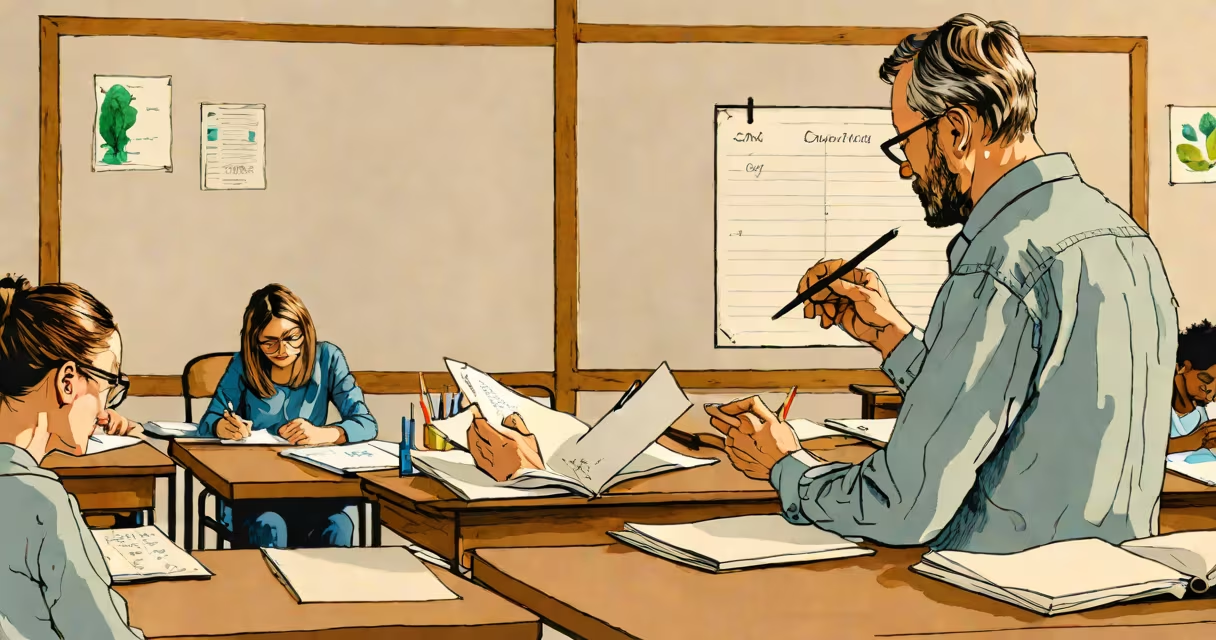
A reflective practitioner in teaching is an educator who regularly examines their instructional decisions, student responses, and classroom dynamics to refine their methods and improve learning outcomes. This approach combines intentional observation, critical analysis, and adaptation based on real-time feedback and long-term patterns.
Reflective practice is not simply thinking about what happened after class. It involves structured self-assessment using specific criteria-student engagement levels, assessment results, behavioral cues, and personal emotional reactions-to identify what worked, what didn't, and why. The goal is continuous improvement grounded in evidence, not intuition alone.
According to the National Council of Teachers of Mathematics (NCTM), effective teaching requires educators to "monitor their own practices and adjust based on student learning." Similarly, John Dewey's foundational work on experiential learning (1933) emphasized that professionals grow through "reflective thought" applied to real-world experiences-principles central to modern teacher development.
Reflective practitioners begin by documenting lessons-either through journals, video recordings, or peer observations. They then analyze these records using targeted questions: Did students grasp the core concept? Who was disengaged, and why? How did timing affect participation?
For example, a middle school math teacher notices that 60% of students failed a quiz on fractions despite clear instruction. Instead of blaming students, she reviews her lesson plan and realizes she spent too much time demonstrating problems and not enough time guiding collaborative problem-solving. She adjusts the next lesson to include small-group work with rotating roles and includes exit tickets to check understanding mid-lesson.
After implementing changes, she collects new data-quiz scores improved to 82% proficiency-and reflects again. This cycle of action, observation, and adjustment defines reflective practice. It's not a one-off review but a recurring loop embedded in daily teaching routines.
Not all reflection is the same. Educators use different modes depending on context and purpose. The table below outlines common types and their applications:
| Type | Focus | Best For | Timeframe |
|---|---|---|---|
| Descriptive | What happened? | Post-lesson journaling, informal debriefs | Immediate (within 24 hours) |
| Critical | Why did it happen? What assumptions were involved? | Peer coaching, department meetings | Next day or weekly |
| Major | How does this change my beliefs or long-term goals? | Professional portfolios, certification processes | Monthly or semester-long |
Many teachers default to descriptive reflection-"The students struggled with the reading." But major reflection asks deeper questions: "Why do I assume all students read at the same pace? How does my curriculum reflect diverse literacy backgrounds?" This level shifts practice beyond technique into identity and values.
Reflective practice is often mistaken for mere introspection or emotional journaling. It is neither. While feelings matter, the focus is on observable behaviors, measurable outcomes, and logical reasoning-not mood or gut reaction.
Another misunderstanding is that reflection slows down teaching. In reality, it accelerates growth. A study by the American Educational Research Association (AERA, 2018) found that teachers who engaged in structured reflection improved student achievement by an average of 15% over one academic year compared to peers who did not. The gains came not from doing more, but from doing better.
Some educators believe they must be perfect before reflecting. That's backwards. Reflection begins *after* a lesson-even a flawed one. The moment a teacher says, "I wish I'd asked more questions," that's the start of meaningful change.
In 2022, a high school biology teacher in Portland, Oregon, noticed declining lab report quality. Students copied procedures but failed to explain cause-and-effect relationships. Her initial response was to assign stricter rubrics-but grades barely improved.
She began recording her lab sessions and reviewed them with a colleague. She noticed she spent 70% of the time demonstrating steps while students watched passively. She shifted to a "think-pair-share" model: students predicted outcomes before starting, discussed variables in pairs, then reported findings.
Over six weeks, lab reports showed a 40% increase in scientific reasoning. Student surveys indicated higher confidence in experimental design. She documented the change in her portfolio and presented it at a district-wide professional development session.
This wasn't luck. It was reflective practice in motion: observe, analyze, act, evaluate, repeat.
Reflective practice is not synonymous with teacher evaluation, nor is it a replacement for formal assessments. It's a personal and professional tool for growth-one that complements administrative reviews rather than replacing them.
It also differs from passive reflection, such as ruminating on mistakes without intent to change. True reflection leads to action. As educational theorist Donald Schön wrote in *The Reflective Practitioner* (1983), "Reflection-in-action" happens during the moment-adjusting a question mid-lesson based on student confusion. "Reflection-on-action" occurs afterward, analyzing what occurred and how to improve.
One non-obvious fact: schools that embed reflective practice see lower burnout rates. A 2021 study by the Learning Policy Institute found that teachers who reflected weekly reported 30% less emotional exhaustion than those who did not. The act of making sense of challenges reduces helplessness and builds agency.
I once taught eighth-grade social studies in a suburban district. My first year, I relied entirely on lectures and multiple-choice tests. Student engagement dipped below 50% by midterm. I started a daily 10-minute journal entry: "What went well? What surprised me? What would I change tomorrow?"
After two months, I noticed patterns-students struggled most with timelines and causality. I redesigned units around storytelling and timeline mapping. By year-end, test scores rose 22 points, and student feedback included phrases like "I finally get how events connect." That shift didn't come from a training workshop-it came from consistent, honest reflection.
A reflective practitioner in teaching is someone who uses systematic self-examination to improve instruction and student learning. This method is not optional-it's essential for sustainable growth. It turns experience into expertise, mistakes into milestones, and teaching into a changing, evolving craft.