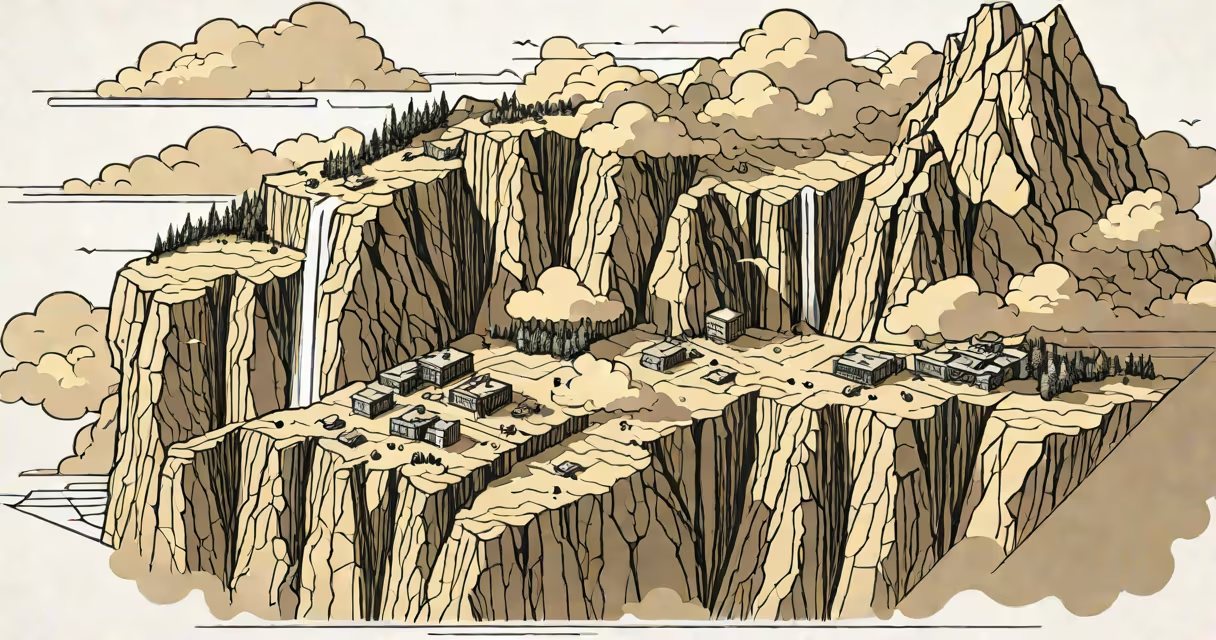
The word precipice refers to a steep, often vertical cliff or a sudden drop, especially one that is dangerous to approach. It also describes a critical or perilous situation where a major decision or consequence looms.
Literally, a precipice is a high, narrow edge of rock that drops sharply downward. The term originates from the Latin *praecipitium*, meaning "a fall" or "a sudden descent." This root reflects both physical danger and abrupt change.
In modern usage, precipice appears frequently in literature, political commentary, and everyday speech to describe moments of high risk or irreversible outcomes. It's not just about height-it's about consequence.
Precipice functions as a noun. It can appear in both physical and metaphorical contexts. When describing terrain, it refers to a natural feature-like the edge of a canyon or a mountain ridge. When used figuratively, it signals a turning point where failure or disaster is imminent.
For example: "The country stood on the precipice of economic collapse." Here, "precipice" doesn't mean a cliff-it means a moment of extreme vulnerability. The speaker implies that further action or inaction could lead to ruin.
Another example: "She hesitated at the precipice of quitting her job." This illustrates emotional weight-the character stands at a crossroads between stability and upheaval. The word emphasizes the gravity of the choice, not the physical location.
There are no formal subtypes of "precipice," but its usage falls into two clear categories: literal and figurative.
| Usage Type | Meaning | Example |
|---|---|---|
| Literally | A steep cliff or drop | The hikers paused at the precipice overlooking the valley. |
| Figuratively | A point of high risk or irreversible change | Climate scientists warn we're nearing the precipice of irreversible warming. |
Figurative use is far more common in contemporary writing. According to the Oxford English Dictionary, the metaphorical sense emerged in the 16th century and gained traction during the Industrial Revolution, when rapid social change created new anxieties about progress and decline.
People often mistake "precipice" for "precipitate"-a verb meaning "to cause something to happen suddenly." These words sound similar but have different meanings and parts of speech.
"Precipitate" can be a verb: "The government precipitated a crisis by cutting funding." "Precipice" is always a noun: "They stood at the edge of a precipice." Mixing them leads to grammatical errors and confusion.
Another frequent error is using "precipice" to describe slow decline. But the word implies suddenness. A gradual slide toward disaster is better described as "decline," "deterioration," or "downward spiral."
For example: "The company's profits fell steadily over five years." This is a decline. But "The board faced the precipice of bankruptcy after the scandal broke." That's sudden danger. The difference matters in tone and precision.
Consider the 2008 financial crisis. News outlets widely reported that "Wall Street stood on the precipice of collapse." This wasn't hyperbole-it was accurate. Markets had already begun freezing, and regulators were preparing emergency interventions. The word captured the urgency of the moment.
Similarly, in climate science, researchers use "precipice" to stress urgency. The Intergovernmental Panel on Climate Change (IPCC) reports state that global temperatures are approaching thresholds beyond which feedback loops may trigger irreversible changes. Scientists refer to these points as "climate precipices."
Even in fiction, the word carries weight. In *The Lord of the Rings*, Frodo stands at the edge of Mount Doom-the literal precipice of destruction. But it's also symbolic: the moment of final choice between surrender and sacrifice.
I once stood at the edge of the Grand Canyon's South Rim during a storm. Wind howled, visibility dropped, and the sheer drop felt endless. I remember thinking: this is what "precipice" truly means-not just a word, but a sensation. The ground vanished beneath my feet, and the air itself seemed to pull me forward. That moment taught me that the word isn't just descriptive-it's visceral.
Using "precipice" correctly sharpens communication. It signals danger, urgency, and irreversible consequence. Misusing it weakens impact. Overusing it dilutes meaning.
For writers, choosing "precipice" over weaker alternatives like "edge" or "point" adds gravity. For speakers, it conveys stakes. In policy debates, journalism, and personal decisions, precision matters.
When you say someone is "on the precipice," you're not suggesting they're near a problem-you're saying they're facing a moment where small choices lead to big outcomes. That's the power of the word.
Understanding "precipice" improves clarity in writing and speaking. It's not just a synonym for "danger"-it's a precise marker of critical junctures. Learn it, use it, and avoid the trap of mistaking it for similar-sounding words.