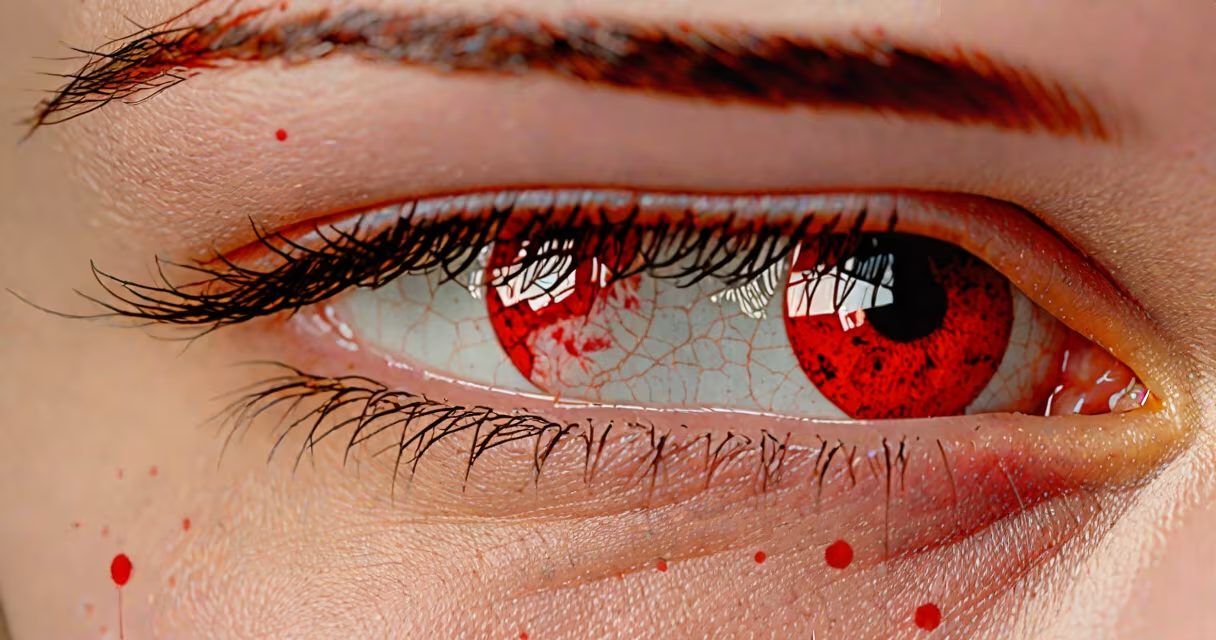
A red dot on skin near eye is a small, localized area of redness or a raised lesion appearing close to the eye's edge. It may be a benign growth like a cherry angioma, a minor irritation, or a sign of infection. This condition often appears suddenly and can persist for days to weeks without changing.
These dots typically form on the eyelid, brow bone, or cheek near the eye's corner. They're usually less than 3 mm wide and may appear flat or slightly raised. While most are harmless, changes in color, size, or texture require medical evaluation.
Common causes include blocked oil glands, insect bites, allergic reactions, or early-stage skin conditions such as seborrheic keratosis. In rare cases, a red dot near the eye signals a precancerous or cancerous lesion, especially if it bleeds easily or doesn't heal.
Red dots near the eye arise from blood vessel dilation, inflammation, or abnormal cell growth. The most frequent cause is a dilated capillary cluster forming a cherry angioma. These are benign vascular tumors composed of tightly packed capillaries. They appear as small, round, red or purple spots that don't fade under pressure.
Another common origin is a milia cyst-a tiny, trapped keratin-filled sac beneath the skin. When inflamed, it can look red and pimple-like. Infections like styes (hordeolum) also present as red, painful bumps at the eyelash base due to bacterial buildup in the oil gland.
According to the American Academy of Dermatology Association, about 75% of people develop at least one cherry angioma by age 60. These grow slowly and rarely cause symptoms beyond cosmetic concern.
Not all red dots near the eye are the same. Their appearance, location, and behavior help determine the underlying cause.
| Type | Appearance | Location | Common Cause |
|---|---|---|---|
| Cherry angioma | Small, round, bright red or purple, dome-shaped | Upper eyelid, temple, cheek | Blood vessel proliferation, aging |
| Stye (hordeolum) | Painful, swollen, yellowish center, red base | At lash root, inside eyelid | Staphylococcus aureus infection |
| Milia | White or yellowish, firm, 1-2 mm diameter | On eyelid or cheek | Keratin trapped under skin |
| Seborrheic keratosis | Dark brown to black, waxy, slightly raised | Forehead, cheek, near eye | Benign skin cell overgrowth |
Cherry angiomas are the most common red dot near the eye. They appear in adulthood and increase in number with age. Styes, while painful, resolve within 3-7 days with warm compresses. Milia often persist unless removed professionally.
One overlooked issue: contact dermatitis from skincare products. A red dot may appear after using a new eye cream or sunscreen. The reaction typically spreads slightly and causes itching. Patch testing helps identify triggers.
Most red dots near the eye aren't serious. But certain signs indicate a need for medical attention. Seek care if the dot:
I once saw a patient with a red dot on the upper lid that grew rapidly over five days. Biopsy revealed a basal cell carcinoma-early stage, but still required surgical removal. This highlights that even small lesions near the eye can be dangerous if ignored.
The American Academy of Ophthalmology warns that lesions near the lacrimal duct or medial canthus (inner corner) have higher risk of malignancy. These areas are rich in blood vessels and lymph nodes, making them vulnerable to aggressive skin cancers.
Many assume all red dots near the eye are acne or allergies. But acne doesn't occur on the eyelid because it lacks sebaceous glands. Allergies cause widespread redness, not isolated dots.
Another error: squeezing or picking at the dot. This increases infection risk and can spread bacteria. A single pimple on the face may resolve on its own, but a dot near the eye is part of the "danger triangle" - a facial region where veins drain directly to the brain. Infection here can lead to cavernous sinus thrombosis, a life-threatening condition.
Some patients mistake a cherry angioma for a sign of poor health. This is false. Cherry angiomas are linked to aging, not disease. They don't indicate liver problems or high blood pressure, despite old myths.
Start with observation. Note the dot's size, color, texture, and whether it's tender. Take daily photos to track changes. Avoid touching or applying makeup until clarity is reached.
For styes, apply warm compresses four times daily for 10 minutes. This reduces swelling and promotes drainage. Most resolve in 5-7 days. If no improvement, consult a provider.
If the dot persists beyond 14 days, grows, or bleeds, see a dermatologist. A biopsy or dermatoscopy may be needed. Treatment options include cryotherapy (freezing), electrodessication (electrical burning), or laser ablation.
For suspected allergic reactions, stop using new products. Apply a mild hydrocortisone cream (1%) twice daily for up to three days. If redness spreads or worsens, discontinue use and seek care.
Red dots near the eye are often harmless, but they demand careful attention. Recognizing the difference between a benign cherry angioma and a concerning lesion saves time and protects health.
Understanding the nature of a red dot on skin near eye begins with visual cues and history. If uncertainty remains, professional evaluation is essential. Early diagnosis ensures effective treatment and peace of mind.