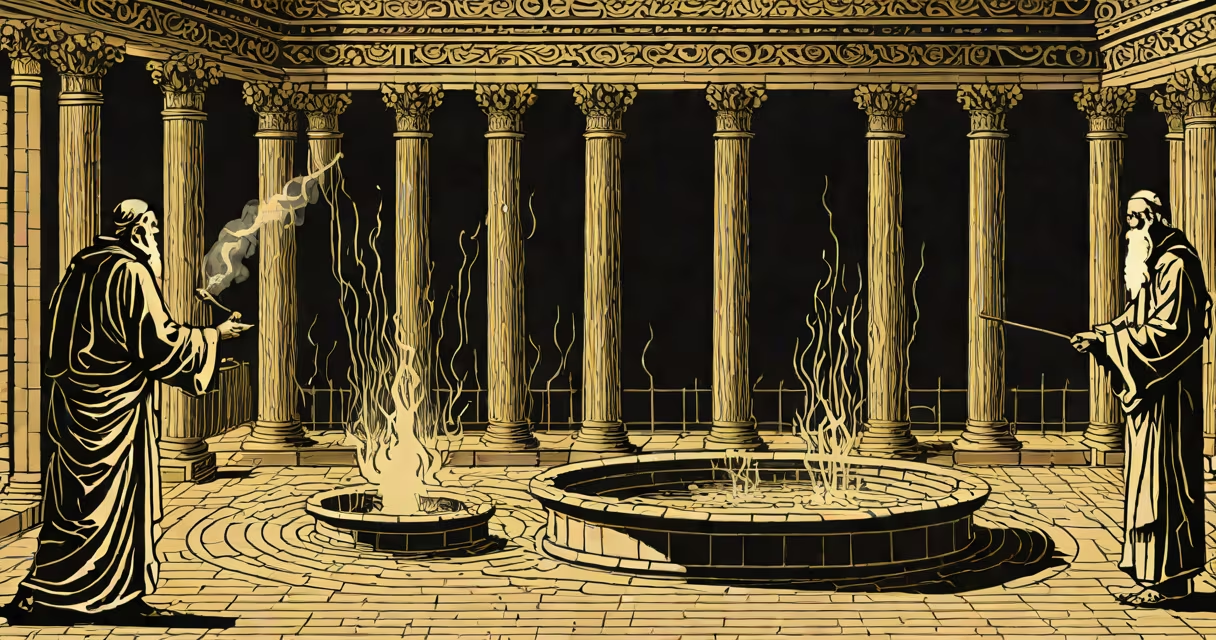
Purification in the Bible is a deliberate act of restoring ritual and moral cleanliness, enabling individuals and communities to maintain holiness and remain fit for worship. It appears in both physical rites and spiritual metaphors, primarily governed by laws in Exodus, Leviticus, and Numbers.
The concept originates in the covenantal structure between God and Israel. When someone became ceremonially unclean-through contact with death, childbirth, skin disease, or bodily emissions-they were barred from entering the sanctuary. Purification rituals reintegrated them into religious life. These acts were not about personal hygiene but about maintaining sacred order.
For example, after childbirth, a woman was considered unclean for seven days (15 days for a daughter), then required a 40-day purification period. At its close, she brought a lamb for a burnt offering and a pigeon or dove for a sin offering. This is detailed in Leviticus 12:6-8. The priest examined her and, if acceptable, declared her clean. Only then could she resume temple worship.
Purification in the Hebrew Bible operated through specific procedures tied to the Tabernacle and later the Temple. These were not symbolic gestures but required actions with precise timing, materials, and priestly oversight. Failure to follow the steps meant continued exclusion from sacred space.
Common methods included immersion in water, the use of ashes from a red heifer (Numbers 19), and offerings of animals. The red heifer ritual was especially strict: the animal had to be entirely red, never have borne a yoke, and be burned outside the camp. Its ashes were mixed with spring water and sprinkled on the unclean person on the third and seventh days.
According to the British and Foreign Bible Society, this process was designed to address uncleanness caused by bodily discharges, which were seen as disruptions to divine order. The ritual did not erase guilt-it restored access to worship. Moral guilt required separate atonement through sin offerings.
Biblical purification falls into three categories: ritual, moral, and spiritual. Each serves a distinct purpose within the theological system.
| Type | Source | Trigger | Method | Outcome |
|---|---|---|---|---|
| Ritual | Leviticus 11-15 | Touching dead bodies, childbirth, skin diseases | Water immersion, animal sacrifices, waiting periods | Restoration to holy community |
| Moral | Leviticus 16 (Yom Kippur) | Sins against God's commandments | High Priest enters Holy of Holies with blood of goat | Forgiveness of national sins |
| Spiritual | Psalm 51, 1 John 1:9 | Personal failure, disobedience | Confession, repentance, divine cleansing | Reconciliation with God |
A key distinction often missed is that ritual purification did not forgive sin-it prepared the individual to stand before God. Forgiveness came through sacrifice, particularly on Yom Kippur, the Day of Atonement. The high priest entered the Most Holy Place once a year, carrying blood from a goat offered for the people's sins.
As noted by the Jewish Virtual Library, Yom Kippur was the only day when the high priest could enter the inner sanctum. His actions were strictly regulated: he wore linen garments, offered incense, and sprinkled blood on the mercy seat. Without this ritual, the nation remained under divine judgment.
Purification was central to Israel's religious identity. It maintained separation between the holy and the common, reinforcing the idea that God dwells among a people who are set apart. The Tabernacle and later the Temple were places of presence-but only accessible to those deemed ritually clean.
Every festival cycle included purification elements. Passover required removing leavened bread from homes-a symbolic act of cleansing from corruption. Pentecost involved the offering of firstfruits and a wave offering, which also carried purifying significance.
During the Babylonian exile, the prophets emphasized that external rituals were insufficient without internal purity. Jeremiah 4:14 states: "Wash your heart from evil, O Jerusalem, that you may be saved." This shift marked a move toward spiritual purification as essential for lasting restoration.
Many confuse purification with forgiveness. They are related but distinct. A person could be purified (ritually clean) yet still carry guilt. Only confession and sacrifice removed sin's penalty.
Another error is assuming purification was only for priests. While priests had special duties, ordinary Israelites were responsible for their own purification. A man with a skin condition had to report to the priest, who assessed him. If diagnosed as unclean, he lived outside the camp until declared clean.
Modern readers sometimes treat biblical purification as metaphorical. But in its original context, it was literal and enforceable. The Law of Moses prescribed penalties for violating purification rules. Leviticus 15:31 says: "Keep my decrees and laws, because the people who do so will live by them." Disobedience carried communal consequences.
Consider the red heifer described in Numbers 19. The ritual required a perfect, unblemished red cow, never used for labor. It was slaughtered outside the camp, its body burned completely, including the hide, flesh, and dung. The priest collected the ashes and mixed them with spring water.
This mixture was used to sprinkle on people or objects that had touched a corpse. The ceremony occurred on the third and seventh days. After the seventh day, the person was considered clean. The priest who performed the rite became unclean himself-an ironic twist: the agent of purification became unclean through the act.
Archaeological evidence from Qumran (Dead Sea Scrolls site) shows that Essenes practiced similar rituals. The Copper Scroll references a red heifer ritual, suggesting ongoing relevance beyond the Second Temple period.
I once visited the ancient city of Bethsaida, where archaeologists uncovered a ritual bath (mikveh) dating to the 1st century CE. The stone-lined pool had steps leading down, consistent with immersion requirements. Nearby fragments bore inscriptions referencing "cleansing" and "holiness." Standing there, I realized how deeply purification shaped daily life-not as abstract theology, but as physical necessity.
These concepts intersect but differ. Affirmation supports faith; adornment shapes conduct; purification restores access. All contribute to holiness, but only purification reestablishes ritual eligibility.
Understanding purification in the Bible requires seeing it not as outdated ritualism but as a foundational expression of holiness. It reflects a worldview where physical actions shape spiritual reality. Today, many Christians interpret purification spiritually-through confession, repentance, and sanctification-but the original meaning remains grounded in law, action, and consequence.