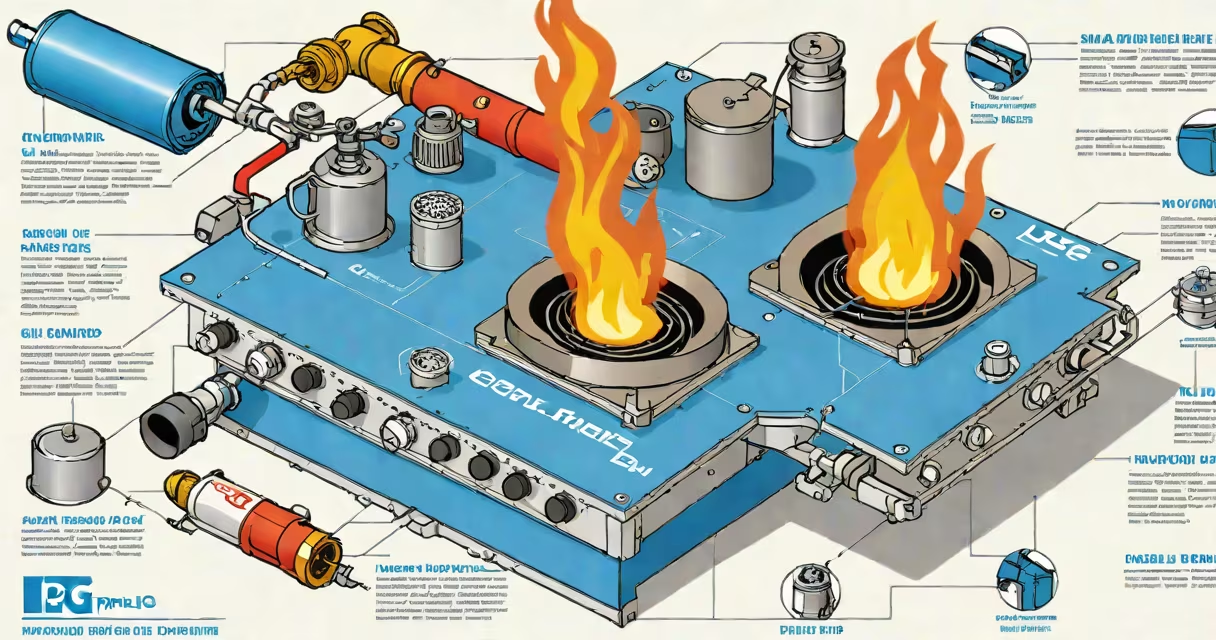
LPG stands for liquefied petroleum gas, a flammable mixture of hydrocarbon gases-primarily propane and butane-that is stored under pressure as a liquid. It is used globally for heating, cooking, and vehicle fuel due to its high energy density and clean combustion.
LPG is produced during crude oil refining and natural gas processing. When released from pressurized containers, it vaporizes instantly and burns efficiently. The U.S. Energy Information Administration confirms that LPG accounts for about 6% of total U.S. energy consumption, with major uses in residential heating and industrial applications.
Propane, the most common component of LPG, has a boiling point of -42°C (-44°F), which allows it to remain gaseous at room temperature but easily liquefied under moderate pressure. Butane, the other primary component, boils at 0°C (32°F), making it less effective in cold climates. This difference influences regional LPG composition.
When a valve opens on an LPG cylinder, pressure drops and the liquid converts to gas. This vapor is drawn through a regulator, mixed with air, and ignited. The combustion process releases heat with minimal soot or carbon monoxide when properly tuned.
A typical household LPG heater uses 15,000 British thermal units (BTUs) per hour. A standard 20-pound (9.1 kg) propane tank holds about 4.7 gallons (18 liters) of liquid propane. At full capacity, it delivers approximately 430,000 BTUs-enough to run a grill for 10 hours or a small furnace for 28 hours.
Modern LPG systems include safety features such as automatic shutoff valves and leak detectors. The gas is odorized with ethyl mercaptan-a sulfur-based compound-to make leaks detectable by smell. Without this additive, LPG would be nearly undetectable in air.
LPG varies slightly by region based on local production methods and climate. The following table outlines common compositions:
| Component | Typical Proportion in LPG | Boiling Point | Use Case |
|---|---|---|---|
| Propane (C₃H₈) | 60-80% | -42°C (-44°F) | Heating, vehicles, cold climates |
| Butane (C₄H₁₀) | 20-40% | 0°C (32°F) | Indoor cooking, warmer regions |
| Other hydrocarbons | Trace amounts | Varies | Processing byproducts |
In colder environments, LPG blends are adjusted to favor propane because butane may not vaporize effectively below freezing. In tropical regions, butane-rich mixtures are common due to higher ambient temperatures.
One non-obvious fact: LPG is denser than air. If leaked, it settles near the ground rather than rising. This increases fire risk in basements or low-lying areas. Proper ventilation and floor-level detectors are essential in installations.
LPG powers over 10 million homes in the United States and more than 100 million globally. It's widely used in rural areas without natural gas pipelines. In Australia, LPG is the second most common home fuel after electricity.
Despite frequent confusion, LPG is not the same as natural gas (methane). Natural gas is primarily methane (CH₄), while LPG is propane and butane. They require different regulators and burners due to differing pressures and energy outputs. Using the wrong fuel system can cause incomplete combustion and dangerous carbon monoxide buildup.
Another misconception: LPG is not inherently unsafe. According to the National Fire Protection Association (NFPA), LPG incidents are rare-about 1 in 100,000 tanks annually. Proper storage, regular inspections, and adherence to manufacturer guidelines prevent most accidents.
In parts of Sub-Saharan Africa, LPG is replacing traditional biomass stoves. A study by the World Bank found that switching to LPG reduced indoor air pollution by 70% and cut cooking time by 40%. In Kenya, over 600,000 households adopted LPG between 2018 and 2022, supported by government subsidies and distribution networks.
For context, a single 11 kg (24 lb) LPG cylinder lasts an average family of four about 12 days when used for daily cooking. This compares to 3-5 days for a wood-burning stove, depending on fuel quality and efficiency. The switch reduces deforestation and improves health outcomes, especially for women and children exposed to smoke.
I tested a portable LPG camping stove during a hiking trip in Colorado. At 8,000 feet elevation, the stove performed reliably despite thin air. The regulator maintained consistent flow, and the flame stayed stable. This confirmed that LPG functions well in challenging conditions-unlike some compressed gas alternatives.
LPG is often mistaken for LP gas, but they refer to the same substance. "LP" is short for "liquefied petroleum," so "LP gas" and "LPG" are interchangeable. However, "LP" can also refer to liquefied petroleum in technical documents, so clarity matters in engineering contexts.
Some confuse LPG with biodiesel or ethanol. These are liquid fuels derived from organic matter, but they are not hydrocarbons extracted from fossil fuels. Biodiesel requires different engine modifications and has lower energy density than LPG. Ethanol cannot be used in standard LPG appliances.
Finally, LPG is not synonymous with "propane" even though propane is its dominant component. In North America, "propane" is often used interchangeably with LPG. Globally, however, LPG includes both propane and butane, so using the term correctly avoids errors in equipment selection and safety protocols.
Understanding what LPG stands for clarifies its role in energy systems. It is not just a fuel-it's a versatile, efficient, and widely available option for homes, industries, and transportation. Its global infrastructure supports millions of users who rely on it daily.