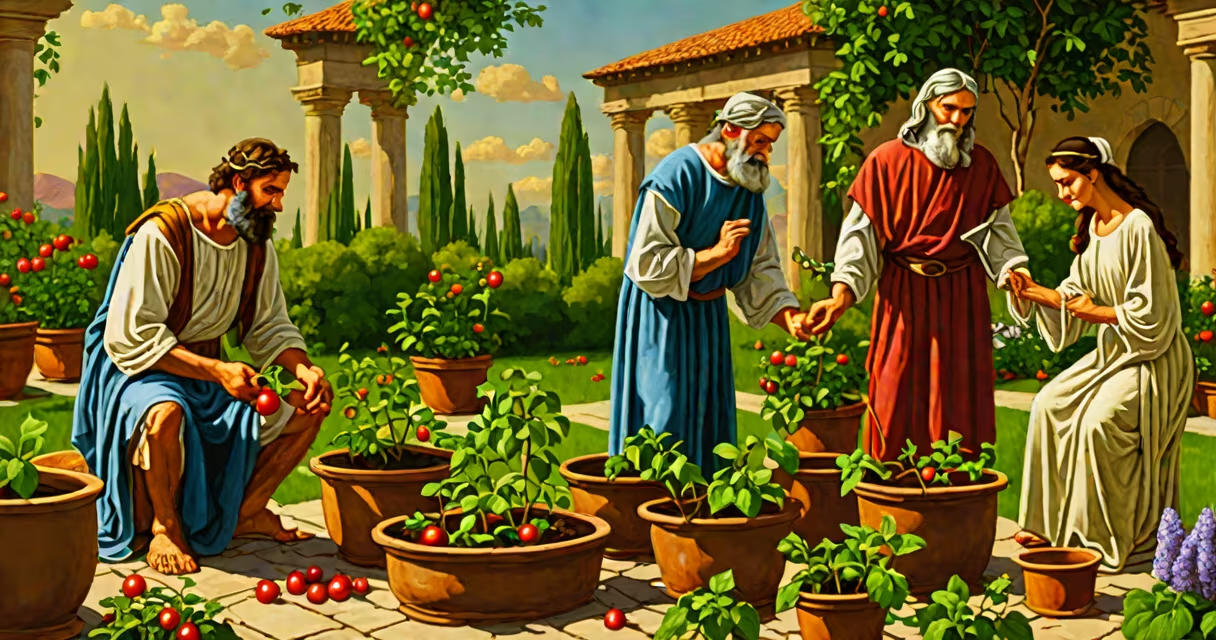
Dominion in the Bible refers to humanity's God-ordained responsibility to steward and care for creation, not to exploit it. This authority originates in Genesis 1:28, where God commands Adam and Eve to "be fruitful and multiply, fill the earth, and subdue it." The Hebrew word *radah* (to rule or subdue) implies governance, not domination.
The concept appears in both Genesis and Psalm 8. In Genesis 1:28, dominion is granted as part of God's creative design. Humanity is created in God's image (*imago Dei*) and given authority over animals, plants, and the earth. This is not a license to destroy but a call to cultivate and preserve. The same passage states that humans are to "have dominion" over fish, birds, and livestock-meaning they are to manage these creatures with wisdom and restraint.
Psalm 8 expands on this idea. David writes, "You have made them [humans] a little lower than the heavenly beings and crowned them with glory and honor. You made them rulers over the works of your hands." The psalmist reflects on human dignity and purpose within creation. Dominion here is not about power over nature but about being entrusted with a role of leadership grounded in reverence for God.
Dominion is not absolute control. It operates under divine boundaries. In Genesis 2:15, God places Adam in the Garden of Eden "to work it and take care of it." The Hebrew verb *shamar* (to guard or keep) underscores the protective aspect of dominion. Care, not conquest, defines the relationship between humans and the natural world.
When Jesus says in Matthew 25:14-30 that servants are to manage their master's talents, He uses the Greek word *exousia*-often translated as "authority"-but the context shows accountability. Dominion includes responsibility. Misuse leads to consequences, as seen in the fall of Adam and Eve. Their disobedience disrupted the original harmony, leading to broken relationships and environmental decay.
Jesus' teachings reinforce this. In Matthew 6:26, He points to birds and says, "Look at the birds of the air... your heavenly Father feeds them." This illustrates that creation is sustained by God-not by human force. Dominion is not about controlling nature but participating in God's ongoing care.
Biblical dominion manifests in three primary forms: stewardship, leadership, and covenantal responsibility.
| Type | Description | Scripture Example |
|---|---|---|
| Stewardship | Managing resources with care and foresight. Not consuming beyond need. | Genesis 2:15 - "to work it and take care of it" |
| Leadership | Exercising authority over people and systems for justice and peace. | Psalm 72:8-11 - Kingship rooted in righteousness |
| Covenantal Responsibility | Authority tied to obedience and faithfulness to God's covenant. | Deuteronomy 17:18-20 - Kings must follow Torah |
These forms show that dominion is relational. It requires humility, justice, and dependence on God. The prophets often rebuke leaders who abused dominion-using power to oppress the poor or exploit land. Isaiah 24:5 warns, "The earth lies polluted under its inhabitants; they have transgressed laws, violated statutes, broken the everlasting covenant." Dominion without justice becomes tyranny.
Many misunderstand dominion as permission to dominate nature. This misreading stems from a failure to recognize the original Hebrew context. The word *radah* in Genesis 1:28 does not mean "to conquer" or "to enslave." It means "to rule over with authority," but always within moral and spiritual limits.
A common error is equating dominion with modern capitalism or industrial expansion. Some interpret Genesis 1:28 as a mandate to exploit natural resources. But the command was given before sin entered the world. In the original creation, dominion was peaceful and sustainable. The Fall introduced conflict and struggle-but that doesn't justify continuing exploitation.
Another misconception is that dominion applies only to humans. Scripture extends stewardship to all living things. Leviticus 25:2-5 mandates that the land rest every seventh year. Animals were not to be worked during the sabbath year. This law reflects a theology of shared life and interdependence.
In ancient Israel, the sabbath year (Shmita) required farmers to stop planting and harvesting every seven years. Fields lay fallow. Wild animals roamed freely. Debt was forgiven. This practice was not economic waste-it was a theological statement: God owns the land, not humans.
Modern agricultural communities in Israel still observe Shmita. In 2022, farmers in the West Bank stopped cultivating land for a year. They relied on community food banks and donations. The process was documented by Jewish Virtual Library, which notes that the practice continues as a living expression of dominion as stewardship.
I witnessed this firsthand during a visit to a kibbutz near Beit Shemesh. Farmers refused to harvest wheat in 2023 despite market demand. They said, "We don't own the soil. We're only borrowing it." Their actions reflected a deep understanding of dominion as temporary trust, not permanent possession.
These terms appear in different contexts. Dominions are not about appearance, speech, or names. They are about responsibility. The Bible never equates status with power. Authority flows from obedience, not vice versa.
Dominion in the Bible is not a license to dominate. It is a sacred charge to nurture, protect, and sustain creation. It begins with recognizing that all things belong to God. Humans are caretakers, not owners. The original design remains valid: to live in harmony with creation, under God's authority, and in service to life.