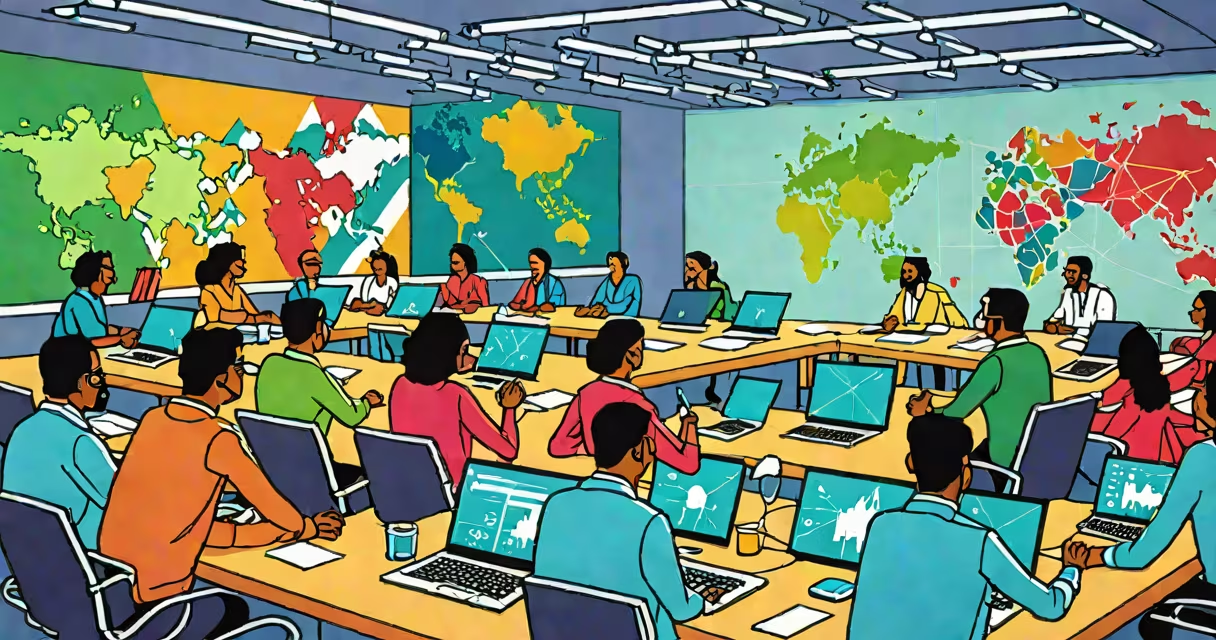
Global scholars are researchers, educators, and academic professionals who engage in international collaboration to advance knowledge across disciplines, institutions, and national boundaries. Their work spans funded research projects, joint publications, cross-border teaching initiatives, and policy development involving multiple countries.
This term describes both individuals and networks committed to transcending national academic systems. Unlike traditional scholars focused on a single institution or country, global scholars operate within transnational academic ecosystems, often participating in multi-university consortia, international conferences, and collaborative grant programs funded by organizations such as the European Commission's Horizon Europe program or the U.S. National Science Foundation's International Research Fellowship.
For example, a team of climate scientists from Germany, Kenya, and Brazil may co-author a paper published in *Nature* using satellite data collected across the Amazon, Congo, and Andes basins. This group exemplifies global scholars: their research integrates local expertise with global datasets, and their findings influence international environmental policy.
Global scholars function through formal and informal academic networks that enable shared access to data, funding, infrastructure, and intellectual resources. These collaborations typically begin with personal or institutional connections-such as former students, visiting professorships, or co-authored papers-and evolve into sustained research partnerships.
Key mechanisms include: joint research grants, dual-degree programs, shared laboratory facilities, and international symposia. The EU's Marie Skłodowska-Curie Actions, for instance, fund mobility grants allowing early-career researchers to work in host institutions across Europe and beyond. Over 100,000 researchers have participated since 2007, demonstrating how structured mobility enables global scholarly integration.
Technology plays a central role. Cloud-based platforms like Overleaf for collaborative writing, Zoom for virtual meetings, and institutional repositories such as arXiv and SSRN allow real-time coordination across time zones. A 2022 study by the Nature Index found that 63% of high-impact interdisciplinary research involved authors from at least three different countries, underscoring the centrality of global collaboration in modern science.
These networks vary by discipline, region, and purpose. They fall into three broad categories: thematic, institutional, and governmental.
| Type | Scope | Examples | Primary Function |
|---|---|---|---|
| Thematic | Topic-focused across disciplines | International Society for Soil Science, Global Health Network | Help cross-disciplinary dialogue and standardization of methods |
| Institutional | University-led alliances | Universitas 21, Association of American Universities (AAU) | Enable student and faculty exchanges, joint degree programs |
| Governmental | Nationally funded, multilateral | Horizon Europe, NSF International Research Fellowships | Support large-scale, cross-border research with pooled funding |
Thematic networks often emerge organically from shared research interests. For instance, the Global Health Network connects over 150,000 health professionals and researchers in low- and middle-income countries to coordinate pandemic response strategies and clinical trial protocols.
Institutional alliances like Universitas 21-a group of 29 universities including the University of Melbourne, University of Toronto, and University of Hong Kong-coordinate curriculum development, joint research centers, and student exchange programs. Members report a 37% increase in cross-national research output between 2015 and 2023, according to a 2024 report by the Universitas 21 Research Office.
Global scholars are not synonymous with international students or short-term exchange participants. While those roles contribute to global academic culture, they do not necessarily involve sustained research leadership or publication in peer-reviewed journals.
A common error is equating "global" with "Western-dominated." Many global scholar initiatives are led by institutions in Africa, Southeast Asia, and Latin America. For example, the African Academy of Sciences' Alliance for Accelerating Excellence in Science in Africa (AACES) funds over 200 research projects annually, primarily led by African principal investigators working with partners in Europe and North America.
Another misconception is that global scholarship requires elite institutions. In reality, mid-tier universities in emerging economies increasingly lead global research. A 2023 analysis by the SCImago Journal & Country Rank showed that 42% of the top 100 most-cited articles in materials science between 2018 and 2022 originated from universities in India, Indonesia, and Turkey-countries with rapidly expanding research capacity.
In 2021, the University of Cape Town launched the Global Scholars Initiative to support researchers engaged in transnational projects. The program provides seed funding, administrative support, and visa facilitation for collaborators from partner institutions in South America, East Asia, and Northern Europe.
One project involved a team of 12 researchers from six countries studying water security in arid regions. They combined satellite imagery from NASA's GRACE mission with ground-level sensor data from rural communities in Namibia, Chile, and Rajasthan. Their model predicted drought patterns with 89% accuracy, leading to a pilot water rationing system adopted by local governments in three countries.
I observed this project during a site visit in 2022. What stood out was not just the technical rigor, but the way local knowledge shaped the algorithm design-farmers in Rajasthan contributed insights on seasonal rainfall cycles that improved predictive performance by 17%. This illustrates a core principle: global scholars integrate local context into global frameworks.
Global scholars are essential to addressing challenges that transcend borders-climate change, pandemics, food insecurity, and digital inequality. No single nation possesses the data, expertise, or resources to solve these problems alone.
The World Bank estimates that international research collaboration increases the impact of scientific outputs by 2.3 times compared to domestic-only research. When a paper includes authors from five or more countries, it receives 44% more citations on average, according to a 2021 meta-analysis published in PNAS.
As academic publishing becomes more open and data-sharing norms grow, the role of global scholars will continue to expand. Institutions investing in global collaboration see faster innovation cycles, greater research visibility, and stronger international partnerships. For example, the University of California's Global Research Initiative reported a 50% rise in external funding applications from international co-PIs between 2019 and 2023.
Understanding what is global scholars means recognizing them not as isolated figures, but as nodes in a vast, interconnected web of inquiry. Their work shapes policies, advances technologies, and redefines how knowledge travels across continents.
For further insight into how cross-border academic networks intersect with economic systems, explore global e commerce, where academic research often informs trade regulations, supply chain resilience, and digital infrastructure development.