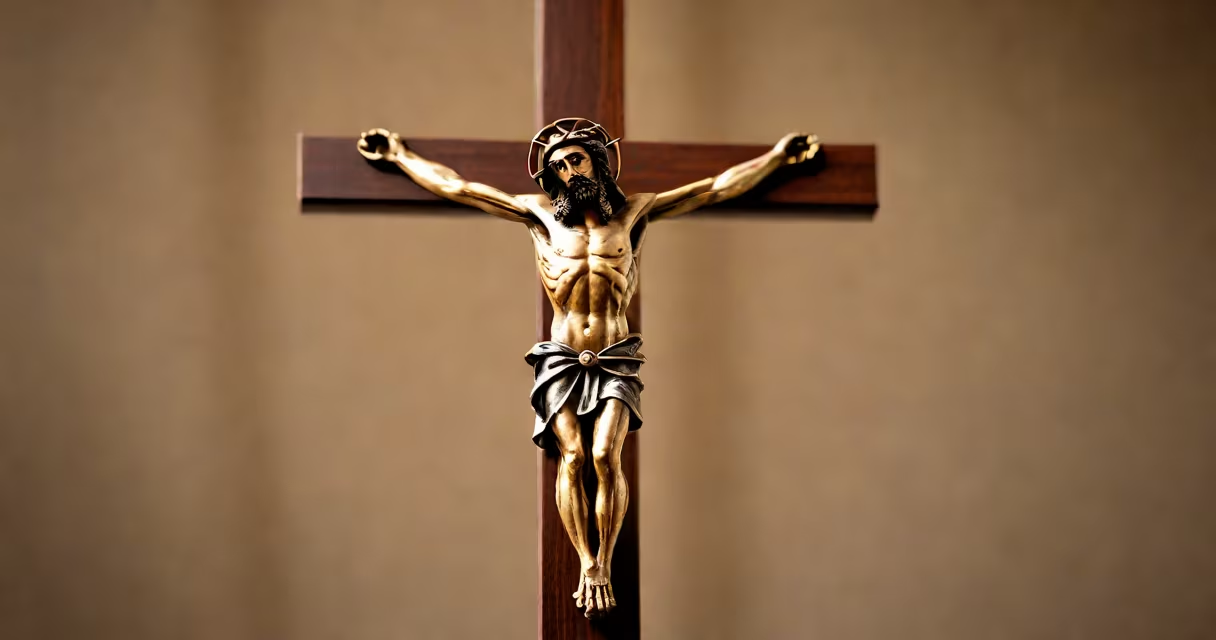
The crucifix is a Christian symbol depicting Jesus Christ on the cross, representing his death and resurrection. It differs from a plain cross by including the figure of Christ, emphasizing sacrifice, suffering, and salvation. The term originates from the Latin *crux*, meaning "cross," and *fixus*, meaning "fixed."
Crucifixes appear in churches, homes, and religious art worldwide. They serve as focal points for prayer, meditation, and worship. The image of Christ on the cross is central to Christian theology, particularly in Catholic, Orthodox, and some Protestant traditions.
Christ's body on the cross is typically shown in a state of serene dignity, not agony. This reflects theological views that his death was voluntary and redemptive. The crucifix is not merely a depiction of pain-it is a statement of divine love and victory over sin and death.
When Christians view a crucifix, they are reminded of key doctrines: substitutionary atonement, where Christ takes on human sin; the concept of sacrificial love; and the promise of eternal life. The symbol functions both as a historical reference and a spiritual invitation.
In liturgical settings, crucifixes hang above altars or are placed on the altar itself. During Mass, the priest may face the crucifix while praying. In personal devotion, people touch or kiss the crucifix during prayer, especially during Lent or Good Friday services.
Some denominations use crucifixes only in specific contexts. For example, many evangelical Protestants prefer a plain cross to emphasize resurrection over suffering. Others, like Catholics, display crucifixes prominently in homes and schools.
Crucifixes differ by material, design, and regional tradition. The most common form is the Latin cross, with a vertical beam and a shorter horizontal beam near the top. This design dominates Western Christianity.
| Type | Design | Common Use | Symbolic Focus |
|---|---|---|---|
| Latin Cross | Vertical beam with short horizontal beam near top | Catholic, Anglican, Protestant churches | Sacrifice, divine justice |
| Eastern Cross | Longer horizontal beam, three steps at base | Orthodox Christianity | Resurrection, judgment, ascension |
| St. Francis Cross | Simple wooden cross with Christ's body facing forward | Mendicant orders, Franciscan communities | Humility, peace, poverty |
| Crucifix with Crown of Thorns | Christ's head adorned with thorns | Passion narratives, Holy Week | Mockery, suffering, kingship |
Material choice affects meaning. Wooden crucifixes suggest humility and connection to nature. Metal ones-bronze, silver, gold-signal permanence and sacredness. Some crucifixes feature detailed carvings of wounds, nails, and blood, reflecting medieval devotional practices.
A lesser-known fact: the crucifix was historically used as a protective amulet. In early Christian Rome, small crucifixes were worn around the neck to ward off evil spirits. This practice continued into the Middle Ages and persists in some cultures today.
People often confuse the crucifix with a plain cross. A plain cross lacks the figure of Christ and is used by various groups, including secular organizations and some Protestant denominations. The presence of Christ's body makes the crucifix uniquely Christian and theological.
Another misconception is that the crucifix symbolizes defeat. In reality, it stands for triumph. Early Christians interpreted the cross as God's reversal of human failure. As theologian N.T. Wright writes in The Resurrection of the Son of God, "The cross is not the end of the story-it is the turning point."
Some assume crucifixes are exclusively Catholic. While Catholicism uses them widely, Eastern Orthodoxy has long-standing traditions of crucifix veneration. In Russia, Ukraine, and Greece, crucifixes are central to home altars and church interiors.
At the center of St. Peter's Basilica in Vatican City hangs a large bronze crucifix. It measures 12 feet tall and depicts Christ with outstretched arms, eyes closed, and a serene expression. The hands are pierced with nails, and the feet are fused together-a detail based on archaeological evidence from Roman crucifixion methods.
This crucifix is not just decorative. It is part of the liturgy. During the Easter Vigil, the priest lights a candle from the Paschal fire and places it near the crucifix, symbolizing Christ's resurrection. The image remains visible throughout the year, reminding worshippers of the core of Christian belief.
I once stood before this crucifix during a visit to Rome. The weight of the bronze, the quiet stillness of the space, and the way light fell across Christ's face created a moment of profound focus. It wasn't about fear or guilt-it was about presence. That's the power of the crucifix: it draws attention not to death, but to love.
Understanding "what does crucifix mean" requires context. In a church, it's a sacred object. In a home, it's a devotional aid. In art, it's a narrative device. In popular culture, it can be misused-such as in horror films where it's a tool to repel demons, which distorts its original intent.
Historically, the crucifix became a standard symbol after Constantine's Edict of Milan in 313 CE, which ended persecution of Christians. From then on, the cross-especially with Christ's body-was displayed openly. By the 6th century, crucifixes were common in monasteries and cathedrals.
Today, the crucifix remains a useful symbol. According to a 2021 Pew Research Center survey, 74% of Christians in the U.S. view the crucifix as central to their faith. Among Catholics, that number rises to 92%. These figures reflect deep cultural and spiritual significance.
"what does crucifix mean" is not a question of aesthetics. It's about identity, memory, and meaning. The crucifix is not a relic of the past-it is a living sign of a promise: that love conquers death.