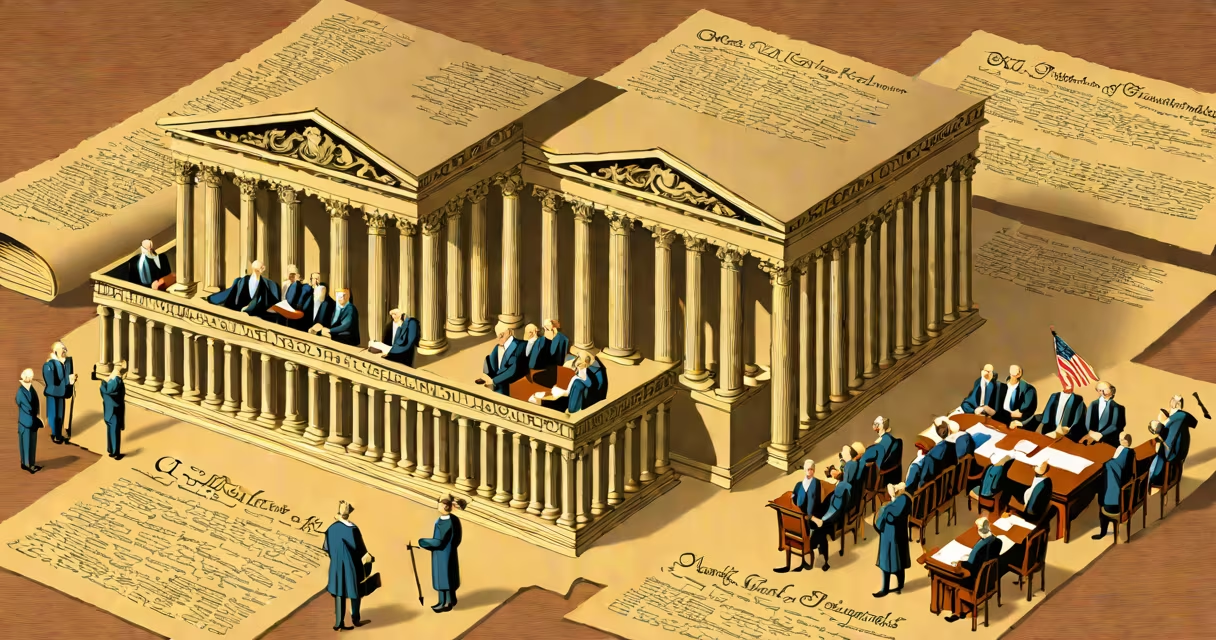
The Bill of Rights consists of the first ten amendments to the U.S. Constitution and defines core individual freedoms, limits federal authority, and ensures legal protections against government overreach. It was ratified in 1791 to address concerns that the original Constitution lacked explicit safeguards for personal liberties.
These amendments were written to prevent abuse of power by the national government. They establish rights such as freedom of speech, the right to a fair trial, protection from unreasonable searches, and the right to bear arms. Without them, the federal government could infringe on personal autonomy without judicial oversight.
For example, Amendment 1 guarantees five key freedoms: speech, religion, press, assembly, and petition. A person can protest peacefully at a city council meeting, publish criticism of elected officials, or practice their faith openly-all protected under this amendment. The Supreme Court has ruled on hundreds of cases interpreting these rights, including Tinker v. Des Moines Independent Community School District (1969), where students wore black armbands to protest the Vietnam War. The Court upheld their right to symbolic speech under the First Amendment.
Each amendment functions as a legal boundary between individual liberty and state power. When a government action violates one of these rights, courts can strike it down. This system relies on judicial review-the power of courts to assess whether laws or actions comply with constitutional standards.
Amendment 4 prohibits unreasonable searches and seizures. Police must have probable cause and a warrant to search a home or seize property. In Miranda v. Arizona (1966), the Supreme Court ruled that suspects must be informed of their right to remain silent and to legal counsel during police questioning. This decision stemmed from the Fifth Amendment's protection against self-incrimination.
Amendment 8 forbids excessive bail, fines, and cruel and unusual punishment. In Coker v. Georgia (1977), the Court held that executing a man who raped a woman violated this clause. The ruling reflected evolving standards of decency and reinforced that punishments must fit the crime.
The Bill of Rights includes both negative rights (freedoms from government interference) and positive obligations (government duties). For instance:
| Amendment | Type of Right | Example Application |
|---|---|---|
| 1 | Negative (freedom from interference) | Protesting a new tax law at a public forum |
| 2 | Negative | Carrying a firearm for self-defense in a state that allows it |
| 4 | Negative | Challenging a warrantless search of your home in court |
| 6 | Positive (government obligation) | Receiving a lawyer in a criminal case if you cannot afford one |
| 8 | Negative | Arguing that a $1 million fine for a minor offense is disproportionate |
These protections are not absolute. Courts balance rights against public safety, national security, and other interests. In United States v. O'Brien (1968), the Court upheld the conviction of a man who burned his draft card during a protest. While burning a draft card is expressive conduct, the government's interest in maintaining the draft system outweighed the symbolic speech in that case.
Many people assume the Bill of Rights applies only to federal actions. But through the Fourteenth Amendment's incorporation doctrine, most rights are enforced against state and local governments too. The Supreme Court has applied the First, Fourth, Fifth, Sixth, and Eighth Amendments to state laws since the early 20th century.
Another misconception is that the Bill of Rights grants rights. It doesn't. It recognizes and protects rights people already possess. As Justice Hugo Black wrote in Dennis v. United States (1951), "The Bill of Rights does not create rights-it preserves them."
A lesser-known fact: the original Constitution did not include a bill of rights. Anti-Federalists opposed ratification unless explicit protections were added. James Madison proposed the amendments in 1789, and twelve were sent to the states. Ten were ratified by 1791. The other two-on congressional pay and representation-were not adopted until centuries later. The 27th Amendment, which limits congressional pay changes, was ratified in 1992 after being proposed in 1789.
In 2014, a group of activists gathered in a city park to protest a proposed pipeline. They set up signs, handed out flyers, and spoke to passersby. City officials told them to stop because the park had a permit requirement for events. The group sued, arguing their First Amendment rights were violated.
A federal court ruled in their favor. The judge noted that public parks are traditional public forums where speech is protected. Even though the city required permits, enforcement had to be neutral and not based on content. The court emphasized that the government cannot silence speech simply because it disagrees with the message.
This case shows how the Bill of Rights operates in daily life. It doesn't just apply in courtrooms-it shapes how communities interact, how dissent is handled, and how citizens engage with power.
I once attended a town hall meeting where a resident challenged a zoning law that blocked a nonprofit from building a shelter for homeless youth. The group cited the First Amendment's right to assemble and petition the government. After months of legal review, the court agreed that the city's denial of access to the hearing process violated due process under the Fifth Amendment. The shelter project moved forward.
These outcomes reflect the enduring purpose of the Bill of Rights: to ensure that individuals have a voice and a legal path when government acts unfairly.
The Bill of Rights does not merely define rights-it creates a structure for accountability. It empowers citizens to challenge unlawful actions, ensures fair treatment under the law, and prevents arbitrary power. When someone says, "What do the Bill of Rights do?" the answer lies in the daily exercise of free speech, the right to a jury trial, and the protection from unlawful detention.