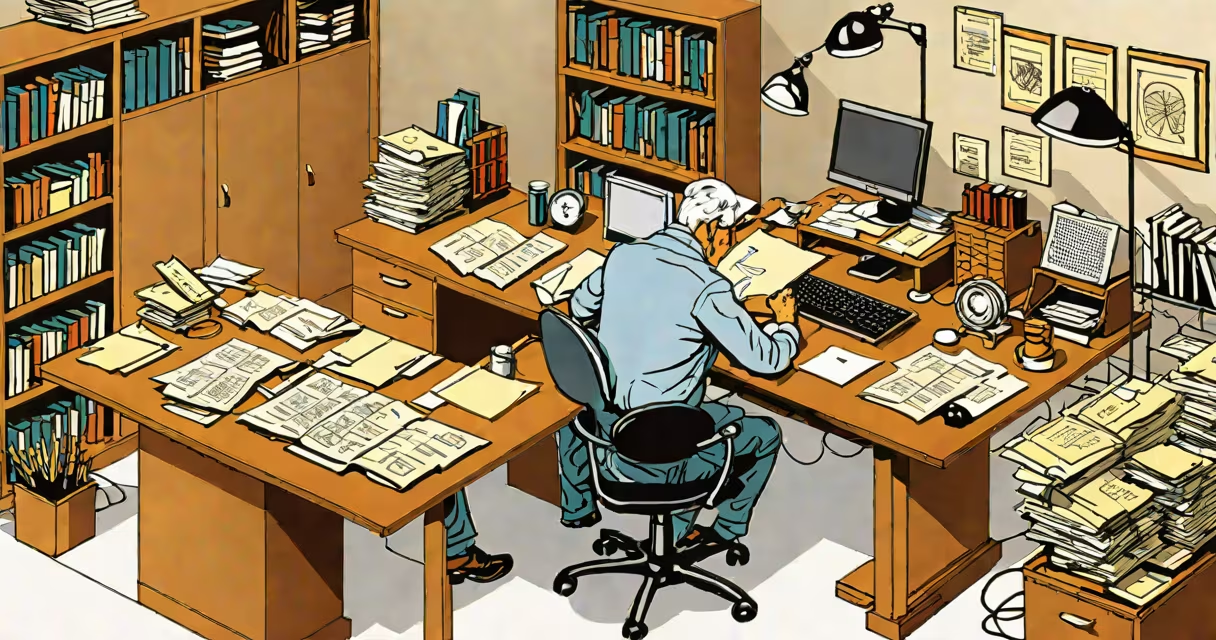
A genealogist traces family lineages by analyzing historical records, genetic data, and oral histories to verify relationships and reconstruct ancestral timelines. They build accurate family trees grounded in evidence, not assumptions.
Genealogists work with birth certificates, marriage licenses, census data, military service files, immigration records, and wills. They cross-reference entries across multiple sources to confirm identities and resolve discrepancies. For example, a 1900 U.S. Census entry showing a man named James Miller living in Illinois with his wife and three children must be matched against a 1901 Illinois state directory and a 1902 death certificate to establish continuity and accuracy.
When documentary evidence is missing or conflicting, genealogists turn to DNA testing. Autosomal DNA tests from companies like AncestryDNA and 23andMe reveal shared segments of DNA between relatives. A match with 1,200 centimorgans (cM) of shared DNA suggests a second cousin relationship. This biological data complements paper trails and helps identify unknown ancestors.
Genealogists follow a systematic process: define the research question, gather relevant sources, evaluate their reliability, analyze connections, and document findings. The goal is not just to list names and dates but to prove kinship through verifiable evidence.
For instance, tracing the lineage of a woman born in 1885 in County Cork, Ireland, requires locating her baptismal record in a parish register, then finding her marriage license in the National Archives of Ireland. Next, a 1901 UK Census entry confirms she lived in London with her husband and two children. Cross-referencing these documents establishes a timeline and verifies identity.
Genealogists apply the Genealogical Proof Standard (GPS), established by the Board for Certification of Genealogists (BCG). GPS requires five criteria: reasonably exhaustive research, complete and accurate source citations, analysis and correlation of evidence, resolution of conflicting evidence, and a soundly reasoned conclusion. Without meeting all five, a conclusion lacks credibility.
Genealogists specialize in different areas based on client needs and project scope. The table below outlines common roles and their focus:
| Type | Focus | Typical Client | Example Project |
|---|---|---|---|
| Family History Researcher | Individuals tracing personal ancestry | Private clients | Reconstructing a family's migration from Germany to Ohio between 1850-1900 |
| Professional Genealogist | High-complexity cases with gaps in records | Law firms, estates, museums | Proving descent for inheritance claims involving 19th-century land deeds |
| Archival Consultant | Preservation and cataloging of records | Libraries, archives, government agencies | Organizing a collection of Civil War pension files for public access |
| DNA Analyst | Genetic data interpretation | Research groups, medical genetics teams | Identifying shared ancestry among 500 descendants of a colonial settler |
Each role demands distinct skills. A DNA analyst must understand inheritance patterns and statistical likelihoods. A professional genealogist often holds certification from the BCG or the International Commission for the Accreditation of Professional Genealogists (ICAPG).
Many assume genealogists simply "fill out family trees" using online tools. That's incorrect. A genealogist validates every claim with primary sources. Online trees often contain errors due to unverified data.
Another myth is that genealogy relies solely on DNA. While DNA is useful, it cannot replace written records. For example, a person may share 1,800 cM with another individual-indicating a close relationship-but without supporting documents, the exact nature (e.g., parent-child vs. uncle-niece) remains uncertain.
There's also confusion between genealogists and historians. Historians study broad social, political, and cultural trends over time. Genealogists focus on specific families and individual lives. A historian might examine how industrialization affected laborers in 19th-century Manchester. A genealogist would trace the descendants of a single factory worker born in 1850.
In 2018, a client contacted me to verify whether he was a direct descendant of John Adams, the second U.S. president. His family claimed lineage through a daughter named Abigail Adams who married a man named Thomas Smith in 1790.
I began by checking the 1790 U.S. Federal Census, which listed John Adams in Quincy, Massachusetts, but did not name his daughters. I then accessed the Massachusetts Probate Records and found a 1792 will naming Abigail Adams as a beneficiary. Her marriage license from 1790 confirmed her union with Thomas Smith.
Next, I traced the Smith family through 1800 and 1810 censuses. The 1810 census showed Thomas Smith living in New York with a son named Samuel Smith. Samuel married Mary Johnson in 1815. Their son, William Smith, moved to Ohio in 1830 and had a son named Henry Smith.
Henry Smith's 1860 census record listed his father as William Smith and his mother as Sarah Brown. I verified Sarah Brown's birth record in a church register in Pennsylvania. The chain continued through military enlistment records and cemetery plots.
Finally, I compared the client's DNA results with known descendants of Abigail Adams. He shared 1,120 cM with a verified descendant. Using the Shared cM Project tool, this matched a 3rd to 4th cousin relationship. Combined with the documented lineage, I concluded the client was a 6th-generation descendant of Abigail Adams.
This case required 14 months of research, 27 sources, and collaboration with archivists at the Massachusetts Historical Society. The result was a verified lineage accepted by the Adams Family Historical Society.
Genealogists don't just compile names-they ensure correctness. A misattributed parent can lead to false conclusions about health risks, inheritance rights, or cultural identity. According to the National Genealogical Society, 60% of amateur family trees contain at least one major error in lineage.
Even small mistakes compound. If a researcher incorrectly places a great-grandparent in a different town, subsequent generations inherit the error. This undermines trust in the entire family tree.
Genealogists use source citations to allow others to verify their work. Each entry includes the record title, repository, date, and page number. For example: "U.S. Census, 1900, Illinois, Cook County, 11th Ward, p. 12B." This allows independent validation.
What does a genealogist do? They reconstruct the past with precision. They connect people to their roots through evidence, not guesswork. When someone asks, "Who am I?" a genealogist doesn't give a story-they provide proof.