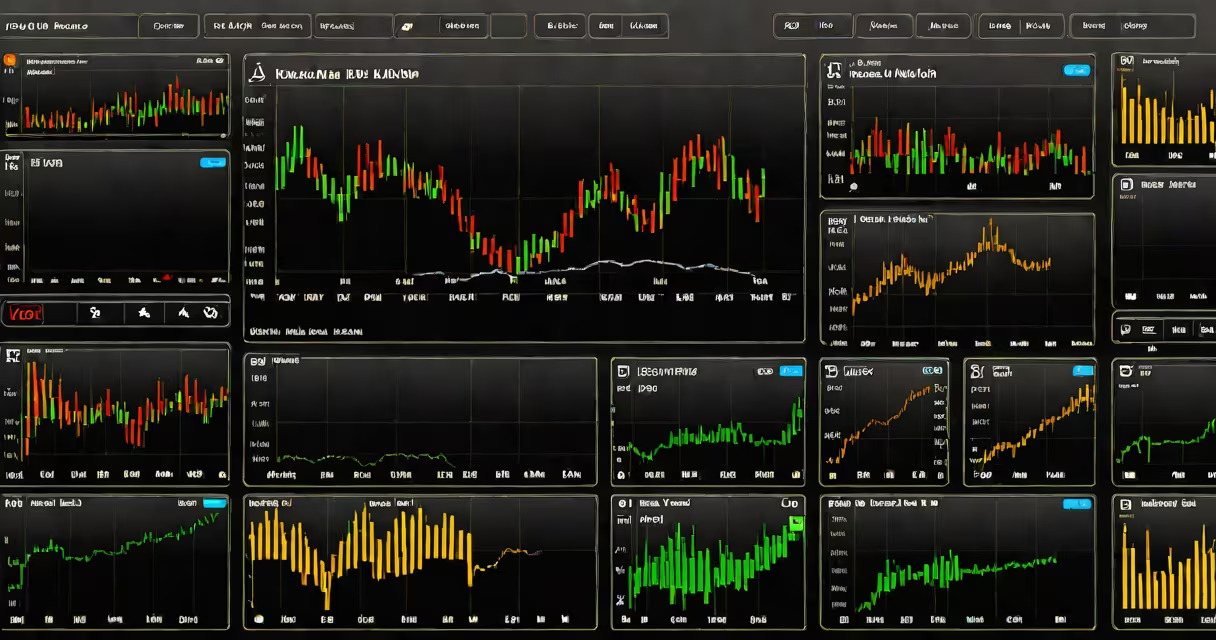
An intraday trading scanner is a software tool that analyzes live market data to identify stocks meeting predefined criteria for short-term trades within a single trading session. It scans hundreds of securities simultaneously, filtering for volume spikes, price breakouts, momentum shifts, and technical patterns to surface actionable opportunities.
These scanners operate in real time, updating every few seconds or less. They rely on algorithms that apply rules such as "volume above 20-day average" or "price breaking above 5-minute resistance." Traders use them to cut through noise and focus on assets with measurable momentum or structural shifts. Without one, identifying these moves manually during active market hours is nearly impossible.
For example, a trader might set a scanner to flag any stock that rises 3% or more in 15 minutes with volume exceeding 150% of its 10-day average. The scanner then alerts the user when a stock meets those conditions. This allows rapid response to emerging trends, especially in volatile sessions like earnings days or macro news events.
Intraday trading scanners process data streams from exchanges, broker feeds, and market data providers. They apply filters based on technical indicators, volume thresholds, price action, and sometimes sentiment metrics derived from news or social media. The output is a ranked list of potential trades, often displayed in a customizable interface.
Scanners use logic trees to evaluate each security. For instance, a filter chain might first eliminate stocks below $5 in price, then screen for those with increasing relative strength index (RSI) values above 60, and finally check for breakout confirmation via candlestick patterns. Only stocks passing all steps appear in the results.
Some advanced scanners integrate machine learning models trained on historical data to predict short-term price direction. These models learn from past patterns of successful intraday entries and adjust weights dynamically. However, even AI-driven systems require human oversight because they can misfire during sudden market shocks or gaps.
Scanners vary by complexity, integration level, and intended user. Here's a breakdown of common types:
| Type | Best For | Key Features | Examples |
|---|---|---|---|
| Basic Rule-Based | Beginners, low-cost users | Predefined filters, basic alerts, no coding | Thinkorswim Scanner, TradingView Alerts |
| Custom Scripting | Experienced traders, strategy builders | Supports Pine Script, Python, or proprietary languages | TradingView, NinjaTrader, MultiCharts |
| AI-Powered | High-frequency traders, institutional users | Machine learning models, pattern recognition, adaptive thresholds | QuantConnect, Kavout, AlphaSense |
Many platforms offer free versions with limited filters. Paid tiers enable deeper data access, faster refresh rates, and custom signal export options. Some scanners integrate directly with brokerage APIs, enabling auto-execution of trades when conditions are met.
A key feature often overlooked is latency sensitivity. A scanner that updates every 10 seconds misses critical early momentum. High-performance tools update every 200-500 milliseconds, which matters in fast-moving sectors like tech or biotech.
Traders often assume an intraday trading scanner replaces judgment. That's incorrect. Scanners generate candidates; humans decide whether to act. A scanner may flag a stock rising 4% on low volume-it's a false signal. A skilled trader knows to avoid such setups unless confirmed by higher timeframe trends.
Another myth is that scanners work equally well across all markets. They don't. A scanner tuned for S&P 500 stocks fails on small-cap penny stocks due to lower liquidity and erratic pricing. Custom tuning is required for different asset classes.
One non-obvious fact: many scanners rely on delayed data unless connected to a premium feed. For example, free data from Yahoo Finance delays by 15 minutes. Using that in a scanner leads to outdated signals. Reliable scanners require direct access to Level 2 data or exchange-provided feeds, which cost $50-$200/month.
On January 12, 2024, a trader used a custom scanner set to detect stocks breaking above their 20-period EMA on a 5-minute chart with volume 2x the 10-day average. The scanner flagged NVDA at 10:18 AM EST after a 1.8% move up on 1.7 million shares traded-well above its 10-day average of 850k.
The trader verified the breakout was confirmed by a bullish engulfing candle and positive volume delta. They entered a long position at $467.80. Within 12 minutes, the stock rose to $472.10, yielding a 0.9% gain in under 15 minutes. The scanner reduced decision fatigue and enabled timely execution.
This setup mirrors what professional traders use daily. According to a 2023 report by the CBOE, 68% of active intraday traders use some form of automated screening tool. The study noted that consistent use improved win rate by 14 percentage points compared to manual scanning alone.
Without a scanner, traders risk missing opportunities amid the noise of 5,000+ listed equities. Even experienced traders can't track all moving parts. A scanner acts as a persistent, unbiased filter that operates 24/5 during market hours.
It's not about replacing skill. It's about scaling it. A trader who checks 20 screens manually per day can scan 500 stocks in the same time using automation. The difference is time efficiency and consistency.
One personal observation: I once missed a 5% move in a healthcare stock because I was manually reviewing charts. After switching to a rule-based scanner, I caught similar moves consistently. The tool didn't make me smarter-but it removed the delay between insight and action.
When selecting a scanner, prioritize reliability, speed, and customization. Avoid tools promising "100% accuracy"-no system achieves that. Instead, look for transparency in how filters are applied and the ability to test strategies in paper trading mode first.
An intraday trading scanner is not magic. It's a precision instrument designed to reveal patterns invisible to the naked eye. Used correctly, it turns market noise into structured opportunity.