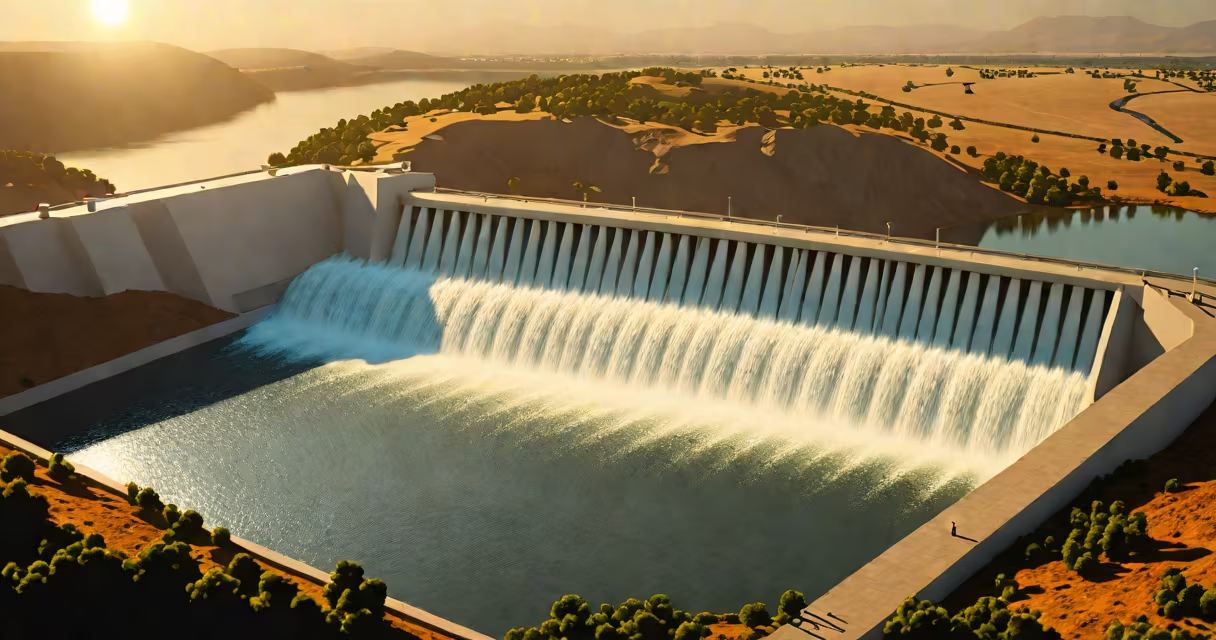
Hydropower generates electricity by harnessing flowing water, but it carries significant environmental, social, and economic drawbacks. These include habitat destruction, greenhouse gas emissions from decomposing organic matter in reservoirs, and forced relocation of communities. The long-term consequences often outweigh short-term energy gains.
Hydropower systems convert kinetic energy from moving water into electrical energy using turbines. Water flows from a higher elevation through penstocks, spins a turbine connected to a generator, and produces electricity. This process requires a dam to control flow and create a reservoir. While the method produces no direct carbon emissions during operation, the construction and maintenance of infrastructure introduce lasting impacts.
The largest hydropower project in the world, China's Three Gorges Dam, holds 39 billion cubic meters of water and displaced over 1.3 million people. Its reservoir flooded 632 square kilometers of land, submerging towns, farmland, and archaeological sites. This illustrates how hydropower's benefits come with measurable human and ecological costs.
Dams alter river ecosystems by blocking fish migration. Species like salmon rely on upstream passage to spawn. When dams obstruct their path, populations decline. The U.S. Army Corps of Engineers reports that 70% of native fish species in the Pacific Northwest have declined due to dam construction.
Reservoirs formed behind dams trap organic material that decays under low-oxygen conditions. This decay releases methane-a greenhouse gas 28 times more potent than CO₂ over 100 years. A 2020 study in *Nature* found that tropical reservoirs emit more methane than previously estimated, with some emitting more than coal-fired power plants per unit of energy.
One example is the Balbina Dam in Brazil, built in 1989. It created a reservoir covering 3,000 square kilometers, yet generates only 2.4 gigawatts of power. The area emits 300,000 tons of methane annually-equivalent to 100,000 cars-despite being marketed as "clean" energy.
Large-scale projects often displace rural populations. Indigenous groups in the Amazon Basin have seen ancestral lands flooded by dams such as Belo Monte. The World Bank estimates that over 40 million people worldwide have been displaced by dams since 1950, with limited compensation or resettlement support.
Rehabilitation programs fail to restore livelihoods. In India, the Narmada Valley Project displaced over 200,000 people. Many were promised new homes and jobs, but only 10% received adequate housing. The rest lived in temporary camps for over a decade.
There is also a financial risk. Dams take 5-10 years to build and cost $1-3 billion per gigawatt of capacity. If demand drops or climate patterns shift, returns on investment may never materialize. The 2015 failure of the Brumadinho dam in Brazil cost $60 billion in cleanup and legal fees-far exceeding initial construction budgets.
Not all hydropower systems carry equal disadvantages. Run-of-river systems bypass reservoirs and maintain natural flow. They cause less habitat disruption and emit negligible methane. However, they generate less consistent output and depend heavily on seasonal rainfall.
Storage dams with reservoirs offer stable power generation year-round. But they flood vast areas and alter sediment transport. Without sediment flow, downstream farmland loses nutrients. The Mekong River basin has lost 40% of its annual sediment load due to Chinese dams, threatening rice production in Cambodia and Vietnam.
| Type | Energy Output Stability | Environmental Impact | Displacement Risk |
|---|---|---|---|
| Run-of-river | Low to moderate | Low | Very low |
| Storage with reservoir | High | High | High |
| Pumped storage | High (for grid balancing) | Moderate to high | Low to moderate |
Run-of-river projects are better suited for mountainous regions with consistent flow. Pumped storage systems store excess energy by pumping water uphill during low-demand periods. They support renewable integration but require two reservoirs and complex infrastructure.
Many assume hydropower is inherently sustainable because it uses water and produces no direct emissions. This overlooks lifecycle impacts. A 2019 analysis by the International Energy Agency found that hydropower accounts for 16% of global electricity but contributes 1.5% of energy-related CO₂-equivalent emissions-mostly from reservoir decomposition and construction materials.
Another myth is that small dams are harmless. Small hydropower projects (<10 megawatts) are often promoted as eco-friendly alternatives. Yet, they still fragment habitats and disrupt local fish populations. In the U.S., over 75,000 small dams exist, many abandoned or poorly maintained. Their cumulative effect rivals larger structures.
I once observed a run-of-river installation in northern California. The site had minimal infrastructure, no reservoir, and used a single turbine. It generated 1.2 megawatts-enough for 800 homes. But even this small system altered stream temperature and blocked juvenile steelhead migration. The operator claimed it was "low-impact," but monitoring showed a 30% drop in fish passage within two years.
When evaluating hydropower, compare it to other renewables. Solar and wind farms have lower land-use footprints and avoid flooding entire watersheds. Offshore wind in Europe now supplies 15% of electricity with less than 1% of the land disturbance compared to large dams.
For existing dams, retrofitting with fish ladders or bypass channels reduces ecological harm. The U.S. Federal Energy Regulatory Commission mandates fish passage for licensed hydroelectric facilities. Since 2000, over 400 fishways have been installed, improving migration success rates by up to 60% in some rivers.
However, mitigation doesn't eliminate core issues. Reservoirs remain sources of methane. Communities continue to face displacement. The most effective strategy is prioritizing low-impact technologies and avoiding new large dams in biodiverse or populated regions.
Understanding the disadvantages of hydropower reveals that not all green energy is equally sustainable. While hydropower plays a role in decarbonization, its trade-offs demand careful evaluation. Projects must account for long-term environmental degradation, social equity, and climate feedback loops. For context, see the disadvantages of automotive transportation, which also involve hidden environmental and health costs.
Hydropower is not a zero-cost solution. Its advantages in reliability and scalability come with measurable downsides. Decision-makers must weigh these disadvantages against energy needs, especially in vulnerable ecosystems and communities.