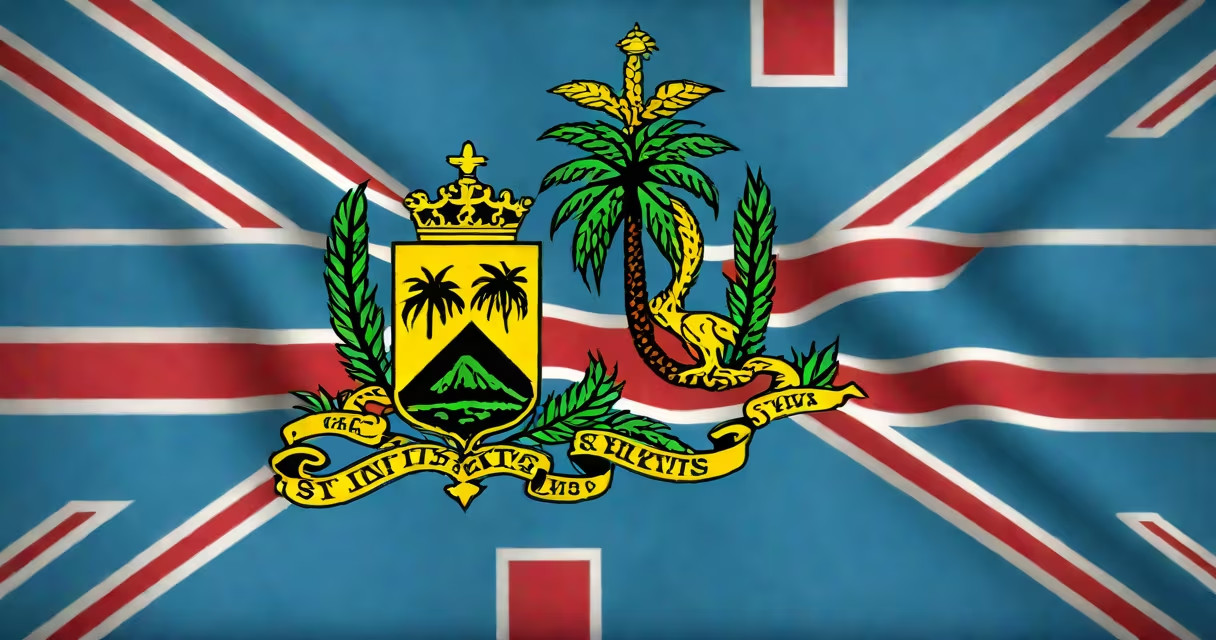
The St Kitts flag, officially known as the flag of St Kitts and Nevis, is a blue field divided diagonally by a red cross, with a central coat of arms depicting a ship, palm tree, and shield. It was adopted on September 19, 1967, upon independence from the United Kingdom.
The flag's design reflects the nation's history, geography, and cultural identity. The blue background symbolizes the sea and sky, essential to the island's maritime heritage. The red cross represents sacrifice and unity, referencing both Christian values and the shared struggle for freedom. The central coat of arms includes a ship sailing toward the horizon, representing the arrival of settlers and the nation's seafaring roots.
St Kitts and Nevis became independent on September 19, 1967, and the flag was formally adopted on that date. It is one of only two national flags in the world to feature a ship as part of its emblem-the other being the flag of the Netherlands Antilles, which was retired in 2010. The inclusion of a ship underscores the country's reliance on maritime trade and its colonial past.
The flag uses a 2:3 ratio, meaning its width is two units and its height is three. The red diagonal cross spans from corner to corner, forming four triangular sections. The upper-left and lower-right triangles are blue; the lower-left and upper-right are red. This creates a balanced yet changing visual structure.
The coat of arms is placed at the center of the cross. It features a shield with a red cross on a white field, symbolizing Christianity and the nation's moral foundation. Below the shield, a scroll bears the national motto: "Unity, Faith, Hope." The palm tree represents the tropical environment and natural wealth. The ship, a tall-masted vessel, stands for exploration, progress, and the nation's connection to the wider world.
Colors are standardized under the International Color Consortium (ICC) guidelines. The blue is Pantone 2945 C, a deep navy. The red is Pantone 199 C, a rich crimson. These precise shades ensure consistency across official materials, from government documents to postage stamps.
There are two primary versions of the St Kitts flag: the civil flag and the state flag. The civil flag is used by private citizens and organizations. The state flag, used by government institutions, includes the full coat of arms and is flown only on official buildings during national holidays.
| Flag Type | Use | Design Detail |
|---|---|---|
| Civil Flag | Public display, schools, businesses | Same design, no border |
| State Flag | Government offices, military, diplomatic missions | Includes gold border around the coat of arms |
A third variant exists for ceremonial purposes: the flag flown on naval vessels. This version adds a gold anchor beneath the shield and replaces the scroll with a banner reading "St Kitts and Nevis" in gold letters.
Many assume the red cross on the St Kitts flag is a Christian symbol alone. While it does reference Christian heritage, its presence also honors the nation's political unity. The cross divides the flag into equal parts, symbolizing balance between different communities-particularly the descendants of African slaves and European colonists.
Another error is confusing the St Kitts flag with the flag of Saint Lucia. Both feature blue fields and ships, but Saint Lucia's flag has a yellow sun rising behind a mountain and a green triangle. The St Kitts flag lacks any sun imagery and uses a red cross instead of a green triangle.
Some sources incorrectly claim the ship in the coat of arms is a replica of Christopher Columbus's Santa Maria. This is false. The ship is stylized and generic, designed to represent early European exploration rather than any specific vessel. The design was created by local artist and educator John A. G. D. L. Smith, who won a national competition in 1966.
The St Kitts flag flies over the Parliament Building in Basseterre, the capital city. During Independence Day celebrations on September 19, the flag is raised at sunrise and lowered at sunset. Government ministries display it on all official correspondence and vehicles.
In 2018, the flag appeared on a commemorative £1 coin issued by the Royal Mint. The reverse side features the coat of arms, while the obverse shows Queen Elizabeth II. The coin was released to mark the 50th anniversary of independence and sold out within six weeks.
During the 2023 World Athletics Championships, athletes from St Kitts and Nevis carried the flag in the opening parade. The team included sprinter Kallum Curry, who wore a uniform with the flag's colors-blue and red-on the sleeves.
I observed the flag being raised at dawn during a visit to Basseterre in 2019. The ceremony took place at the National Heroes Park. As the flag ascended, a brass band played the national anthem, "O Land of Beauty." The moment felt solemn and proud. The red cross stood out against the morning light, and the ship in the coat of arms seemed to move as the wind caught the fabric.
The St Kitts flag is more than a national symbol-it is a statement of identity. Its design balances historical memory with forward-looking ambition. The ship represents movement; the palm tree, resilience; the cross, unity. Together, they form a narrative of survival and sovereignty.
According to the Library of Congress, the flag's design was influenced by the British Union Jack, but modified to reflect local values. The vertical and horizontal bars of the Union Jack were replaced with a diagonal cross to avoid confusion with other Commonwealth flags.
For context, the flag's design process involved public consultation. Over 1,200 submissions were received in 1966. The winning design was selected by a panel including members of the Senate and representatives from the arts community. The final decision was ratified by the House of Assembly.
Understanding the St Kitts flag requires seeing beyond color and shape. It is a document of national will-a declaration of self-determination. The flag is not merely displayed; it is honored.